

Archive position — measured, not model output
1 like on Devpost
505 of the 7,850 archived projects have more likes, and 1,758 share exactly 1 — so this project's #821 place in the like-ranked listing is a tie-break inside that group, not a ranking.
Projects (log scale)
Likes on Devpost. ▲ marks this project's group.
Show the figures
| Likes | Projects | Share of archive |
|---|---|---|
| 0 | 5,587 | 71.2% |
| 1 | 1,758 | 22.4% |
| 2 | 284 | 3.6% |
| 3–4 | 132 | 1.7% |
| 5–9 | 75 | 1.0% |
| 10+ | 14 | 0.2% |
 User Stories BotA demo video on every pull request
Get a demo video on every new feature
GitHub App that watches your pull requests and records a narrated, captioned demo.
Save time on demo prep and make informed decisions faster with a video walkthrough of every new feature.
Executive Summary
What the company appears to be
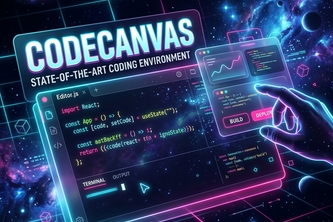
Code Canvas is described as an AI-powered browser-based workspace for web developers. The author states it combines a code editor with visual design tools, an AI tutor, and a whiteboard for brainstorming. It is built using GPT 5.6 and aims to reduce friction in prototyping.
What changed
This is a hackathon submission (submitted to the OpenAI 2026 hackathon), indicating it is a prototype or proof-of-concept project, not yet a commercial product.
Single most important open question
Is there any evidence of traction, revenue, or customer adoption beyond the author’s own description?
What The Product Actually Is
The description states that Code Canvas is:
- A browser-based workspace for web development.
- A full-featured web playground combining code editing and visual design.
- Equipped with a high-performance editor, live preview, auto-debugger powered by GPT 5.6, and a “Cyber Board” whiteboard.
- Designed to be a unified command center for creating, learning, and brainstorming.
It is described as having:
- Glassmorphic UI elements.
- Live preview functionality.
- Auto-debugging capabilities.
- A personal AI coding partner powered by GPT 5.6.
- An infinite whiteboard with neon drawing tools and locked cursor mode.
Inference The product appears to be a hybrid IDE + visual collaboration tool, built as a single-page application in the browser.
Positioning & Claim Evolution
The author claims Code Canvas:
- Is an “ultimate AI-powered workspace.”
- Removes barriers between imagination and working prototypes.
- Offers a “cosmic glassmorphic UI” and “fast, visual, and intelligent” experience.
- Is designed for beginners and hackathon hackers to reduce friction in development.
Inference The positioning is that of a developer tool aimed at reducing setup friction and enhancing creativity through AI integration. It positions itself as a modern, visually appealing, and AI-enhanced environment for prototyping.
Target Customer & ICP
The description states:
- The target audience includes “beginners and hackathon hackers.”
- It aims to reduce friction in prototyping.
- It is described as a tool for “creative momentum.”
Inference The initial customer segment appears to be developers or aspiring developers who are prototyping ideas quickly, especially in hackathon settings. There is no evidence of a defined ICP beyond this.
Business Model & Pricing Evidence
No information is provided about:
- Revenue streams.
- Pricing models.
- Monetization strategy.
- Customer acquisition costs.
- Sales process or go-to-market strategy.
Not evidenced
Technical & Delivery Signals
The description states:
- Built with “aitools, gpt5.6, promptengineering.”
- Uses React and custom canvas rendering.
- Implements dynamic boundary listeners to fix layout math issues.
- Optimizes performance by caching drawing paths and using draft preview steps.
- Leverages GPT 5.6 for UI structure testing and debugging optimization.
Inference The technical stack includes React, browser-based canvas rendering, and AI integration via GPT 5.6. The team solved engineering challenges related to layout and performance through prompt engineering and dynamic rendering logic.
Traction & Maturity Signals
The description states:
- This is a hackathon submission (Devpost entry).
- Built in a single “build week.”
- Accomplished visual polish, cursor lock feature, and integration with GPT 5.6.
- The team learned about prompt engineering, context window management, and default project templates.
Not evidenced
- No evidence of revenue, customers, or usage metrics.
- No evidence of product-market fit or adoption beyond the author’s own account.
Competitive Context
The description does not mention:
- Competitors.
- Market positioning relative to existing tools like CodeSandbox, Replit, or VS Code with AI extensions.
- Differentiation from similar developer environments or IDEs.
Not evidenced
Open Questions & Risks
Key risks and open questions based on the self-reported description:
- The project is a hackathon submission — no evidence of commercial viability or traction.
- No revenue, customer data, or monetization strategy are provided.
- The use of GPT 5.6 implies reliance on an AI model that may not be available in production or scalable.
- The product is described as a single-person effort with no team size beyond one member — raises concerns about scalability and long-term development.
- The UI is described as “cosmic glassmorphic,” which may not align with enterprise or mainstream developer preferences.
Inference The project lacks commercial evidence, and its reliance on a single developer and an unverified AI model raises questions about sustainability and scalability.
Questions the description leaves open
- What is the current stage of development beyond this hackathon prototype?
- Is there any plan to monetize or scale this product beyond the initial concept?
- How does the team intend to handle the technical challenges of integrating GPT 5.6 in a production environment?
- Are there any early adopters or users who have tested the tool beyond the author’s own experience?
- What are the plans for customer acquisition and retention?
Overall Assessment
Not evidenced
The description provides no evidence of:
- Revenue.
- Customers.
- Product-market fit.
- Traction.
- Commercial viability.
This is a self-reported hackathon project with no independent verification or commercial data. The author states it was built in one week, using GPT 5.6 and a single developer — indicating a prototype, not a product.
Confidence level Low. This analysis is based entirely on the author’s own description, which is unverified and self-reported.
User Stories BotA demo video on every pull request
Get a demo video on every new feature
GitHub App that watches your pull requests and records a narrated, captioned demo.
Save time on demo prep and make informed decisions faster with a video walkthrough of every new feature.
Source
Submitted to the OpenAI 2026 hackathon on Devpost. Project home on Devpost. Back to the full gallery on Devpost.
This competitive analysis was produced by top-founders.com (opens in a new tab)
Generated by a language model from this project's public Devpost page — its tagline, the author's own write-up and any built-with tags listed there — as captured in August 2026. Short quotations are the author's words. It is an opinion on the idea as a business, not on the people behind it, and it reflects the description as published then. If the project has moved on, request a correction below. The analysis is not independent research and contains no verified traction, revenue or customer data.
An independent guide by KFG International LLC — not affiliated with, endorsed by, or connected to Devpost or OpenAI.