

Archive position — measured, not model output
0 likes on Devpost
2,263 of the 7,850 archived projects have more likes, and 5,587 share exactly 0 — so this project's #4,747 place in the like-ranked listing is a tie-break inside that group, not a ranking.
Projects (log scale)
Likes on Devpost. ▲ marks this project's group.
Show the figures
| Likes | Projects | Share of archive |
|---|---|---|
| 0 | 5,587 | 71.2% |
| 1 | 1,758 | 22.4% |
| 2 | 284 | 3.6% |
| 3–4 | 132 | 1.7% |
| 5–9 | 75 | 1.0% |
| 10+ | 14 | 0.2% |
 User Stories BotA demo video on every pull request
Get a demo video on every new feature
GitHub App that watches your pull requests and records a narrated, captioned demo.
Save time on demo prep and make informed decisions faster with a video walkthrough of every new feature.
Executive Summary
Project: k12
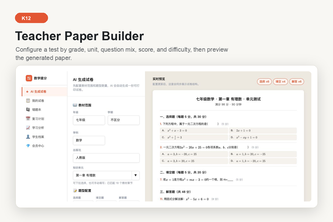
Self-reported purpose: Converts school papers, PDFs, and DOCX files into structured question banks using AI and OCR, with review workflows.
Team size: 1 person (per author).
Key claim: The product automates the process of turning educational documents into reusable question banks while maintaining traceability and auditability.
What changed: This is a hackathon submission; no prior version or commercial history is evidenced.
Single most important open question: Is there any evidence of traction, revenue, or customer adoption beyond the self-reported project description?
What The Product Actually Is
The description states that k12 converts school papers, PDFs, and DOCX files into structured question banks using OCR, document parsing, visual QA, and review workflows. It supports:
- OCR extraction
- Document parsing (PDF/DOCX)
- Structured normalization
- Image asset handling
- Admin review pages
The system is built around a pipeline that includes Codex for inspecting failures, writing repair scripts, verifying outputs, and improving the workflow iteratively.
Inference: The product appears to be an internal tool or prototype for automating question bank creation from educational documents. It is not described as a SaaS offering or platform for multiple users.
Positioning & Claim Evolution
The author states:
- Teachers spend a lot of time converting real papers into classroom materials.
- The goal was to make this process faster and safer without losing traceability.
- The product supports visual QA, review queues, and repair workflows.
- AI is used in tandem with verification and human review.
Inference: The positioning is that k12 is a tool for educators or content creators who want to automate the creation of question banks from physical or digital documents. It emphasizes safety, traceability, and auditability over pure automation.
Target Customer & ICP
The description states:
- The product targets teachers.
- It is built for converting school papers and teaching materials into reusable question banks.
- It supports review workflows, implying a role for educators in validating outputs.
Inference: The primary customer is likely a teacher or instructional designer working with educational documents. The ICP appears to be educators in K12 settings who need structured question banks from raw content.
Business Model & Pricing Evidence
Not evidenced.
The description does not mention:
- Revenue model
- Pricing structure
- Subscription tiers
- Customer acquisition strategy
- Monetization approach
Technical & Delivery Signals
The author states:
- Built with: ai-agents, codex, docx-parsing, education, k12, next.js, ocr, openai, pdf-parsing, question-bank, typescript, visual
- Uses OCR and document parsing for PDF/DOCX files
- Includes image asset handling
- Admin review pages are part of the system
- Codex is used for inspecting failures and writing repair scripts
Inference: The technical stack suggests a web-based application using AI tools (OpenAI, Codex) and modern frontend (Next.js). It handles structured data normalization and visual QA.
Traction & Maturity Signals
Not evidenced.
The description does not mention:
- Customers
- Revenue
- Usage metrics
- Product adoption
- Iteration history or prior versions
- Any form of product launch or market entry
Competitive Context
Not evidenced.
The description does not reference:
- Competitors
- Market landscape
- Prior art in educational document processing or question bank creation tools
Open Questions & Risks
- No traction evidence: The project is a hackathon submission with no indication of real-world adoption.
- Single-person team: Limited capacity for execution, scaling, or product development.
- Unproven business model: No evidence of monetization or customer value capture.
- High technical complexity without validation: The system handles messy documents (formulas, diagrams), but no evidence of robustness or testing in real-world conditions.
- No commercial history: This is a prototype, not a product with a track record.
Questions the description leaves open
- What is the current stage of development? Is this a prototype or a working product?
- Have you tested this with actual teachers or schools? If so, what feedback did you get?
- How do you plan to monetize this tool? Is there a business model in mind?
- What are the main technical challenges you've faced in real-world use cases?
- Are you planning to expand beyond K12 education or focus on specific subjects?
Overall Assessment
Not evidenced.
There is no evidence of:
- Revenue
- Customers
- Product-market fit
- Commercial traction
- Team scalability
- Clear path to monetization
This is a hackathon project with no demonstrated commercial viability, adoption, or business model. The author’s own description indicates it's an early-stage idea or prototype, not a product in the market.
Confidence: Low. This analysis is based entirely on self-reported information and lacks any external validation or evidence of traction, revenue, or customer data.
User Stories BotA demo video on every pull request
Get a demo video on every new feature
GitHub App that watches your pull requests and records a narrated, captioned demo.
Save time on demo prep and make informed decisions faster with a video walkthrough of every new feature.
Source
Submitted to the OpenAI 2026 hackathon on Devpost. Project home on Devpost. Back to the full gallery on Devpost.
This competitive analysis was produced by top-founders.com (opens in a new tab)
Generated by a language model from this project's public Devpost page — its tagline, the author's own write-up and any built-with tags listed there — as captured in August 2026. Short quotations are the author's words. It is an opinion on the idea as a business, not on the people behind it, and it reflects the description as published then. If the project has moved on, request a correction below. The analysis is not independent research and contains no verified traction, revenue or customer data.
An independent guide by KFG International LLC — not affiliated with, endorsed by, or connected to Devpost or OpenAI.