

Archive position — measured, not model output
0 likes on Devpost
2,263 of the 7,850 archived projects have more likes, and 5,587 share exactly 0 — so this project's #6,677 place in the like-ranked listing is a tie-break inside that group, not a ranking.
Projects (log scale)
Likes on Devpost. ▲ marks this project's group.
Show the figures
| Likes | Projects | Share of archive |
|---|---|---|
| 0 | 5,587 | 71.2% |
| 1 | 1,758 | 22.4% |
| 2 | 284 | 3.6% |
| 3–4 | 132 | 1.7% |
| 5–9 | 75 | 1.0% |
| 10+ | 14 | 0.2% |
 User Stories BotA demo video on every pull request
Get a demo video on every new feature
GitHub App that watches your pull requests and records a narrated, captioned demo.
Save time on demo prep and make informed decisions faster with a video walkthrough of every new feature.
Executive Summary
What the company appears to be
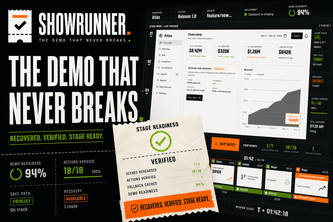
Showrunner is a developer tool that enables teams to rehearse product releases in a real browser environment, with GPT-5.6 assisting in structured planning and recovery candidate selection. It supports public GitHub repositories and HTTPS deployments, offering a “clean-browser rehearsal” and “complete recovery replay” for demo readiness.
What changed
The project is self-reported as a hackathon submission (Devpost entry) to the OpenAI 2026 hackathon. It was built in one week by a single team member (YIP Labs), using a range of technologies including React, Playwright, Supabase, and GPT-5.6.
Single most important open question
Is there evidence that Showrunner has traction or adoption beyond the hackathon context? The description does not state whether any customers, users, or revenue exist outside of this self-reported build.
What The Product Actually Is
The description states that Showrunner:
- Turns a product release into a “bounded, rehearsed, stage-ready story.”
- Connects a public GitHub repository and HTTPS deployment.
- Resolves the default branch and exact commit.
- Performs a server-side deployment handshake.
- Stores workspace, project, and release under Supabase Row Level Security (RLS).
- Runs a fixed, authorized Atlas product scenario in an isolated Chromium context.
- Detects semantic control changes (e.g., renamed buttons).
- Uses GPT-5.6 to select recovery candidates from a set of safe options.
- Replays the full story in another clean browser context.
- Produces a readiness receipt and stage-ready presenter controls.
Inference The tool appears to be a demo rehearsal and recovery system for product releases, intended to prevent “demo failure” due to release drift. It is not a general-purpose CI/CD or testing tool but rather a specialized solution for pre-demo validation.
Positioning & Claim Evolution
The description states that Showrunner treats a demo like a “release artifact,” aiming to map, rehearse, verify, and carry a recovery route onto the stage.
It positions itself as a tool that:
- Prevents demo failures due to release drift.
- Provides a “verified proof” of readiness.
- Offers “stage-ready presenter controls.”
Inference The positioning is focused on product demos in a pre-release context. It does not claim to be a general-purpose testing or CI/CD platform, but rather a tool for ensuring demo stability.
Target Customer & ICP
The description states that Showrunner:
- Supports public GitHub repositories and HTTPS deployments.
- Allows approved users to connect repositories.
- Uses invite-only access and token-free onboarding.
- Is built for teams presenting product releases.
Inference The target customer appears to be internal or external product teams, developers, or product managers who present product releases. The ICP is likely small to mid-sized teams with public-facing products that require demo stability.
Business Model & Pricing Evidence
The description does not state:
- Any pricing model.
- Revenue streams.
- Monetization strategy.
- Customer acquisition approach.
Not evidenced
Technical & Delivery Signals
The description states that Showrunner uses:
- React, Vite, TypeScript for frontend.
- Node.js service on Google Cloud Run.
- Playwright for browser execution.
- Supabase Auth and RLS for access control.
- GitHub REST API for repository resolution.
- GPT-5.6 for structured outputs (not arbitrary browser control).
- Zod for canonical JSON contracts.
- Vercel for frontend hosting.
Inference The system is built with a clear separation of concerns: deterministic execution and evidence control, with AI used only in bounded planning or selection tasks. It uses modern tools and cloud infrastructure.
Traction & Maturity Signals
The description states:
- Built in one week by one team member (YIP Labs).
- 118 automated tests.
- Invite-only access.
- Public-repository import and Atlas rehearsal are separate in this build.
- No mention of customers, users, or revenue.
Not evidenced
Competitive Context
The description does not state:
- Direct competitors.
- Market size or positioning.
- How it compares to existing tools for demo rehearsal or release validation.
Not evidenced
Open Questions & Risks
- The project is a hackathon submission with no evidence of traction, revenue, or users.
- GPT-5.6 is used only in structured outputs — this is a positive signal for safety but does not indicate adoption or commercial viability.
- No mention of scalability, performance, or long-term maintenance plans.
- The tool is limited to public repositories and invite-only access, which may restrict market reach.
Inference The project lacks evidence of commercial traction or product-market fit beyond the hackathon. It is a proof-of-concept with no known users or monetization strategy.
Questions the description leaves open
- What is the current usage or adoption rate outside of this hackathon build?
- How does Showrunner plan to scale beyond invite-only access and public repositories?
- Are there any plans for private GitHub App integration or authenticated target applications?
- What are the long-term monetization strategies?
- How does the tool handle edge cases in browser execution or recovery?
Overall Assessment
Assessment Not evidenced.
The description is a self-reported hackathon submission with no evidence of traction, revenue, customers, or commercial viability. It demonstrates technical capability and a clear safety boundary for AI use but does not indicate a viable business model or product-market fit beyond the build week context.
Confidence Level Low — based on minimal, unverified evidence.
User Stories BotA demo video on every pull request
Get a demo video on every new feature
GitHub App that watches your pull requests and records a narrated, captioned demo.
Save time on demo prep and make informed decisions faster with a video walkthrough of every new feature.
Source
Submitted to the OpenAI 2026 hackathon on Devpost. Project home on Devpost. Back to the full gallery on Devpost.
This competitive analysis was produced by top-founders.com (opens in a new tab)
Generated by a language model from this project's public Devpost page — its tagline, the author's own write-up and any built-with tags listed there — as captured in August 2026. Short quotations are the author's words. It is an opinion on the idea as a business, not on the people behind it, and it reflects the description as published then. If the project has moved on, request a correction below. The analysis is not independent research and contains no verified traction, revenue or customer data.
An independent guide by KFG International LLC — not affiliated with, endorsed by, or connected to Devpost or OpenAI.