

Archive position — measured, not model output
0 likes on Devpost
2,263 of the 7,850 archived projects have more likes, and 5,587 share exactly 0 — so this project's #6,678 place in the like-ranked listing is a tie-break inside that group, not a ranking.
Projects (log scale)
Likes on Devpost. ▲ marks this project's group.
Show the figures
| Likes | Projects | Share of archive |
|---|---|---|
| 0 | 5,587 | 71.2% |
| 1 | 1,758 | 22.4% |
| 2 | 284 | 3.6% |
| 3–4 | 132 | 1.7% |
| 5–9 | 75 | 1.0% |
| 10+ | 14 | 0.2% |
 User Stories BotA demo video on every pull request
Get a demo video on every new feature
GitHub App that watches your pull requests and records a narrated, captioned demo.
Save time on demo prep and make informed decisions faster with a video walkthrough of every new feature.
Executive Summary
What the company appears to be
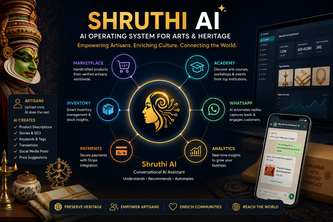
Shruthi AI is an AI-powered operating system for arts and heritage organizations. The description states it aims to connect education, commerce, and cultural preservation into a single platform through integrated tools like CRM, marketplace, WhatsApp communication, payments, and AI-assisted content generation.
What changed
The project began as an internal tool for one performing arts institution (Kairali Arts Centre) but evolved into a scalable platform designed to support artisans, educators, and cultural organizations globally. It was built for the OpenAI 2026 hackathon and is self-reported as functional in its current form.
Single most important open question
Is there evidence of real-world usage or traction beyond the author’s own organization? The description does not indicate any customers, revenue, or adoption outside of the initial use case.
Note: This analysis is based entirely on the self-reported project description provided by the author. No external verification, third-party data, or historical records are available. All claims are labeled as “the description states” and should be treated as unverified assertions.
What The Product Actually Is
The description states that Shruthi AI is an AI-powered operating system for arts and heritage institutions. It combines:
- Student and course management
- CRM
- Website (music/dance academy)
- Heritage marketplace
- Inventory and payment workflows
- WhatsApp communication
- Marketing tools
- Analytics
- Business automation
It integrates technologies including:
- OpenAI models
- PHP backend
- JavaScript, HTML/CSS
- Frappe ERP / CRM
- Stripe APIs
- WhatsApp workflows
- REST APIs
The platform is described as a synchronized ecosystem where data entered once can be reused across systems.
Inference: The product appears to be a custom-built integrated SaaS-like system designed for small to mid-sized arts and heritage organizations. It is not a generic tool but tailored to specific needs of cultural institutions.
Positioning & Claim Evolution
The description states that Shruthi AI was originally built to solve operational problems within the author’s own organization — Kairali Arts Centre — before expanding its scope to help broader communities of artists, artisans, and educators.
It positions itself as:
- A connected ecosystem for education, commerce, and cultural heritage
- An AI intelligence layer connecting multiple business systems
- A tool that helps preserve culture through digital means
The author emphasizes:
- AI is used to organize information, not replace human judgment
- AI-generated content remains reviewable by humans
- The system supports cultural knowledge graphs, storytelling, and multilingual content generation
Inference: The positioning evolved from a personal operational tool into a scalable platform for cultural commerce. However, the evolution is described in terms of intent rather than actual market traction or product maturity.
Target Customer & ICP
The description states that Shruthi AI targets:
- Performing arts institutions (e.g., music and dance academies)
- Artisans and craftspeople
- Cultural organizations
- Students and parents seeking educational services
It also mentions support for:
- Artists selling heritage products
- Institutions managing student admissions, workshops, events, and marketing campaigns
Inference: The ICP seems to be small-to-medium-sized arts and heritage institutions with a focus on education and cultural preservation. There is no indication of enterprise-level customers or B2B scaling beyond the initial use case.
Business Model & Pricing Evidence
The description does not provide any information about:
- Revenue streams
- Pricing models
- Monetization strategy
- Customer acquisition costs
- Sales cycles
It only mentions that the platform includes features like:
- Marketplace
- Payments
- CRM
- AI-assisted content generation
Not evidenced: No business model or pricing data is available in the description.
Technical & Delivery Signals
The description states that Shruthi AI was built using:
- OpenAI models
- PHP backend
- JavaScript, HTML/CSS
- Frappe ERP / CRM
- Stripe APIs
- WhatsApp workflows
- REST APIs
It also mentions:
- Integration of multiple independent systems
- Synchronization of data across platforms
- Use of AI to improve presentation rather than invent facts
Inference: The technical stack suggests a hybrid, custom-built solution with integration capabilities. However, there is no evidence of scalability, performance metrics, or deployment architecture beyond the initial build.
Traction & Maturity Signals
The description states:
- The platform was built for Kairali Arts Centre
- It connects multiple systems within one organization
- It supports AI-assisted content generation and product publishing
- It includes plans for multi-institution support and international marketplace features
However, it does not mention:
- Real users or customers outside of the author’s own institution
- Revenue or monetization
- Adoption metrics
- Product usage data
- Customer feedback or testimonials
Not evidenced: No traction or maturity indicators beyond the initial development phase.
Competitive Context
The description does not provide any information about:
- Competitors in the market
- Market size or segment analysis
- Differentiation from existing tools
- Industry benchmarks or standards
It only describes the author’s own solution and its intended use cases.
Not evidenced: No competitive landscape or positioning relative to other platforms is provided.
Open Questions & Risks
Key risks identified from the description:
- No external validation or traction — The platform exists only in the context of one organization.
- Unproven business model — No evidence of monetization, pricing, or revenue streams.
- Limited technical maturity — Built for a single use case; no indication of scalability or robustness.
- AI risk misalignment — The description warns against AI inventing facts but does not clarify how this is enforced in practice.
- Founder-only team — Only one member listed (Dhanish Krishna), which may limit execution capacity.
Inference: The lack of external validation and business traction raises concerns about viability as a commercial product or investment opportunity.
Questions the description leaves open
- What specific operational challenges did Kairali Arts Centre face that led to this solution?
- How many institutions are currently using the platform beyond your own?
- Have you tested AI content generation with real users? How do you ensure accuracy and cultural sensitivity?
- What is the current monetization strategy, if any?
- Are there plans for multi-tenancy or API access for other organizations?
- What are the key assumptions about user behavior in the marketplace and CRM components?
- How do you plan to scale beyond one founder and one development cycle?
Overall Assessment
The description states that Shruthi AI is a self-built solution for a single institution, with no evidence of external adoption or revenue.
Assessment: Not evidenced as a viable commercial opportunity at this stage. The platform shows potential in concept and execution but lacks traction, business model clarity, or customer validation. It may be early-stage, exploratory work rather than a product ready for investment or partnership.
Confidence Level: Low — based on minimal evidence of real-world usage, revenue, or market demand.
User Stories BotA demo video on every pull request
Get a demo video on every new feature
GitHub App that watches your pull requests and records a narrated, captioned demo.
Save time on demo prep and make informed decisions faster with a video walkthrough of every new feature.
Source
Submitted to the OpenAI 2026 hackathon on Devpost. Project home on Devpost. Back to the full gallery on Devpost.
This competitive analysis was produced by top-founders.com (opens in a new tab)
Generated by a language model from this project's public Devpost page — its tagline, the author's own write-up and any built-with tags listed there — as captured in August 2026. Short quotations are the author's words. It is an opinion on the idea as a business, not on the people behind it, and it reflects the description as published then. If the project has moved on, request a correction below. The analysis is not independent research and contains no verified traction, revenue or customer data.
An independent guide by KFG International LLC — not affiliated with, endorsed by, or connected to Devpost or OpenAI.