

Archive position — measured, not model output
0 likes on Devpost
2,263 of the 7,850 archived projects have more likes, and 5,587 share exactly 0 — so this project's #6,679 place in the like-ranked listing is a tie-break inside that group, not a ranking.
Projects (log scale)
Likes on Devpost. ▲ marks this project's group.
Show the figures
| Likes | Projects | Share of archive |
|---|---|---|
| 0 | 5,587 | 71.2% |
| 1 | 1,758 | 22.4% |
| 2 | 284 | 3.6% |
| 3–4 | 132 | 1.7% |
| 5–9 | 75 | 1.0% |
| 10+ | 14 | 0.2% |
 User Stories BotA demo video on every pull request
Get a demo video on every new feature
GitHub App that watches your pull requests and records a narrated, captioned demo.
Save time on demo prep and make informed decisions faster with a video walkthrough of every new feature.
Executive Summary
What the company appears to be
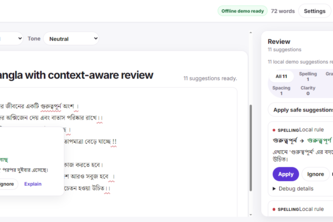
Shuddho is an AI writing assistant for Bangla, built by a single founder (Md Rumman Ali), designed to improve spelling, grammar, clarity, and style in real time. It uses a hybrid architecture combining fine-tuned language models (Qwen3-8B with LoRA), rule-based systems, and contextual AI reasoning. The platform is self-reported as functional and end-to-end, with an emphasis on user control, linguistic accuracy, and preserving the writer's voice.
What changed
The project was submitted to the OpenAI 2026 hackathon. It represents a proof-of-concept or early-stage product that has been developed into a working prototype using open-source tools and frameworks like FastAPI, React, Qwen3-8B, and Hugging Face.
Single most important open question
Is there any evidence of traction, revenue, or user adoption beyond the author’s own description? The self-reported write-up does not include any data on users, customers, monetization, or usage metrics.
What The Product Actually Is
The description states that Shuddho is an AI-powered writing assistant built specifically for Bangla. It includes:
- A web editor where users can input or paste Bangla text
- Real-time assistance with:
- Spelling and grammar
- Punctuation and sentence structure
- Clarity, readability, and word choice
- Contextually unnatural expressions
- Tone and stylistic consistency
- Fluency and natural phrasing
It is described as not replacing human expression but strengthening it through actionable suggestions.
The system uses a hybrid architecture:
- A fine-tuned Bangla language model (Shuddho LLM) based on Qwen3-8B with LoRA
- Deterministic linguistic rules
- Contextual AI reasoning
- Structured outputs for corrections
- Fallback mechanisms using providers like Gemini and OpenRouter
It is built using technologies such as React, TypeScript, FastAPI, Python, Vite, and deployed via Vercel and Render.
Inference The product appears to be a prototype or MVP, not yet a commercial offering with users or monetization.
Positioning & Claim Evolution
The author positions Shuddho as an AI writing assistant tailored for Bangla, distinct from English-first tools that are adapted for the language. Key claims include:
- Bangla writers are underserved by modern writing technology.
- Unlike general-purpose AI systems, Shuddho is built around Bangla's grammar, sentence structure, cultural context, and natural expression.
- It does not translate an English tool into Bangla but builds writing intelligence specifically for Bangla.
The project evolved from an idea to a functional platform through:
- Fine-tuning Qwen3-8B
- Using curated linguistic datasets (e.g., Vacaspati/Vaiyakarana)
- Combining AI and rule-based systems
- Implementing fallbacks and resilient infrastructure
Inference The positioning is clear: a niche, language-specific writing assistant for Bangla. However, there is no evidence of market validation or competitive differentiation beyond self-statement.
Target Customer & ICP
The description states that Shuddho targets Bengali speakers who are underserved by current writing tools. It aims to help:
- Writers in academic, professional, journalistic, and creative contexts
- Users seeking accuracy, clarity, and confidence in Bangla writing
It is implied that the primary users are individuals or small teams who write in Bangla and want real-time feedback on grammar, style, and fluency.
Inference The ICP appears to be individual writers and content creators working in Bangla. No evidence of enterprise or institutional adoption is provided.
Business Model & Pricing Evidence
There is no mention of pricing, monetization, or business model in the description.
The author states that Shuddho is designed to strengthen human expression—not replace it—and emphasizes user control over suggestions.
Not evidenced No revenue streams, subscriptions, licensing, or commercial partnerships are described.
Technical & Delivery Signals
Shuddho uses:
- Fine-tuned Qwen3-8B with LoRA
- Hybrid AI + rule-based correction pipeline
- React/TypeScript frontend
- FastAPI backend in Python
- Cloud deployment on Vercel and Render
- Inference fallbacks (Gemini, OpenRouter)
- Unicode normalization and Bangla-specific data pipelines
The system is designed to be resilient:
- Graceful handling of API outages or quota limits
- Structured model outputs for precision
- Rule engine as a backup
Inference The technical stack suggests a capable engineering effort, but no evidence of scalability, performance metrics, or production-grade delivery.
Traction & Maturity Signals
The description does not provide any traction data:
- No user numbers
- No revenue figures
- No customer testimonials or case studies
- No product usage statistics
It is described as a prototype developed for the OpenAI 2026 hackathon, with no indication of ongoing development or market presence.
Inference The project is at an early stage, likely pre-product-market fit. There is no evidence of traction or maturity beyond the author’s own account.
Competitive Context
The description does not mention competitors directly. However, it implies that English-first writing assistants (e.g., Grammarly, ProWritingAid) do not adequately serve Bangla users.
It also notes that general-purpose AI systems are not built around Bangla's structure.
Inference The competitive landscape is unclear, but the author positions Shuddho as addressing a gap in support for Bangla writing tools. No evidence of existing solutions or market dynamics is provided.
Open Questions & Risks
- No traction or revenue: The project has no demonstrated adoption or monetization.
- Single-founder team: The entire product was built by one person, which raises questions about scalability and long-term maintenance.
- Limited dataset and benchmarks: The author notes challenges in evaluating performance due to lack of established Bangla writing benchmarks.
- High technical complexity for a small team: Fine-tuning an 8B parameter model with limited resources is challenging.
- Unclear path to monetization: No business model or pricing strategy is described.
- Unverified claims: All statements are self-reported and unverified.
Questions the description leaves open
- What specific linguistic datasets were used for fine-tuning, and how were they curated?
- How many users have tested the tool? Is there any feedback or user testing data?
- Are there plans to monetize the product? If so, what is the proposed business model?
- What are the current limitations of Shuddho LLM in terms of accuracy, latency, and scalability?
- How does the system handle edge cases like code-mixing (Bangla-English)?
- Has the team considered integrating with existing platforms or tools (e.g., Google Docs, Notion)?
- What is the long-term roadmap for improving correction explanations and confidence scoring?
- Are there any partnerships or collaborations in progress with educational institutions or publishers?
Overall Assessment
Not evidenced: There is no evidence of revenue, customers, or traction to assess investment or partnership viability.
The project is described as a functional prototype built by one person for a hackathon. It shows technical capability and a clear vision for addressing a gap in Bangla writing tools, but lacks any commercial or user validation.
Confidence level: Low — based entirely on self-reported information with no external verification or data points.
Assessment: This is an early-stage idea with potential, but not yet a product ready for investment or partnership. Further diligence would require evidence of traction, usage, and business model development.
User Stories BotA demo video on every pull request
Get a demo video on every new feature
GitHub App that watches your pull requests and records a narrated, captioned demo.
Save time on demo prep and make informed decisions faster with a video walkthrough of every new feature.
Source
Submitted to the OpenAI 2026 hackathon on Devpost. Project home on Devpost. Back to the full gallery on Devpost.
This competitive analysis was produced by top-founders.com (opens in a new tab)
Generated by a language model from this project's public Devpost page — its tagline, the author's own write-up and any built-with tags listed there — as captured in August 2026. Short quotations are the author's words. It is an opinion on the idea as a business, not on the people behind it, and it reflects the description as published then. If the project has moved on, request a correction below. The analysis is not independent research and contains no verified traction, revenue or customer data.
An independent guide by KFG International LLC — not affiliated with, endorsed by, or connected to Devpost or OpenAI.