

Archive position — measured, not model output
1 like on Devpost
505 of the 7,850 archived projects have more likes, and 1,758 share exactly 1 — so this project's #790 place in the like-ranked listing is a tie-break inside that group, not a ranking.
Projects (log scale)
Likes on Devpost. ▲ marks this project's group.
Show the figures
| Likes | Projects | Share of archive |
|---|---|---|
| 0 | 5,587 | 71.2% |
| 1 | 1,758 | 22.4% |
| 2 | 284 | 3.6% |
| 3–4 | 132 | 1.7% |
| 5–9 | 75 | 1.0% |
| 10+ | 14 | 0.2% |
 User Stories BotA demo video on every pull request
Get a demo video on every new feature
GitHub App that watches your pull requests and records a narrated, captioned demo.
Save time on demo prep and make informed decisions faster with a video walkthrough of every new feature.
Executive Summary
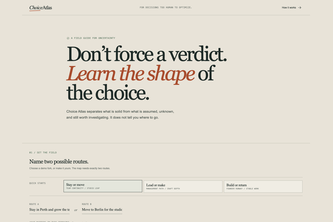
What the company appears to be: ChoiceAtlas is a self-reported tool that uses GPT-5.6 to help young people make life-changing decisions by mapping choices to knowns, unknowns, and trade-offs. It is presented as a decision-support system built for individuals facing difficult personal or professional choices.
What changed: The project was submitted to the OpenAI 2026 hackathon, indicating it is in an early-stage development phase, likely prototyping or proof-of-concept level.
Single most important open question: Is there any evidence of user adoption, revenue, or traction beyond the hackathon submission?
The description is self-reported and unverified. There is no evidence of customers, revenue, pricing, or product-market fit. The project appears to be a concept or prototype with no demonstrated commercial activity.
What The Product Actually Is
The description states that ChoiceAtlas uses live GPT-5.6 to map choices to knowns, unknowns, and trade-offs for young people facing life-changing decisions. It is described as not deciding for users but helping them understand the implications of their options.
Evidence:
- The author states that ChoiceAtlas uses “live GPT-5.6”
- It is described as mapping choices to knowns, unknowns, and trade-offs
- It is said to not decide for users
Inference:
- The product appears to be an AI-powered decision-support tool
- It may involve a web interface or application built with React and TypeScript
Not evidenced:
- No functional prototype or live version described
- No details on how the GPT integration works in practice
- No UI/UX design or user flow explained
Positioning & Claim Evolution
The tagline states: “When young people face life-changing decisions, they can't see what each choice really means. Choice Atlas uses live GPT-5.6 to map the choices to knowns, unknowns, trade-offs—never deciding for them.”
Evidence:
- The author positions ChoiceAtlas as a tool to help young people understand decision implications
- It is framed as non-decisive but informative
Inference:
- The positioning suggests an emphasis on clarity and transparency in decision-making
- The use of GPT implies AI-driven insight generation
Not evidenced:
- No claim about market size, target demographics beyond “young people”
- No evidence of prior versions or evolution of the idea
- No indication of how this differs from existing tools or advice platforms
Target Customer & ICP
The description states that ChoiceAtlas is for young people facing life-changing decisions.
Evidence:
- The author says it helps “young people” make difficult choices
- It is framed as a tool for those who “can't see what each choice really means”
Inference:
- The target audience may include students, early-career professionals, or young adults navigating major life transitions
Not evidenced:
- No segmentation beyond age group
- No evidence of specific use cases (e.g., career, education, relationships)
- No indication of whether the tool is for individuals or groups
- No evidence of customer personas or ICP validation
Business Model & Pricing Evidence
There is no evidence in the description of a business model or pricing structure.
Evidence:
- The author does not state how the product will be monetized
- No mention of subscriptions, freemium tiers, or one-time purchases
Inference:
- If it becomes a commercial product, it may follow a SaaS model with usage-based or tiered pricing
Not evidenced:
- No revenue streams described
- No pricing information provided
- No indication of whether the tool will be free, paid, or ad-supported
Technical & Delivery Signals
The project is built using technologies declared by the author: codex, GPT-5.6, OpenAI responses API, React, SVG, TypeScript, Vercel, Vite, Vitest, Zod.
Evidence:
- The author lists the tech stack used
- It is built with React and TypeScript
- It uses OpenAI’s API (GPT-5.6)
Inference:
- The tool likely runs on a web platform
- It may be a single-page application or web-based interface
- The use of Zod suggests data validation, and Vitest implies testing practices
Not evidenced:
- No evidence of deployment or hosting details beyond Vercel
- No information about scalability or performance
- No mention of backend architecture or data storage
- No evidence of API usage limits or cost structure
Traction & Maturity Signals
There is no evidence of traction, adoption, or maturity.
Evidence:
- The project was submitted to the OpenAI 2026 hackathon
- It is described as a prototype or concept
Inference:
- The product is likely in early development
- No user feedback, beta testing, or customer engagement reported
Not evidenced:
- No evidence of users, customers, or adoption
- No data on usage metrics, retention, or growth
- No indication of whether it has been tested with real users
- No mention of product iterations or roadmap
Competitive Context
There is no evidence provided about the competitive landscape.
Evidence:
- The author does not reference competitors or similar tools
- No mention of existing decision-support platforms or AI tools in this space
Inference:
- The tool may compete with general AI assistants, life coaching apps, or decision-making frameworks
- It could be positioned against tools like Notion, Calm, or other self-help platforms
Not evidenced:
- No competitive analysis
- No evidence of market research or differentiation strategy
- No mention of how it compares to existing solutions
Open Questions & Risks
Several risks and open questions are present due to the lack of evidence.
Evidence:
- The project is a hackathon submission with no commercial traction
- No revenue, customers, or product-market fit demonstrated
Inference:
- High risk of failure if no clear path to monetization or user adoption
- Lack of technical depth or product maturity raises concerns about scalability
- Risk of overpromising on AI capabilities without real-world validation
Not evidenced:
- No evidence of intellectual property, team experience, or funding
- No indication of whether the idea has been validated with users
- No mention of regulatory or ethical considerations around AI decision-making
Questions the description leaves open
- What specific life decisions does ChoiceAtlas aim to help users navigate?
- How is the GPT-5.6 integration implemented in practice? Is it a single prompt, or a multi-step process?
- Have you tested this with real users? If so, what feedback did you get?
- What is your plan for monetization and scaling beyond the hackathon?
- How do you ensure that AI-generated insights are not misleading or harmful?
- Are there any legal or ethical concerns around using AI to guide personal decisions?
Overall Assessment
Not evidenced:
- No evidence of revenue, traction, or commercial viability
- No indication of team experience or funding
- No product-market fit or user validation
Confidence level: Very low. The project is described as a hackathon submission with no demonstrated progress beyond concept stage.
Assessment:
ChoiceAtlas appears to be an early-stage idea or prototype. There is no evidence of commercial readiness, traction, or business model. It is not ready for investment or partnership consideration at this time. Further due diligence would require evidence of user testing, product development, and market validation.
User Stories BotA demo video on every pull request
Get a demo video on every new feature
GitHub App that watches your pull requests and records a narrated, captioned demo.
Save time on demo prep and make informed decisions faster with a video walkthrough of every new feature.
Source
Submitted to the OpenAI 2026 hackathon on Devpost. Project home on Devpost. Back to the full gallery on Devpost.
This competitive analysis was produced by top-founders.com (opens in a new tab)
Generated by a language model from this project's public Devpost page — its tagline and any built-with tags listed there, since the author published no write-up — as captured in August 2026. Short quotations are the author's words. It is an opinion on the idea as a business, not on the people behind it, and it reflects the description as published then. If the project has moved on, request a correction below. The analysis is not independent research and contains no verified traction, revenue or customer data.
An independent guide by KFG International LLC — not affiliated with, endorsed by, or connected to Devpost or OpenAI.