

Archive position — measured, not model output
4 likes on Devpost
89 of the 7,850 archived projects have more likes, and 39 share exactly 4 — so this project's #120 place in the like-ranked listing is a tie-break inside that group, not a ranking.
Projects (log scale)
Likes on Devpost. ▲ marks this project's group.
Show the figures
| Likes | Projects | Share of archive |
|---|---|---|
| 0 | 5,587 | 71.2% |
| 1 | 1,758 | 22.4% |
| 2 | 284 | 3.6% |
| 3–4 | 132 | 1.7% |
| 5–9 | 75 | 1.0% |
| 10+ | 14 | 0.2% |
 User Stories BotA demo video on every pull request
Get a demo video on every new feature
GitHub App that watches your pull requests and records a narrated, captioned demo.
Save time on demo prep and make informed decisions faster with a video walkthrough of every new feature.
Executive Summary
What the company appears to be
Sherlock is a self-reported AI investigation framework built for problem-solving by ruling out incorrect explanations rather than generating plausible answers. The author describes it as an end-to-end product that uses GPT-5.6 Structured Outputs and OpenAI Codex, with no hand-written code.
What changed
The project evolved through four implementation blocks, from a canonical schema to iterative reasoning, using structured outputs and semantic evaluation. It was submitted to the OpenAI 2026 hackathon.
Single most important open question
Is Sherlock a working investigation framework or an unvalidated idea? The description states it is built with GPT-5.6 and Codex but provides no evidence of real-world use, performance metrics, or customer feedback.
What The Product Actually Is
The description states that Sherlock is an "investigation framework" designed to make large language models (LLMs) think like investigators instead of assistants. It builds structured investigations by:
- Classifying observations as expected or unexpected.
- Maintaining competing hypotheses simultaneously.
- Tracking rejected explanations in a "Hypothesis Graveyard."
- Ranking missing evidence by value.
- Recommending the next test to distinguish between leading hypotheses.
- Supporting iterative learning where new evidence updates existing investigations.
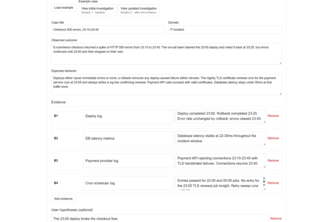
The demo case involves a software incident (HTTP 500 errors after deployment), where Sherlock identifies that a TLS certificate renewal log should have appeared but did not, instead of blaming the deployment.
Evidence The author describes how it works in detail, including its components and reasoning process. However, there is no evidence of actual implementation beyond the self-reported narrative.
Inference Based on the description, Sherlock appears to be a structured AI tool for hypothesis falsification and evidence-based reasoning, not a general-purpose assistant or chatbot.
Positioning & Claim Evolution
The author positions Sherlock as an alternative to traditional AI tools that "try to find the right answer" by instead eliminating wrong ones. It draws analogies from Sherlock Holmes, differential diagnosis, and Karl Popper’s falsification theory.
Sherlock is described not as another prompting technique but as a "reasoning workflow" that constrains how models investigate problems. The goal is not to generate better answers but to make the model "earn the answer."
Evidence The author explicitly contrasts Sherlock with typical AI tools and positions it within philosophical frameworks of reasoning and falsification.
Inference This suggests a niche positioning for complex problem-solving, particularly in domains where missing evidence is critical — such as debugging, compliance, or forensic analysis.
Target Customer & ICP
The description does not name specific customers or personas. It mentions that the demo case is one many engineers recognize (a software incident), implying an engineering audience might be relevant.
However, the author states that Sherlock is intentionally domain-independent and can be applied beyond software incidents.
Evidence No explicit customer segments or ideal customer profiles are mentioned.
Inference The target market may include technical professionals who need structured reasoning for debugging, compliance audits, or investigative tasks. But there's no evidence of actual users or buyer personas.
Business Model & Pricing Evidence
There is no mention of pricing, monetization strategy, or business model in the description.
Evidence Not evidenced.
Inference Since this is a hackathon project submitted by one person and not described as commercialized, it likely has no revenue model at present. Any future business model would be speculative without further information.
Technical & Delivery Signals
The system was built using:
- GPT-5.6 Structured Outputs
- OpenAI Codex for implementation
- Next.js, React, TypeScript, Tailwind CSS, Vercel
- JSON Schema validation via AJV
- A versioned investigation workflow with explicit rules
Development followed disciplined blocks with acceptance criteria and governance.
Evidence The author lists technologies used and describes development stages.
Inference The technical stack suggests a modern web-based AI application. The use of structured outputs and schema validation indicates attention to reasoning quality and auditability.
Traction & Maturity Signals
There is no evidence of traction, revenue, customers, or adoption beyond the author’s own account.
The project was submitted as part of a hackathon and includes a demo case but lacks any data on usage, performance, or impact.
Evidence Not evidenced.
Inference This is a prototype or proof-of-concept, not a mature product with real-world deployment or user engagement.
Competitive Context
The description does not reference competitors directly. However, it implies that current AI tools focus on generating explanations rather than ruling out incorrect ones.
It positions itself against general-purpose LLM assistants and suggests a unique approach to reasoning and hypothesis testing.
Evidence No mention of existing products or competitive landscape.
Inference If Sherlock gains traction, it could compete with AI-powered debugging tools, incident response platforms, or investigative software. But no such competitors are named or described.
Open Questions & Risks
- Unvalidated assumptions: The system relies heavily on the author’s reasoning framework and model behavior without empirical validation.
- Limited scope: It is described as a hackathon project with no evidence of scalability or real-world application.
- No performance metrics: There are no benchmarks, accuracy claims, or evaluation results provided.
- Single contributor: The team size is listed as one person, raising questions about long-term development and maintenance.
- Unclear commercial viability: No indication of monetization strategy or path to market.
Evidence These risks stem from the lack of external validation, real-world usage, and business planning in the description.
Questions the description leaves open
- What specific problems have you observed where traditional AI tools failed to help?
- How do you validate that Sherlock’s reasoning is sound and not just a clever narrative?
- Have you tested Sherlock with real users or teams? If so, what feedback did they give?
- What are the limitations of GPT-5.6 Structured Outputs in this context?
- Is there any plan to move beyond the hackathon prototype into a scalable product?
- How does Sherlock handle ambiguity when evidence is incomplete or contradictory?
- What kind of domain-specific customization will be needed for different use cases?
Overall Assessment
Not evidenced.
The description provides no data on financials, traction, or market opportunity that would support an investment or partnership decision.
This appears to be a hackathon submission with a compelling idea but no demonstrated product-market fit, revenue, or customer base.
It may represent a promising concept for further development, but there is insufficient evidence to assess its commercial potential or risk profile.
Confidence level Low. The project is described as a prototype with no external validation or performance data.
User Stories BotA demo video on every pull request
Get a demo video on every new feature
GitHub App that watches your pull requests and records a narrated, captioned demo.
Save time on demo prep and make informed decisions faster with a video walkthrough of every new feature.
Source
Submitted to the OpenAI 2026 hackathon on Devpost. Project home on Devpost. Back to the full gallery on Devpost.
This competitive analysis was produced by top-founders.com (opens in a new tab)
Generated by a language model from this project's public Devpost page — its tagline, the author's own write-up and any built-with tags listed there — as captured in August 2026. Short quotations are the author's words. It is an opinion on the idea as a business, not on the people behind it, and it reflects the description as published then. If the project has moved on, request a correction below. The analysis is not independent research and contains no verified traction, revenue or customer data.
An independent guide by KFG International LLC — not affiliated with, endorsed by, or connected to Devpost or OpenAI.