

Archive position — measured, not model output
4 likes on Devpost
89 of the 7,850 archived projects have more likes, and 39 share exactly 4 — so this project's #121 place in the like-ranked listing is a tie-break inside that group, not a ranking.
Projects (log scale)
Likes on Devpost. ▲ marks this project's group.
Show the figures
| Likes | Projects | Share of archive |
|---|---|---|
| 0 | 5,587 | 71.2% |
| 1 | 1,758 | 22.4% |
| 2 | 284 | 3.6% |
| 3–4 | 132 | 1.7% |
| 5–9 | 75 | 1.0% |
| 10+ | 14 | 0.2% |
 User Stories BotA demo video on every pull request
Get a demo video on every new feature
GitHub App that watches your pull requests and records a narrated, captioned demo.
Save time on demo prep and make informed decisions faster with a video walkthrough of every new feature.
Executive Summary
What the company appears to be
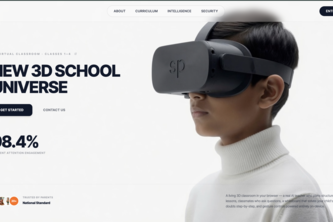
Sparsh Mukthi is an interactive, AI-powered 3D classroom platform designed for young learners. It aims to deliver immersive educational experiences using only a smartphone and a DIY cardboard VR holder — without requiring expensive headsets or installations.
What changed
The project was submitted as part of the OpenAI 2026 hackathon. The description reflects an early-stage prototype built in a short timeframe, with no evidence of commercial traction, revenue, or customer adoption.
Single most important open question
Is there any evidence that this concept has been tested with real users beyond the hackathon context, and if so, what were the outcomes?
Note: This analysis is based entirely on the self-reported project description provided by the authors. No external verification or historical data is available.
What The Product Actually Is
The description states that Sparsh Mukthi is an interactive, AI-powered 3D classroom platform. It uses:
- A browser-based 3D environment built with Three.js + React Three Fiber
- An AI backend that generates live lessons including teaching content and peer interactions
- Gesture tracking via webcam/phone camera, running fully in-browser
- A custom-built cardboard VR phone holder to enable immersive experience without hardware
The platform allows users to:
- Enter a 3D classroom using just a smartphone
- Raise their actual hand to ask questions, which are responded to by an AI teacher
- Interact with peers and the environment through gestures
- Access lessons that are not pre-recorded but generated live
Inference: The product appears to be a proof-of-concept prototype built for demonstration purposes rather than a production-ready solution.
Positioning & Claim Evolution
The authors claim:
- Interactive, hands-on learning works best — but most kids never get it.
- AR/VR can deliver immersion but is cost-prohibitive.
- Existing VR/AR solutions in schools are rigid and unadaptive.
- They aim to offer immersive experience without cost or one-size-fits-all design.
The positioning centers on accessibility and adaptability:
- No headset required
- Runs fully in-browser
- Uses gesture-based interaction instead of controllers
Claim vs Fact: These claims reflect the authors’ intent and vision, not evidence of traction or adoption. The description does not indicate whether these claims have been validated with real users.
Target Customer & ICP
The target customer is described as:
- Young learners (presumably K–12 age group)
- Families who cannot afford VR headsets
- Schools seeking affordable, immersive learning tools
The ICP appears to be:
- Educators or parents looking for low-cost alternatives to traditional digital learning
- Students in under-resourced environments where technology access is limited
Not evidenced: There is no mention of specific customer segments, usage patterns, or feedback from actual users beyond the hackathon setting.
Business Model & Pricing Evidence
The description does not provide any information about:
- Revenue model
- Pricing strategy
- Monetization approach
- Customer acquisition costs
- Subscription or licensing structures
Not evidenced: No evidence of a defined business model or pricing structure exists in the provided text.
Technical & Delivery Signals
Technical stack includes:
- 3D rendering: Three.js, React Three Fiber
- AI backend: Codex on GPT-5.6
- Gesture recognition: MediaPipe, OpenCV, PyAutoGUI, pygame
- Language: JavaScript, Python
The authors state:
- The system runs fully in-browser
- No data leaves the device (on-device gesture tracking)
- Designed a custom cardboard VR holder for accessibility
Inference: The technical approach suggests a lightweight, portable solution that leverages modern web technologies and AI APIs. However, this is a prototype built for a hackathon, not a scalable product.
Traction & Maturity Signals
The project was submitted to the OpenAI 2026 hackathon.
The authors mention:
- A working prototype
- Multiple iterations of cardboard design
- Live AI-generated lessons
- Plans for future features (e.g., lip-synced avatars, parent dashboards)
Not evidenced: There is no evidence of user testing, adoption metrics, or real-world deployment beyond the hackathon. No data on engagement, retention, or usage is provided.
Competitive Context
The description does not reference existing competitors or market players directly.
However, based on the stated goals:
- Immersive learning experiences
- Low-cost alternatives to VR/AR education tools
- AI-powered personalized instruction
This space includes:
- Traditional LMS platforms (e.g., Google Classroom, Canvas)
- AR/VR edtech startups (e.g., zSpace, Labster)
- AI tutoring systems (e.g., Carnegie Learning, Duolingo)
Not evidenced: No competitive analysis or differentiation strategy is described.
Open Questions & Risks
Key risks and open questions include:
- Prototype-only status: Built for a hackathon; no evidence of product-market fit or scalability.
- No commercial traction: No revenue, customers, or user feedback beyond the demo phase.
- Unproven AI integration: The AI backend is described as using Codex on GPT-5.6 — but there’s no clarity on how this integrates into a usable classroom experience.
- Limited technical depth: While the tech stack is mentioned, it lacks detail on performance, reliability, or robustness in real-world conditions.
- Lack of user validation: No mention of testing with children or educators.
Inference: The project shows potential but lacks evidence of viability or readiness for market entry.
Questions the description leaves open
- What was the outcome of any internal or external testing with real students or teachers?
- How does the AI backend handle variability in student questions and learning paces?
- Have you considered privacy implications of on-device gesture tracking and data collection?
- Is there a plan to monetize this platform, and how do you envision scaling it beyond the current prototype?
- What are the key assumptions behind the product concept, and how have they been tested?
Overall Assessment
Not evidenced: There is no evidence of commercial traction, revenue, or customer validation to support an investment or partnership decision.
Confidence Level: Low — this is a self-reported prototype with no external corroboration. The project shows ambition and technical execution but lacks proof of concept in real-world settings.
The authors state that the platform:
- Runs fully in-browser
- Uses gesture-based interaction
- Delivers live AI-generated lessons
These features are promising, but without evidence of usage, impact, or scalability, no conclusion can be drawn regarding its commercial viability or strategic value.
User Stories BotA demo video on every pull request
Get a demo video on every new feature
GitHub App that watches your pull requests and records a narrated, captioned demo.
Save time on demo prep and make informed decisions faster with a video walkthrough of every new feature.
Source
Submitted to the OpenAI 2026 hackathon on Devpost. Project home on Devpost. Back to the full gallery on Devpost.
This competitive analysis was produced by top-founders.com (opens in a new tab)
Generated by a language model from this project's public Devpost page — its tagline, the author's own write-up and any built-with tags listed there — as captured in August 2026. Short quotations are the author's words. It is an opinion on the idea as a business, not on the people behind it, and it reflects the description as published then. If the project has moved on, request a correction below. The analysis is not independent research and contains no verified traction, revenue or customer data.
An independent guide by KFG International LLC — not affiliated with, endorsed by, or connected to Devpost or OpenAI.