

Archive position — measured, not model output
4 likes on Devpost
89 of the 7,850 archived projects have more likes, and 39 share exactly 4 — so this project's #122 place in the like-ranked listing is a tie-break inside that group, not a ranking.
Projects (log scale)
Likes on Devpost. ▲ marks this project's group.
Show the figures
| Likes | Projects | Share of archive |
|---|---|---|
| 0 | 5,587 | 71.2% |
| 1 | 1,758 | 22.4% |
| 2 | 284 | 3.6% |
| 3–4 | 132 | 1.7% |
| 5–9 | 75 | 1.0% |
| 10+ | 14 | 0.2% |
 User Stories BotA demo video on every pull request
Get a demo video on every new feature
GitHub App that watches your pull requests and records a narrated, captioned demo.
Save time on demo prep and make informed decisions faster with a video walkthrough of every new feature.
Executive Summary
What the company appears to be
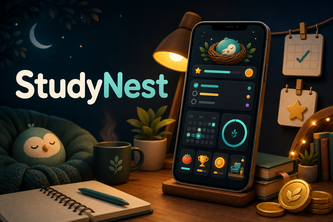
StudyNest is a self-reported mobile application built by one developer (Arun Sudhir) for students. It combines task management, planning, focus tools, habit tracking, note-taking, and gamification into a single phone-first app. The author describes it as a "gamified study companion" that aims to make studying more organized, motivating, and fun.
What changed
This is a self-reported project submitted for the OpenAI 2026 hackathon. It represents an early-stage prototype built over a short timeframe (likely during the hackathon), with no evidence of prior development or user adoption beyond the author's own testing.
Single most important open question
Is there any evidence that StudyNest has achieved product-market fit, user traction, or commercial viability beyond its initial developer-built prototype?
Note: All claims in this report are based on self-reported information from the project description and are unverified. No revenue, customer data, or independent validation is available.
What The Product Actually Is
The description states that StudyNest is a mobile application built with Flutter and Dart for Android, iOS, and potentially web. It includes:
- Task creation, prioritization, completion, and filtering
- Due date tracking and overdue work alerts
- Calendar-planning mode with rescheduling gestures
- Pomodoro focus sessions
- Coin-based reward system for completing tasks and focus sessions
- Customizable study environments (themes, decorations)
- Notes, flashcards, quizzes, formula sheets
- Habit tracking
- Local-first storage with optional Firebase synchronization
The author notes that the app was built using Codex with GPT-5.6 to accelerate implementation, debugging, testing, and release preparation.
Inference: The product is described as a single integrated tool for student study workflows, but no evidence exists regarding actual usage or adoption by users beyond the developer.
Positioning & Claim Evolution
The author positions StudyNest as:
- A "gamified study companion"
- An app that makes studying more organized, motivating, and fun
- A solution to the problem of using multiple apps while studying
- A tool that turns productivity into progress rather than a chore
It is described as a phone-first application designed to be "pretty, fun, and engaging" while remaining functional.
Claim: The app aims to integrate all study-related activities into one cohesive experience.
Inference: The positioning reflects a desire to solve fragmentation in student workflows, but no evidence supports whether this resonates with users or addresses real market demand.
Target Customer & ICP
The description states that StudyNest is intended for students who struggle with organization and motivation when studying. It targets those who:
- Use multiple apps during study sessions
- Need help tracking assignments, exams, and projects
- Want a more engaging way to stay focused and motivated
Claim: The target customer is students.
Inference: No evidence exists about specific demographics, usage patterns, or whether the app has reached its intended audience.
Business Model & Pricing Evidence
The description mentions:
- A coin-based reward system where users earn coins by completing tasks and focus sessions
- Users can spend coins on upgrades, themes, and decorations
- Optional Firebase account synchronization for cloud storage
There is no mention of monetization beyond the in-app rewards system or any pricing structure.
Claim: The business model involves gamification and optional premium features.
Inference: No evidence exists regarding revenue streams, pricing tiers, or monetization strategy beyond the reward system.
Technical & Delivery Signals
The app was built using:
- Flutter and Dart
- Firebase Authentication and Cloud Firestore for account management and data sync
- SharedPreferences for local storage
- Codex with GPT-5.6 to assist in development
Key technical features include:
- Local-first architecture
- Account-data isolation
- Configurable rewards system
- Pomodoro session customization
- Immersive calendar-planning mode with gesture controls
- Automated testing (55 tests pass)
- Android APK build and verification
Claim: The app uses modern development practices including AI-assisted coding, local-first storage, and cross-platform support.
Inference: These are technical capabilities described by the author but not validated through external sources or user feedback.
Traction & Maturity Signals
The description states:
- 18 product-development commits
- 6,262 additions, 2,153 deletions across 53 files
- Completed during OpenAI Build Week (short timeframe)
- Passes 55 automated tests
- Builds successfully as an Android APK
- Fresh-install test passed on a Pixel 9 Pro
However, there is no evidence of:
- User adoption or retention metrics
- Real-world usage data
- Revenue or monetization
- Customer feedback or reviews
Claim: The app was developed rapidly over a short period and includes automated tests.
Inference: No traction or maturity indicators beyond the developer’s own testing.
Competitive Context
The description does not provide any information about competitors, market positioning, or competitive differentiation. It also lacks references to similar tools or platforms in the student productivity space.
Claim: No competitive context is provided.
Inference: Without evidence of existing solutions or market analysis, it's impossible to assess how StudyNest compares or fits into the broader ecosystem.
Open Questions & Risks
- Single-person development: The app was built by one individual; no team or external validation
- No revenue or monetization strategy: No indication of how the product will generate income
- Unverified claims: All features and functionality are self-reported without independent verification
- Limited user feedback: No evidence of usability testing, customer interviews, or real-world usage
- AI-assisted development: While Codex helped accelerate development, reliance on AI-generated code raises questions about long-term maintainability and quality control
Inference: The lack of external validation, traction, and commercial viability makes this a high-risk early-stage prototype.
Questions the description leaves open
- What specific problems do students face that StudyNest solves, and how did you validate these needs?
- How many students have tested the app, and what was their feedback?
- Are there any plans for monetization beyond the in-app reward system?
- Has the app been tested on different devices or operating systems beyond the Pixel 9 Pro?
- What is your roadmap for scaling beyond a single developer?
- How do you plan to acquire users once the app is publicly available?
- What are the key assumptions behind the gamification model, and how were they validated?
Overall Assessment
There is no evidence of revenue, customer traction, or commercial viability. The project is described as a prototype built by one developer over a short timeframe, with no indication of market validation or product-market fit.
Assessment: Not ready for investment or partnership at this stage. This appears to be an early-stage idea or proof-of-concept that requires significant development and user testing before any commercial viability can be assessed.
Confidence Level: Low — based entirely on self-reported information with no external validation or evidence of traction, adoption, or monetization.
User Stories BotA demo video on every pull request
Get a demo video on every new feature
GitHub App that watches your pull requests and records a narrated, captioned demo.
Save time on demo prep and make informed decisions faster with a video walkthrough of every new feature.
Source
Submitted to the OpenAI 2026 hackathon on Devpost. Project home on Devpost. Back to the full gallery on Devpost.
This competitive analysis was produced by top-founders.com (opens in a new tab)
Generated by a language model from this project's public Devpost page — its tagline, the author's own write-up and any built-with tags listed there — as captured in August 2026. Short quotations are the author's words. It is an opinion on the idea as a business, not on the people behind it, and it reflects the description as published then. If the project has moved on, request a correction below. The analysis is not independent research and contains no verified traction, revenue or customer data.
An independent guide by KFG International LLC — not affiliated with, endorsed by, or connected to Devpost or OpenAI.