

Archive position — measured, not model output
0 likes on Devpost
2,263 of the 7,850 archived projects have more likes, and 5,587 share exactly 0 — so this project's #4,046 place in the like-ranked listing is a tie-break inside that group, not a ranking.
Projects (log scale)
Likes on Devpost. ▲ marks this project's group.
Show the figures
| Likes | Projects | Share of archive |
|---|---|---|
| 0 | 5,587 | 71.2% |
| 1 | 1,758 | 22.4% |
| 2 | 284 | 3.6% |
| 3–4 | 132 | 1.7% |
| 5–9 | 75 | 1.0% |
| 10+ | 14 | 0.2% |
 User Stories BotA demo video on every pull request
Get a demo video on every new feature
GitHub App that watches your pull requests and records a narrated, captioned demo.
Save time on demo prep and make informed decisions faster with a video walkthrough of every new feature.
Executive Summary
What the company appears to be
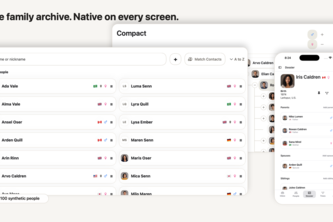
Family Atlas is a self-reported personal project by one developer (Farzad Mahmoodinobar) that builds a native macOS and iOS application for managing family history in a private, collaborative way. The app allows users to create and edit people, relationships, facts, sources, and photos; keep residence and education timelines; search and review sources; explore various tree views; export as PDF; import contacts; and optionally sync via iCloud.
What changed
The project began with a personal inspiration — a paper family tree from the author’s grandfather — and evolved into a technical implementation using Swift, SwiftUI, Core Data, CloudKit, and other Apple frameworks. It was submitted to an OpenAI hackathon (Build Week), where it achieved 47 commits across repositories.
Single most important open question
Is there any evidence of actual user adoption or traction beyond the author’s own development work?
What The Product Actually Is
The description states that Family Atlas is a native Swift and SwiftUI application for macOS and iOS/iPadOS, designed to allow families to collaboratively manage their history. It supports:
- Creating and editing people, relationships, facts, sources, and photos.
- Keeping residence and education histories in clear timelines.
- Searching and reviewing source-backed content through an Inbox.
- Exploring multiple views: Dossier, Pedigree, Descendant, Compact Tree, Full Tree, and Stats.
- Exporting family-tree views as PDF.
- Importing selected Contacts details and photos only when the user chooses.
- Optionally syncing and sharing libraries privately via iCloud.
It uses Core Data backed by SQLite for persistence, with optional CloudKit integration for synchronization. The app integrates with Apple’s Contacts, Photos, StoreKit, and native PDF-rendering frameworks.
Evidence
- The author describes how it works technically.
- Technology tags include: cloudkit, codex, contacts, core-data, core-graphics, cryptokit, git-lfs, github, gpt-5.6, ios, ipados, macos, openai, photosui, storekit, swift, swiftui, xcodegen, xctest.
Inference This is a private, invitation-only family library tool built around Apple ecosystem technologies.
Positioning & Claim Evolution
The author claims that Family Atlas turns “scattered family records into a private, source-backed living archive” and enables relatives to build together on a shared history across generations. It was inspired by a paper family tree created by the author’s grandfather.
It positions itself as:
- A private, collaborative tool.
- Not a public profile or feed.
- Designed for source-backed information.
- A living archive that can be explored, preserved, and safely shared.
There is no indication of broader commercial positioning beyond personal use or hackathon submission.
Evidence
- The author’s own narrative about the origin story and intent.
- No mention of monetization, marketing, or target audience beyond “families.”
Inference The product is positioned as a deeply personal tool for preserving family history, not a scalable commercial offering.
Target Customer & ICP
Not evidenced. The description does not name specific customer segments, personas, or use cases beyond general "families." There is no evidence of segmentation, targeting, or any attempt to define ideal customer profiles (ICPs).
Evidence
- The author refers to “families” broadly.
- No mention of age groups, geographic regions, income levels, or behavioral patterns.
Business Model & Pricing Evidence
Not evidenced. There is no mention of pricing models, monetization strategies, revenue streams, or any indication that the product has moved beyond prototype or hackathon stage.
Evidence
- No reference to subscriptions, freemium tiers, in-app purchases, or sales.
- The app is described as a personal project with no commercial intent stated.
Technical & Delivery Signals
The author reports:
- Native Swift and SwiftUI application for macOS and iOS/iPadOS.
- Shared Swift package owns core model, persistence, graph projections, review workflows, and cross-platform presentation semantics.
- Uses Core Data backed by SQLite inside structured bundles.
- Optional sync via CloudKit.
- Integrates with Apple’s Contacts, Photos, StoreKit, and native PDF-rendering frameworks.
- XcodeGen for project generation; deterministic synthetic fixtures; unit/UI tests; exact visual snapshots.
- Commit history includes 47 owner-accepted commits during Build Week.
Evidence
- The author describes the architecture and development process.
- Technology stack is listed in tags.
Inference The app shows strong technical discipline, particularly around reliability, privacy, and deterministic behavior. However, this is a solo developer effort with no external validation or production deployment.
Traction & Maturity Signals
Not evidenced. There is no evidence of users, customers, downloads, signups, or any form of adoption beyond the author’s own development work. No metrics, usage data, or feedback are provided.
Evidence
- The project was submitted to a hackathon.
- No mention of live deployment, user base, or performance tracking.
Competitive Context
Not evidenced. There is no mention of competitors, market analysis, or competitive positioning within the family tree or genealogy space.
Evidence
- No references to existing tools or platforms in this domain.
- No discussion of how Family Atlas compares to others.
Open Questions & Risks
- Solo Developer Limitation: Only one team member (the founder) is mentioned, which raises concerns about scalability and long-term maintenance.
- No Traction or Revenue: No evidence of users, customers, or monetization indicates the project remains in early-stage development.
- Unverified Claims: All claims are self-reported; no third-party validation exists for product functionality or impact.
- Hackathon Origin: The project originated from a hackathon event, suggesting it may not have been designed for long-term commercial viability.
- Limited Scope: The submission is limited to frozen commits during Build Week and does not reflect ongoing development or release status.
Evidence
- One-person team.
- No revenue, customers, or traction data.
- Submitted to a hackathon.
- No mention of future releases or App Store presence.
Questions the description leaves open
- What is the actual user base or adoption rate beyond your own development?
- Are there any plans for monetization or commercial use?
- How do you intend to scale beyond a single developer?
- Has the app been tested with real users, and what feedback have you received?
- Is there any intention to release on the App Store or make it publicly available?
- What are your long-term goals for Family Atlas beyond personal use?
Overall Assessment
Not evidenced. There is no indication of investment interest, partnership opportunities, or commercial readiness. The project appears to be a solo developer’s prototype or hackathon submission with no evidence of traction, revenue, or market validation.
Evidence
- No funding rounds, investors, or partnerships.
- No mention of commercialization plans.
- No signs of product-market fit or user engagement.
Inference At this stage, Family Atlas is not a viable investment or partnership opportunity. It lacks any evidence of commercial viability or traction.
User Stories BotA demo video on every pull request
Get a demo video on every new feature
GitHub App that watches your pull requests and records a narrated, captioned demo.
Save time on demo prep and make informed decisions faster with a video walkthrough of every new feature.
Source
Submitted to the OpenAI 2026 hackathon on Devpost. Project home on Devpost. Back to the full gallery on Devpost.
This competitive analysis was produced by top-founders.com (opens in a new tab)
Generated by a language model from this project's public Devpost page — its tagline, the author's own write-up and any built-with tags listed there — as captured in August 2026. Short quotations are the author's words. It is an opinion on the idea as a business, not on the people behind it, and it reflects the description as published then. If the project has moved on, request a correction below. The analysis is not independent research and contains no verified traction, revenue or customer data.
An independent guide by KFG International LLC — not affiliated with, endorsed by, or connected to Devpost or OpenAI.