

Archive position — measured, not model output
0 likes on Devpost
2,263 of the 7,850 archived projects have more likes, and 5,587 share exactly 0 — so this project's #6,009 place in the like-ranked listing is a tie-break inside that group, not a ranking.
Projects (log scale)
Likes on Devpost. ▲ marks this project's group.
Show the figures
| Likes | Projects | Share of archive |
|---|---|---|
| 0 | 5,587 | 71.2% |
| 1 | 1,758 | 22.4% |
| 2 | 284 | 3.6% |
| 3–4 | 132 | 1.7% |
| 5–9 | 75 | 1.0% |
| 10+ | 14 | 0.2% |
 User Stories BotA demo video on every pull request
Get a demo video on every new feature
GitHub App that watches your pull requests and records a narrated, captioned demo.
Save time on demo prep and make informed decisions faster with a video walkthrough of every new feature.
Executive Summary
Company: PolicyMesh
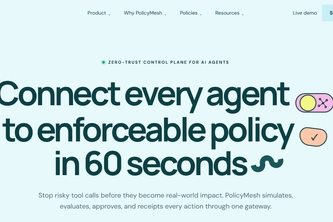
Tagline: ZERO-TRUST CONTROL PLANE FOR AI AGENTS
Self-reported basis: The description is entirely from the author's own submission to the OpenAI 2026 hackathon on Devpost. It is unverified and contains no evidence of revenue, customers, traction or operational data.
PolicyMesh is described as a control plane that checks AI agent actions before they execute, using GPT-5.6 for action interpretation and structured outputs, with JavaScript/Node.js backend and HTML/CSS frontend. The system enforces rules around spending limits, file access, service contact, and action repetition, with three possible outcomes: Allow, Review, or Block. It is built as a hackathon project with no evidence of commercial deployment or user adoption.
Key open question: Is there any evidence that this control plane has been tested in real-world AI agent workflows, or that it can be scaled beyond a hackathon prototype?
What The Product Actually Is
The description states that PolicyMesh is a control plane for AI agents, designed to check agent actions before execution. It is described as:
- A system that evaluates actions proposed by an AI agent.
- A system that enforces rules such as:
- Spending limits
- Approved recipients for payments
- File access restrictions
- Service contact limitations
- Action previews
- Emergency stop mechanisms
- Duplicate action blocking
- Signed decision records
It uses GPT-5.6 to interpret natural language requests into structured actions, and then applies predictable code-based checks to those actions.
The system returns one of three outcomes: Allow, Review, or Block.
Inference: The product is a rule engine with an AI-driven action parser, not a general-purpose AI agent itself. It is positioned as a guardrail for AI agents, not as an agent that performs tasks.
Positioning & Claim Evolution
The description states that PolicyMesh is a zero-trust control plane for AI agents. The author frames it as a solution to the problem of AI agents being too powerful without safeguards.
It is positioned as:
- A checkpoint between AI agents and real-world impact.
- A system that prevents misuse by limiting agent actions.
- A system that separates understanding (GPT) from execution (PolicyMesh).
The claim evolution shows a progression from:
- The problem: AI agents can act without control.
- The solution: PolicyMesh as a control layer.
- The mechanism: GPT-5.6 for interpretation, code-based checks for enforcement.
Inference: The positioning is that of a security or governance tool, not a core AI product. It is a middleware for AI agents, not an agent itself.
Target Customer & ICP
The description does not state who the target customer is or what their role is. It does not name specific industries, use cases, or personas.
It implies that the system is intended for:
- Organizations using AI agents.
- Developers or engineers who deploy AI agents in production.
- Entities that want to limit risk from AI agent actions.
The team size is listed as 1 member: "0xNexuz ekhosu".
Inference: The ICP is likely developers, engineering teams, or enterprises using AI agents and seeking governance or control. However, no explicit customer segment is defined.
Business Model & Pricing Evidence
There is no evidence in the description of a business model or pricing structure.
The project is described as a hackathon submission, with no mention of monetization, licensing, or SaaS offerings.
Inference: No commercial model is evident. The system appears to be a prototype, not a product for sale.
Technical & Delivery Signals
The description provides technical details:
- Built with:
- Backend: JavaScript, Node.js
- Frontend: HTML, CSS, browser JS
- Deployment: Vercel
- Source code: GitHub
- AI tools: GPT-5.6, OpenAI Responses API, Structured Outputs
- Cryptographic elements: ed25519, SHA-256
- Testing: Codex, test files
It is described as a safe demonstration mode for judges to test without real-world impact.
Inference: The technical stack is lightweight and hackathon-grade. It uses modern tools but lacks evidence of production-grade infrastructure or scalability.
Traction & Maturity Signals
The description states that this is a hackathon project, submitted to the OpenAI 2026 hackathon on Devpost.
There is no evidence of:
- Revenue
- Customers
- User adoption
- Product-market fit
- Iteration beyond the hackathon version
- Deployment in production environments
Inference: The system is at a pre-product, pre-commercial stage, likely a prototype or proof-of-concept.
Competitive Context
The description does not mention any competitors. It does not describe how PolicyMesh compares to other tools for AI agent governance or control.
It is positioned as a control plane for AI agents, which may overlap with:
- AI governance platforms
- Zero-trust security tools
- Agent orchestration systems
But no competitive analysis is provided.
Inference: No competitive context is evident. The project does not appear to be part of an existing market or ecosystem.
Open Questions & Risks
- No evidence of traction or adoption: It is a hackathon submission with no commercial use.
- Single-person team: No indication of team capacity for product development or scaling.
- Unverified claims: The system is described as using GPT-5.6, but no real-world testing or validation is shown.
- Prototype nature: The project is not described as a production-ready tool.
- No pricing or business model: No indication of monetization strategy.
Inference: The risk of commercial viability is high due to lack of evidence for product-market fit, traction, or scalability.
Questions the description leaves open
- What real-world use cases have you tested PolicyMesh with?
- How does the system handle edge cases or ambiguous instructions from agents?
- Have you validated the system with actual AI agents in a non-hackathon environment?
- What is your plan for scaling beyond a prototype?
- Are there any known limitations of GPT-5.6 in interpreting agent actions that affect PolicyMesh’s reliability?
- How do you intend to monetize or deploy this product commercially?
Overall Assessment
Not evidenced: The description provides no evidence of commercial traction, revenue, customers, or a clear path to market.
The system is described as a hackathon prototype, not a product in development or deployment. It lacks any indication of:
- Product-market fit
- Commercial viability
- Team capacity for execution
- Scalability
Inference: At this stage, there is no basis for investment or partnership consideration. The project appears to be an idea or proof-of-concept, not a commercial product.
User Stories BotA demo video on every pull request
Get a demo video on every new feature
GitHub App that watches your pull requests and records a narrated, captioned demo.
Save time on demo prep and make informed decisions faster with a video walkthrough of every new feature.
Source
Submitted to the OpenAI 2026 hackathon on Devpost. Project home on Devpost. Back to the full gallery on Devpost.
This competitive analysis was produced by top-founders.com (opens in a new tab)
Generated by a language model from this project's public Devpost page — its tagline, the author's own write-up and any built-with tags listed there — as captured in August 2026. Short quotations are the author's words. It is an opinion on the idea as a business, not on the people behind it, and it reflects the description as published then. If the project has moved on, request a correction below. The analysis is not independent research and contains no verified traction, revenue or customer data.
An independent guide by KFG International LLC — not affiliated with, endorsed by, or connected to Devpost or OpenAI.