

Archive position — measured, not model output
0 likes on Devpost
2,263 of the 7,850 archived projects have more likes, and 5,587 share exactly 0 — so this project's #6,639 place in the like-ranked listing is a tie-break inside that group, not a ranking.
Projects (log scale)
Likes on Devpost. ▲ marks this project's group.
Show the figures
| Likes | Projects | Share of archive |
|---|---|---|
| 0 | 5,587 | 71.2% |
| 1 | 1,758 | 22.4% |
| 2 | 284 | 3.6% |
| 3–4 | 132 | 1.7% |
| 5–9 | 75 | 1.0% |
| 10+ | 14 | 0.2% |
 User Stories BotA demo video on every pull request
Get a demo video on every new feature
GitHub App that watches your pull requests and records a narrated, captioned demo.
Save time on demo prep and make informed decisions faster with a video walkthrough of every new feature.
Executive Summary
Company: SHADOW C Operations Monitor
Self-reported basis: The project description supplied by the caller — its name, tagline, the author's own write-up and any technology tags. This analysis rests entirely on self-reported and unverified information.
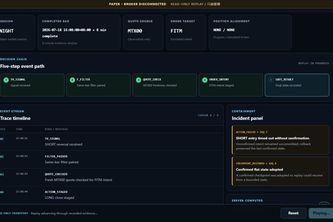
What it is: A read-only incident replay dashboard for stateful automation systems that processes deterministic scenarios involving partial failures, reversals, and restarts. It evaluates safety invariants and presents normalized evidence as a timeline.
What changed: The project was built as part of an OpenAI 2026 hackathon submission. It represents a focused technical prototype with no known commercial traction or customer base.
Single most important open question: Is there a real-world use case for this type of replay monitor in production systems, and if so, what is the market need that would justify further development?
What The Product Actually Is
The description states that SHADOW C Operations Monitor is:
- A read-only incident replay dashboard.
- Designed to handle three deterministic scenarios: Normal LONG to FLAT, Failed Reversal Contained, and Restart and Safe Retry.
- It loads strict bundled JSON evidence, normalizes the event lifecycle, and evaluates ten safety invariants on the server.
- Presents results as an operator-friendly timeline.
- Distinguishes between observed quote identity (MTX00) and simulated order target (FITM).
- Preserves completed eight-minute-bar evidence and separates TV_SIGNAL from F_FILTER evidence.
The product is described as a static dashboard, with no live or interactive functionality. It is built using openai tools, specifically Codex and GPT-5.6, and uses synthetic PAPER scenarios rather than real data.
Inference: The system appears to be a prototype for analyzing partial automation failures in stateful systems, likely within trading or similar domains where deterministic behavior and evidence-based decision-making are critical.
Positioning & Claim Evolution
The description states that the product is:
- Positioned as a read-only incident replay monitor.
- Aims to turn partial automation failures into verifiable evidence.
- Designed for operators who need to see what was requested, confirmed, unresolved, and which state is safe to adopt.
It claims to address a gap in how stateful automation fails: not as one clean error but through partial success and failure, where local intent differs from external state.
The author also states that the system preserves confirmed actions, leaves failed entries uncommitted, and exposes incidents rather than hiding them behind final values.
Inference: The positioning is rooted in operational trust, transparency, and evidence-based recovery — not a commercial product but a technical solution to a problem in automation failure analysis.
Target Customer & ICP
The description does not state who the target customer or ideal customer profile (ICP) is. It implies that the system is for operators working with stateful automation systems, particularly those in trading environments where deterministic behavior and evidence are important.
It also suggests a need for replay dashboards in partial failure scenarios, but does not name specific industries or roles.
Inference: The ICP likely includes operators, engineers, or developers working with stateful systems that require evidence-based recovery, such as trading platforms, financial services, or industrial control systems. However, no explicit customer segment is stated.
Business Model & Pricing Evidence
The description does not provide any information about a business model or pricing. It describes the system as a read-only dashboard, built for hackathon use, and does not require broker accounts, credentials, DLLs, or live data.
There is no mention of monetization, licensing, or customer acquisition strategies.
Inference: No business model or pricing evidence is provided. The project appears to be a prototype with no commercial intent described.
Technical & Delivery Signals
The description states:
- Built using openai tools (Codex and GPT-5.6).
- Isolated in the operations_monitor package.
- Contains strict fixture validation, normalized evidence models, server-side invariant evaluation, and a GET-only loopback server.
- Includes a static dashboard, an isolated Windows launcher, and three synthetic PAPER scenarios.
- Uses focused automated tests (28 total).
- Deliberately independent of existing trading runtime and proprietary broker DLL path.
- Requires no broker account, credentials, DLL, or external network connection.
- Has no code path that can submit an order.
Inference: The system is a technical prototype, built with AI-assisted development tools, and designed to be self-contained and read-only. It is not intended for production use or integration with live systems.
Traction & Maturity Signals
The description states that this was a Build Week hackathon submission and does not provide any evidence of:
- Revenue
- Customers
- Users
- Product adoption
- Market traction
It also does not mention any funding, team size beyond one person, or post-hackathon development.
Inference: No traction or maturity signals are evident. The project is a prototype, and there is no indication of commercial viability or product-market fit.
Competitive Context
The description does not provide information about:
- Competitors
- Market landscape
- Existing solutions in the space of incident replay, automation failure analysis, or evidence-based recovery systems
Inference: No competitive context is provided. The project appears to be a novel technical solution, but its place in the market is unknown.
Open Questions & Risks
The description states:
- The system is read-only and does not submit orders.
- It uses synthetic PAPER evidence, not live or private data.
- It is independent of existing systems, which may limit its applicability in real-world use cases.
Key risks include:
- Limited scope: Only handles three deterministic scenarios.
- Prototype nature: Not intended for production, no commercial traction.
- No integration capability: Deliberately isolated from live systems.
- Unproven market need: No evidence of demand or adoption beyond the hackathon.
Inference: The project is a technical experiment, not a product with commercial intent. It may be useful in niche scenarios but lacks scalability or market relevance without further development.
Questions the description leaves open
- What real-world automation systems are you targeting, and how do you know there's demand for this type of replay monitor?
- How would the system integrate with existing production environments if it were to be used beyond a prototype?
- Are there any plans to expand beyond the three deterministic scenarios?
- What is the expected lifecycle of this product, and what are the next steps in development?
- Is there any interest from potential customers or partners in using or investing in this solution?
Overall Assessment
The description states that SHADOW C Operations Monitor was built as part of a hackathon submission and is not intended for commercial use.
There is no evidence of revenue, customers, traction, or funding, nor any indication of a clear path to monetization or product-market fit.
Inference: The project is a technical prototype with no commercial viability at this stage. It may be of interest for research or development purposes, but not as an investment or partnership opportunity without further evidence of traction, market need, or scalability.
User Stories BotA demo video on every pull request
Get a demo video on every new feature
GitHub App that watches your pull requests and records a narrated, captioned demo.
Save time on demo prep and make informed decisions faster with a video walkthrough of every new feature.
Source
Submitted to the OpenAI 2026 hackathon on Devpost. Project home on Devpost. Back to the full gallery on Devpost.
This competitive analysis was produced by top-founders.com (opens in a new tab)
Generated by a language model from this project's public Devpost page — its tagline, the author's own write-up and any built-with tags listed there — as captured in August 2026. Short quotations are the author's words. It is an opinion on the idea as a business, not on the people behind it, and it reflects the description as published then. If the project has moved on, request a correction below. The analysis is not independent research and contains no verified traction, revenue or customer data.
An independent guide by KFG International LLC — not affiliated with, endorsed by, or connected to Devpost or OpenAI.