

Archive position — measured, not model output
0 likes on Devpost
2,263 of the 7,850 archived projects have more likes, and 5,587 share exactly 0 — so this project's #2,715 place in the like-ranked listing is a tie-break inside that group, not a ranking.
Projects (log scale)
Likes on Devpost. ▲ marks this project's group.
Show the figures
| Likes | Projects | Share of archive |
|---|---|---|
| 0 | 5,587 | 71.2% |
| 1 | 1,758 | 22.4% |
| 2 | 284 | 3.6% |
| 3–4 | 132 | 1.7% |
| 5–9 | 75 | 1.0% |
| 10+ | 14 | 0.2% |
 User Stories BotA demo video on every pull request
Get a demo video on every new feature
GitHub App that watches your pull requests and records a narrated, captioned demo.
Save time on demo prep and make informed decisions faster with a video walkthrough of every new feature.
Executive Summary
What the company appears to be: Argument X-Ray is an educational prototype designed to help learners inspect, contest, and take responsibility for AI-generated formal models—before coherence is mistaken for conceptual adequacy. It is built by a single education researcher and philosopher using GPT-5.6 and Codex, with no revenue or customer data evidenced.
What changed: The project began as an exploration of how generative AI reshapes learners' thinking during argument construction. It evolved into a tool that redesigns the point at which authority is granted in formal model generation, emphasizing learner accountability over AI autonomy.
The single most important open question: Does this prototype have sufficient educational utility or scalability to warrant further development beyond its current vertical slice?
This analysis is based entirely on the self-reported project description provided by the author. No third-party verification, traction data, revenue figures, or customer evidence are available.
What The Product Actually Is
The description states that Argument X-Ray is an educational prototype for auditing the transition from a qualitative argument to a formal relationship model.
It does not ask AI to become more authoritative; instead, it redesigns the point at which authority is granted. It invites learners to:
- inspect provisional suitability recommendations;
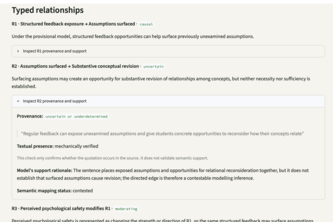
- examine concepts, variables, typed relationships, source spans, assumptions, compressions, and boundaries;
- distinguish mechanical quotation presence from semantic support;
- contest whether an argument should be formalized at all;
- accept, reject, or revise consequential modeling decisions;
- see those decisions produce a new, explicit model version rather than remain as cosmetic feedback;
- predict structural consequences of removing a relationship before the deterministic result is revealed;
- receive an evidence-bounded responsibility report.
The tool uses Python and Streamlit. It leverages Pydantic models for audit packages, learner decisions, model versions, semantic-role bindings, challenge evidence, and responsibility reports. A deterministic graph engine computes structural consequences independently of generated analysis.
This is a self-reported description of the product’s functionality. No independent verification or demonstration of actual use exists.
Positioning & Claim Evolution
The author positions Argument X-Ray as an educational tool that helps learners inspect, contest, and take responsibility for AI-generated formal models—before coherence is mistaken for conceptual adequacy.
It frames itself not as a general-purpose AI assistant but as a mechanism to prevent premature formalization, where the learner must make explicit judgments about when and how to apply formal reasoning. The author emphasizes that:
- A formal representation can be mathematically coherent, visually elegant, and still conceptually inadequate.
- Once embedded in a learner’s intellectual coordinate system, questioning it becomes harder than rejecting an answer.
- The tool does not infer general understanding or readiness for public use from confidence, fluency, verbosity, or agreement.
This positioning implies a focus on epistemic responsibility rather than output generation.
The claim evolution shows a shift from curiosity-driven exploration to a structured accountability mechanism. This is self-described and unverified.
Target Customer & ICP
The description states that the tool targets learners in educational settings, particularly those engaging with philosophical or social-scientific arguments.
It focuses on users who are exploring formal reasoning but need tools to assess whether such formalization is appropriate, and how to do it responsibly.
The current vertical slice uses one canonical educational-research argument about structured peer feedback, psychological safety, conceptual revision, and defensive compliance.
No explicit ICP or segment definition is given beyond the general category of learners in education. No evidence of specific user personas or market segmentation.
Business Model & Pricing Evidence
Not evidenced.
There is no mention of pricing, monetization strategy, or business model in the description. The project is described as a prototype built by one person for educational purposes.
Technical & Delivery Signals
The tool is built using:
- Python and Streamlit
- Codex (GPT-5.6) for implementation acceleration
- Pydantic models to define audit packages, learner decisions, model versions, semantic-role bindings, challenge evidence, and responsibility reports
- A deterministic graph engine that computes structural consequences independently of the generated analysis
- A repository-scoped Codex Skill that reads fixed arguments, intended use, educational contract, and shared schema, then exports a versioned JSON artifact through a deterministic local validator
Key technical features include:
- Separation of conceptual review from implementation;
- Strict import and provenance boundaries;
- Learner decisions with explicit model effects and versions;
- Deterministic graph verification;
- Evidence-bounded responsibility reports;
- Automated test suite covering central technical and epistemic boundaries.
These are self-reported technical details. No evidence of production deployment, scalability, or performance metrics.
Traction & Maturity Signals
Not evidenced.
There is no mention of users, customers, revenue, usage data, or product maturity beyond the prototype stage. The project was submitted to a hackathon and described as an MVP.
Competitive Context
Not evidenced.
No information about competitors or market positioning is provided in the description.
Open Questions & Risks
- Single-person development: The entire project is attributed to one individual (Mario JIN), raising questions about scalability, long-term maintenance, and team capacity.
- Prototype-only status: The tool is described as a vertical slice with limited coverage; no indication of broader applicability or generalization plans.
- No commercial viability: No evidence of monetization, pricing, or business model.
- Unverified claims: All descriptions are self-reported without external validation or demonstration.
- Limited scope: The current implementation focuses on one specific educational argument and does not generalize to other domains.
These risks stem from the lack of traction, scalability, and commercial evidence in the description.
Questions the description leaves open
- What are the key assumptions about learner behavior that underpin this tool?
- How do you plan to scale beyond a single vertical slice without losing the accountability mechanism?
- Is there any feedback from educators or learners who have tested this prototype?
- What would constitute success for this tool beyond its current prototype stage?
- Are there any plans to integrate with existing educational platforms or curricula?
These questions aim to probe the assumptions, scalability, and real-world applicability of the described product.
Overall Assessment
Not evidenced.
There is no indication of investment interest, partnership opportunities, or commercial intent beyond the prototype stage. The project is presented as a research and educational tool with no evidence of market traction or financial viability.
User Stories BotA demo video on every pull request
Get a demo video on every new feature
GitHub App that watches your pull requests and records a narrated, captioned demo.
Save time on demo prep and make informed decisions faster with a video walkthrough of every new feature.
Source
Submitted to the OpenAI 2026 hackathon on Devpost. Project home on Devpost. Back to the full gallery on Devpost.
This competitive analysis was produced by top-founders.com (opens in a new tab)
Generated by a language model from this project's public Devpost page — its tagline, the author's own write-up and any built-with tags listed there — as captured in August 2026. Short quotations are the author's words. It is an opinion on the idea as a business, not on the people behind it, and it reflects the description as published then. If the project has moved on, request a correction below. The analysis is not independent research and contains no verified traction, revenue or customer data.
An independent guide by KFG International LLC — not affiliated with, endorsed by, or connected to Devpost or OpenAI.