

Archive position — measured, not model output
0 likes on Devpost
2,263 of the 7,850 archived projects have more likes, and 5,587 share exactly 0 — so this project's #2,717 place in the like-ranked listing is a tie-break inside that group, not a ranking.
Projects (log scale)
Likes on Devpost. ▲ marks this project's group.
Show the figures
| Likes | Projects | Share of archive |
|---|---|---|
| 0 | 5,587 | 71.2% |
| 1 | 1,758 | 22.4% |
| 2 | 284 | 3.6% |
| 3–4 | 132 | 1.7% |
| 5–9 | 75 | 1.0% |
| 10+ | 14 | 0.2% |
 User Stories BotA demo video on every pull request
Get a demo video on every new feature
GitHub App that watches your pull requests and records a narrated, captioned demo.
Save time on demo prep and make informed decisions faster with a video walkthrough of every new feature.
Executive Summary
What the company appears to be
The project described as argus-k8s is a self-reported three-agent platform for Kubernetes security and resilience, built around the principles of early detection, containment, root-cause analysis, and verified recovery. It consists of three components: Argus (security threat detection and containment), Phoenix (chaos testing and error analysis), and Sentinel (operational command center and evidence layer). The author states this is a self-contained system designed to automate failure discovery and recovery in Kubernetes environments.
What changed
The project evolved from separate security and resilience components into a unified platform with cross-agent correlation, provenance-aware incidents, verified recovery, persistent history, human governance, and one-command demonstrations. It was extended during the OpenAI Build Week hackathon using Codex as an engineering partner.
Single most important open question — the commercial due-diligence read
Is there any evidence of real-world deployment or usage beyond the author’s own demonstration environments? The description makes no claims about revenue, customers, or adoption; all stated functionality is self-reported and unverified.
What The Product Actually Is
The description states that argus-k8s is a three-agent platform for Kubernetes security and resilience:
- Argus: Detects and contains Kubernetes security threats across admission, kernel/runtime, and network enforcement layers.
- Phoenix: Performs synthetic chaos testing, root-cause analysis, and verified recovery of service failures.
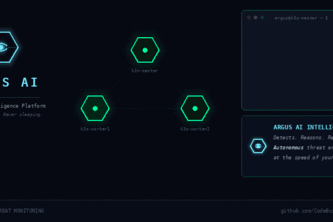
- Sentinel: Serves as an operational command center that connects Argus and Phoenix through a shared evidence layer called the Sentinel Operations Graph (SOG).
The system integrates with technologies such as Kyverno, Falco, Cilium, eBPF, Prometheus, Loki, Chaos Mesh, and k3s.
Inference: The platform appears to be built for Kubernetes environments, combining security monitoring and resilience testing into a single workflow. It is described as capable of running both in simulation mode (for demos) and live mode with real clusters.
Positioning & Claim Evolution
The author claims the system was inspired by their experience at IBM working on synthetic testing frameworks. They state that:
- Traditional systems only collect logs or generate alerts.
- Argus-k8s aims to detect threats early, contain them, and preserve evidence for decision-making.
- Phoenix takes a proactive approach, simulating failures before customers encounter them.
- Sentinel unifies the two agents into one operational layer with shared evidence and governance.
There is no indication of prior versions or evolution beyond this single project submission. The positioning appears to be centered on early intervention, automation, and evidence-based decision-making in Kubernetes environments.
Inference: The platform positions itself as a tool for Kubernetes security and resilience automation, with an emphasis on reducing manual debugging time and improving incident response through AI-assisted root-cause analysis and recovery.
Target Customer & ICP
The description does not clearly define target customers or ideal customer profiles (ICP). It implies use cases in Kubernetes environments where organizations need:
- Early detection of security threats
- Proactive resilience testing
- Automated root-cause analysis
- Verified recovery workflows
It is unclear whether the system targets enterprise users, DevOps teams, SREs, or security engineers directly.
Inference: Based on the technology stack and use case, potential customers may include cloud-native engineering teams, security operations centers (SOCs), and SREs managing Kubernetes clusters. However, no explicit customer segmentation is provided.
Business Model & Pricing Evidence
No information is given about pricing models, monetization strategies, or business models. The project is described as a hackathon submission with no mention of commercial viability or revenue streams.
Inference: There is no evidence of any business model or pricing structure. The system appears to be a prototype or proof-of-concept built for demonstration purposes.
Technical & Delivery Signals
The platform uses:
- Backend services built in Python and FastAPI
- Frontend dashboards using React, TypeScript, Vite
- Redis for shared operational state
- Kubernetes technologies including k3s, Kyverno, Falco, Cilium, eBPF, Prometheus, Loki, Chaos Mesh
It integrates with OpenAI models for reasoning and diagnosis but keeps execution under deterministic policy control.
The author states that Codex was used as an engineering partner during the OpenAI Build Week hackathon to accelerate development.
Inference: The technical stack suggests a cloud-native architecture, likely intended for Kubernetes-based deployments. The use of AI is limited to structured reasoning workflows rather than autonomous execution, with safety boundaries enforced by policy.
Traction & Maturity Signals
There is no evidence of traction, adoption, or user feedback beyond the author’s own description. No customers, users, or performance metrics are mentioned.
The project was submitted as a hackathon entry and has not been independently verified or deployed in production.
Inference: The system remains at the conceptual or prototype stage, with no demonstrated real-world usage or market traction.
Competitive Context
No mention of competitors or competitive positioning is provided. The author does not reference existing tools or platforms in the Kubernetes security and resilience space.
Inference: Without explicit comparison or awareness of similar offerings, it's unclear how this platform would differentiate from current solutions like Falco, Kyverno, Chaos Mesh, or other observability and incident response platforms.
Open Questions & Risks
- Unverified claims: All functionality is self-reported and unverified.
- No traction or revenue: No evidence of real-world deployment or customer base.
- Limited commercialization: The project appears to be a hackathon submission without any indication of monetization plans.
- AI dependency risks: Reliance on OpenAI models for reasoning introduces potential limitations in reliability, interpretability, and scalability.
- Demo-only focus: The system is described as working only in demo mode (portable or guarded live), with no indication of production readiness.
Questions the description leaves open
- What specific Kubernetes environments have you tested this on? Are there any real deployments?
- How does the platform handle false positives or misdiagnoses from AI models?
- Can you provide evidence of how the system would scale beyond a single-node k3s demo?
- Has the platform been tested in adversarial conditions or integrated with existing security tools?
- What is your plan for transitioning from a demo to a production-ready product?
Overall Assessment
There is no evidence of commercial viability, traction, or market demand beyond the author’s own description. The project is presented as a hackathon submission and lacks any indication of real-world usage, revenue, or customer engagement.
Assessment: Not suitable for investment or partnership at this time due to lack of demonstrated traction, business model, or product-market fit. Any future potential depends on whether the author can demonstrate real-world application and scalability beyond the current prototype.
User Stories BotA demo video on every pull request
Get a demo video on every new feature
GitHub App that watches your pull requests and records a narrated, captioned demo.
Save time on demo prep and make informed decisions faster with a video walkthrough of every new feature.
Source
Submitted to the OpenAI 2026 hackathon on Devpost. Project home on Devpost. Back to the full gallery on Devpost.
This competitive analysis was produced by top-founders.com (opens in a new tab)
Generated by a language model from this project's public Devpost page — its tagline, the author's own write-up and any built-with tags listed there — as captured in August 2026. Short quotations are the author's words. It is an opinion on the idea as a business, not on the people behind it, and it reflects the description as published then. If the project has moved on, request a correction below. The analysis is not independent research and contains no verified traction, revenue or customer data.
An independent guide by KFG International LLC — not affiliated with, endorsed by, or connected to Devpost or OpenAI.