

Archive position — measured, not model output
0 likes on Devpost
2,263 of the 7,850 archived projects have more likes, and 5,587 share exactly 0 — so this project's #4,680 place in the like-ranked listing is a tie-break inside that group, not a ranking.
Projects (log scale)
Likes on Devpost. ▲ marks this project's group.
Show the figures
| Likes | Projects | Share of archive |
|---|---|---|
| 0 | 5,587 | 71.2% |
| 1 | 1,758 | 22.4% |
| 2 | 284 | 3.6% |
| 3–4 | 132 | 1.7% |
| 5–9 | 75 | 1.0% |
| 10+ | 14 | 0.2% |
 User Stories BotA demo video on every pull request
Get a demo video on every new feature
GitHub App that watches your pull requests and records a narrated, captioned demo.
Save time on demo prep and make informed decisions faster with a video walkthrough of every new feature.
Executive Summary
What the company appears to be
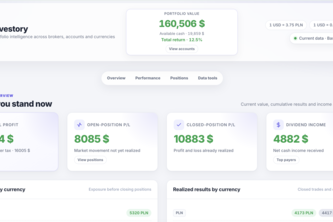
Investory is an AI-powered investment operating system that builds a trusted, immutable financial ledger from individual investor transactions across multiple brokers and currencies. It reconciles portfolio history using transactional data and historical market prices, then uses GPT-5.6 to explain performance in natural language.
What changed
The project is self-reported as a hackathon submission (OpenAI 2026) with no evidence of prior traction or commercial activity. The author describes a novel approach to portfolio reconciliation and AI-driven financial explanation, but there is no evidence of revenue, customers, or product adoption beyond the prototype.
Single most important open question
Is there any evidence of actual investor usage, data integration with real brokers, or performance validation that the reconciliation engine works reliably at scale?
Note: This analysis is based entirely on the self-reported description provided by the author. No external verification, archived data, or third-party sources are available.
What The Product Actually Is
The description states:
- Investory is an AI-powered investment operating system.
- It builds an immutable accounting ledger from trades, cash operations, dividends, fees, taxes, transfers, and historical market prices.
- It reconciles portfolio history by comparing calculated balances with broker-reported values.
- It uses GPT-5.6 to provide natural-language explanations of portfolio behavior.
- It supports Interactive Brokers and XTB.
- It handles multi-currency accounting and historical performance reconstruction.
Inference: The product appears to be a prototype or proof-of-concept, built for a hackathon, with no evidence of commercial deployment or production use.
Positioning & Claim Evolution
The description states:
- Most existing tools focus on visualization and assume imported data is correct.
- Investory assumes financial data is imperfect and must first be reconciled before analysis.
- It shifts the question from “What is my portfolio worth?” to “Can I trust these numbers, and why did they change?”
Inference: The positioning is that of a data-first, reconciliation-centric investment tool, with AI as an enabler for explanation rather than visualization.
Target Customer & ICP
The description states:
- Individual investors managing portfolios across multiple brokers, accounts, currencies, and asset classes.
- Investors who spend hours reconciling spreadsheets instead of understanding their investments.
- Users seeking to understand performance discrepancies between brokers and portfolio trackers.
Inference: The target is likely self-directed individual investors with complex multi-broker portfolios. No evidence of segmentation or specific buyer personas beyond this general description.
Business Model & Pricing Evidence
The description states:
- No pricing model, revenue streams, or monetization strategy are described.
- The project was built for a hackathon and has no commercial traction.
Not evidenced: There is no indication of how the product would be monetized or whether any business model exists beyond the prototype.
Technical & Delivery Signals
The description states:
- Built with chatgpt, codex, docker, java, javascript, postgresql.
- Architecture includes three independent layers: Accounting, Valuation, Reconciliation.
- Materialized views are used for fast dashboard queries without sacrificing accuracy.
- GPT-5.6 is used for portfolio analysis and natural-language explanations.
- Codex was used for architecture design, SQL optimization, debugging, and reconciliation logic.
Inference: The technical stack suggests a modern, scalable approach with AI integration. However, no evidence of production deployment or performance benchmarks.
Traction & Maturity Signals
The description states:
- This is a hackathon submission (OpenAI 2026).
- No revenue, customers, or adoption data are provided.
- The team size is listed as one person (Alex Kotik).
Not evidenced: There is no evidence of product-market fit, user feedback, or any form of traction beyond the prototype.
Competitive Context
The description states:
- Most existing tools focus on visualization and assume data is correct.
- Investory aims to differentiate by focusing on reconciliation and trustworthiness of financial data.
Inference: The competitive landscape includes traditional portfolio trackers and robo-advisors, but no specific competitors are named. No evidence of market analysis or differentiation strategy beyond the stated positioning.
Open Questions & Risks
- Unverified claims: The description makes strong claims about GPT-5.6 performance and reconciliation accuracy without evidence.
- Single-person team: Limited capacity for execution, scaling, or product development.
- No commercial traction: No revenue, customers, or adoption data.
- Unproven AI integration: While GPT-5.6 is mentioned, there’s no demonstration of how it adds value beyond basic natural language processing.
- Hackathon prototype: Likely not production-ready.
Questions the description leaves open
- What specific brokers have been integrated and tested? Are there any known issues with data accuracy?
- How does the reconciliation engine handle missing or inconsistent historical market prices?
- Can you demonstrate a sample of how GPT-5.6 explains portfolio performance in practice?
- Has the team validated the accuracy of the financial model with real-world investor data?
- What is the plan for scaling beyond one developer and a hackathon prototype?
Overall Assessment
Not evidenced: There is no evidence of commercial viability, traction, or market validation to support an investment or partnership decision.
The project is described as a hackathon submission with no revenue, customers, or product adoption. The technical architecture is detailed but unproven in real-world use. The AI integration is claimed but not demonstrated. The team size and lack of external validation raise concerns about execution capability.
Confidence: Low. This is a self-reported prototype with no independent verification or commercial evidence.
User Stories BotA demo video on every pull request
Get a demo video on every new feature
GitHub App that watches your pull requests and records a narrated, captioned demo.
Save time on demo prep and make informed decisions faster with a video walkthrough of every new feature.
Source
Submitted to the OpenAI 2026 hackathon on Devpost. Project home on Devpost. Back to the full gallery on Devpost.
This competitive analysis was produced by top-founders.com (opens in a new tab)
Generated by a language model from this project's public Devpost page — its tagline, the author's own write-up and any built-with tags listed there — as captured in August 2026. Short quotations are the author's words. It is an opinion on the idea as a business, not on the people behind it, and it reflects the description as published then. If the project has moved on, request a correction below. The analysis is not independent research and contains no verified traction, revenue or customer data.
An independent guide by KFG International LLC — not affiliated with, endorsed by, or connected to Devpost or OpenAI.