

Archive position — measured, not model output
0 likes on Devpost
2,263 of the 7,850 archived projects have more likes, and 5,587 share exactly 0 — so this project's #4,682 place in the like-ranked listing is a tie-break inside that group, not a ranking.
Projects (log scale)
Likes on Devpost. ▲ marks this project's group.
Show the figures
| Likes | Projects | Share of archive |
|---|---|---|
| 0 | 5,587 | 71.2% |
| 1 | 1,758 | 22.4% |
| 2 | 284 | 3.6% |
| 3–4 | 132 | 1.7% |
| 5–9 | 75 | 1.0% |
| 10+ | 14 | 0.2% |
 User Stories BotA demo video on every pull request
Get a demo video on every new feature
GitHub App that watches your pull requests and records a narrated, captioned demo.
Save time on demo prep and make informed decisions faster with a video walkthrough of every new feature.
Executive Summary
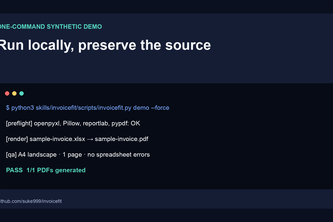
What the company appears to be: InvoiceFit is a self-reported tool that converts Excel invoice spreadsheets into print-ready A4 PDFs using GPT-5.6 in Codex as an orchestration layer and Python/LibreOffice for deterministic rendering. It claims to protect identifiers, validate page dimensions, detect errors, and produce auditable QA reports with SHA-256 hashes.
What changed: The project evolved from a pre-existing local utility into a standalone plugin during OpenAI Build Week, incorporating Codex orchestration, privacy boundaries, QA manifests, artifact hashing, and public documentation.
Single most important open question: Is there any evidence of actual usage or adoption beyond the synthetic demo and self-reported development?
What The Product Actually Is
The description states that InvoiceFit converts folders of Excel invoices into readable, print-ready A4 PDFs without modifying source workbooks. It uses GPT-5.6 in Codex for orchestration and explanation, and Python/LibreOffice for rendering and validation.
It claims to:
- Protect identifiers from clipping
- Repeat worksheet headers
- Validate A4 page dimensions
- Detect obvious spreadsheet error markers
- Refuse overwrites by default
- Create JSON and Markdown QA reports with SHA-256 hashes
The tool is described as a plugin built for Codex, with a synthetic demo workbook and automated tests.
Evidence: Self-reported. No independent verification of functionality or output quality.
Positioning & Claim Evolution
InvoiceFit positions itself as a privacy-first solution for converting Excel invoices to PDFs, emphasizing safety, repeatability, and auditability. It claims to solve the "last mile" problem where spreadsheets look correct on screen but fail in print due to formatting issues like clipped identifiers or incorrectly formatted dates.
The project evolved from an existing local utility into a plugin during Build Week, incorporating:
- Codex orchestration skill
- Privacy boundaries for output
- Dependency preflight checks
- QA manifests and artifact hashing
- Synthetic demo and tests
Inference: The evolution suggests the tool was initially a personal productivity utility that became more structured and public-facing.
Target Customer & ICP
The description does not state who the target customer is. It implies use by individuals or teams managing invoice spreadsheets, but no explicit ICP (Ideal Customer Profile) is defined.
Evidence: Not evidenced.
Business Model & Pricing Evidence
There is no evidence of a business model or pricing structure in the description. The tool is presented as an open-source plugin with a demo and synthetic workbook.
Evidence: Not evidenced.
Technical & Delivery Signals
InvoiceFit uses:
- GPT-5.6 in Codex for orchestration
- Python and LibreOffice for rendering and validation
- OpenPyXL, PyMuPDF, and other libraries for processing
- A plugin architecture built for Codex
- Deterministic document processing with QA reports and SHA-256 hashes
It includes:
- Preflight checks
- Automated tests
- Synthetic demo workbook
- Artifact manifests
- Failure explanation via GPT-5.6
Evidence: Self-reported. No evidence of production deployment or user feedback.
Traction & Maturity Signals
The description states that the tool was developed during OpenAI Build Week and began as a pre-existing local utility. It includes:
- A synthetic demo
- Automated tests
- Public documentation
- Artifact manifests and hashes
However, there is no evidence of:
- Revenue or customers
- Adoption beyond the demo
- Production usage
- User feedback or iteration history
Evidence: Not evidenced.
Competitive Context
The description does not mention competitors. It focuses on solving a specific problem—invoice formatting for print—with a unique approach combining GPT orchestration and deterministic rendering.
Evidence: Not evidenced.
Open Questions & Risks
- No traction or adoption evidence: The tool is described only as a demo and synthetic utility.
- Self-reported maturity: No third-party validation of functionality or reliability.
- Unclear commercial viability: No pricing, business model, or monetization strategy.
- Limited scope: The tool appears to be a niche solution for invoice formatting, not a broad platform.
Inference: The lack of real-world usage or feedback suggests the project may be in early development or conceptual stages.
Questions the description leaves open
- What is the actual use case for this tool beyond the synthetic demo?
- Has it been tested with real-world invoice data?
- Are there any users or customers currently using it?
- How does it handle edge cases in invoice formats (e.g., non-English headers, complex layouts)?
- Is there a plan to monetize or scale this tool?
- What are the limitations of the current deterministic rendering approach?
Overall Assessment
The description presents InvoiceFit as a proof-of-concept tool developed during a hackathon, with no evidence of traction, revenue, or commercial adoption. It is described as a plugin for Codex that converts Excel to PDFs with safety and auditability features.
Confidence: Low. The project appears to be in early development, with no verified users or business model.
Assessment: Not ready for investment or partnership without further evidence of traction, user feedback, or commercial viability.
User Stories BotA demo video on every pull request
Get a demo video on every new feature
GitHub App that watches your pull requests and records a narrated, captioned demo.
Save time on demo prep and make informed decisions faster with a video walkthrough of every new feature.
Source
Submitted to the OpenAI 2026 hackathon on Devpost. Project home on Devpost. Back to the full gallery on Devpost.
This competitive analysis was produced by top-founders.com (opens in a new tab)
Generated by a language model from this project's public Devpost page — its tagline, the author's own write-up and any built-with tags listed there — as captured in August 2026. Short quotations are the author's words. It is an opinion on the idea as a business, not on the people behind it, and it reflects the description as published then. If the project has moved on, request a correction below. The analysis is not independent research and contains no verified traction, revenue or customer data.
An independent guide by KFG International LLC — not affiliated with, endorsed by, or connected to Devpost or OpenAI.