

Archive position — measured, not model output
1 like on Devpost
505 of the 7,850 archived projects have more likes, and 1,758 share exactly 1 — so this project's #758 place in the like-ranked listing is a tie-break inside that group, not a ranking.
Projects (log scale)
Likes on Devpost. ▲ marks this project's group.
Show the figures
| Likes | Projects | Share of archive |
|---|---|---|
| 0 | 5,587 | 71.2% |
| 1 | 1,758 | 22.4% |
| 2 | 284 | 3.6% |
| 3–4 | 132 | 1.7% |
| 5–9 | 75 | 1.0% |
| 10+ | 14 | 0.2% |
 User Stories BotA demo video on every pull request
Get a demo video on every new feature
GitHub App that watches your pull requests and records a narrated, captioned demo.
Save time on demo prep and make informed decisions faster with a video walkthrough of every new feature.
Executive Summary
What the company appears to be
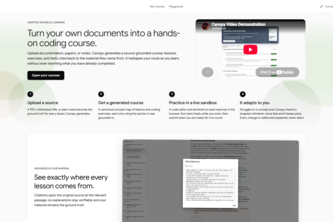
Canopy is a self-reported learning platform that aims to combine large language models (LLMs) with principles from learning science. The product allows users to upload technical material such as research papers or documentation, then generates a structured, hands-on course tailored to their learning goals. It emphasizes active learning through retrieval practice, worked examples, and coding labs, tracking both understanding and application of concepts.
What changed
The description indicates that the project was developed by two individuals (Javier Huang and Ethan Qiu) as part of an OpenAI 2026 hackathon submission. It is presented as a prototype or early-stage product with features like course generation from uploaded sources, AI-assisted learning loops, and mastery tracking based on quiz and lab performance.
Single most important open question
Is there evidence that Canopy’s approach to combining LLMs with learning science actually improves learning outcomes compared to traditional methods or other tools? The description does not provide any data or user feedback on effectiveness.
What The Product Actually Is
The description states that Canopy is a platform designed to turn technical material into structured, hands-on courses using AI. It includes:
- Upload of various formats (PDFs, Markdown, plain text, pasted notes)
- Generation of modules, lessons, quizzes, and coding labs
- Use of LLMs (specifically GPT-5.6) for planning, content creation, and lab verification
- Integration with tools like Supabase, Docker, FastAPI, Next.js, and Monaco Editor
- A five-service architecture including a web app, API, ingestion worker, LLM gateway, and sandbox runner
It is described as not just an AI-generated course but a system that tracks what learners can actually do — distinguishing between understanding and application.
Evidence
- The description explicitly states these features.
- It describes how the platform works in stages: upload → ingest → plan → generate → verify.
- It mentions specific technologies used, such as GPT-5.6, Supabase, PostgreSQL, PyTorch, React, etc.
Inference That Canopy is built around a learning loop involving explanation, practice, feedback, and mastery tracking — though this is inferred from the narrative rather than directly stated.
Positioning & Claim Evolution
The authors claim that current LLMs are helpful but not effective for deep learning because they give answers quickly without verifying whether users have truly mastered concepts. They position Canopy as an alternative that uses AI to support structured, active learning grounded in learning science principles.
Key claims include:
- LLMs help with knowledge access but do not track mastery.
- Canopy turns any source into a personalized course.
- It supports active learning via retrieval practice and hands-on labs.
- Mastery is tracked separately for understanding vs. application.
- The system uses Bayesian Knowledge Tracing (BKT) to estimate mastery.
Evidence
- These are all claims made by the authors in their own write-up.
- No external validation or prior research cited to support these assertions.
Inference That Canopy positions itself as a tool for self-directed learning that bridges the gap between LLM assistance and real skill acquisition — but this is not proven by the description alone.
Target Customer & ICP
The description implies that Canopy targets technical learners who want to understand complex material such as research papers, documentation, or textbooks. These users are likely students, developers, or professionals seeking mastery in fields like computer science, machine learning, or software engineering.
It also suggests that the platform supports different learning goals — from basic comprehension to practical implementation — allowing flexibility for various skill levels and objectives.
Evidence
- The inspiration section mentions using LLMs for learning technical subjects.
- The write-up refers to learners needing to "implement concepts," "run their code," and "debug mistakes."
- Features like coding labs, prerequisite tracking, and mastery dashboards suggest a focus on hands-on learners.
Inference That the target audience is primarily self-directed learners in STEM disciplines — but no explicit segmentation or persona data is provided.
Business Model & Pricing Evidence
There is no mention of pricing, monetization strategy, or business model within the description. The authors do not state whether Canopy will be free, subscription-based, enterprise-focused, or otherwise.
Evidence
- No financial details, revenue streams, or pricing models are included.
- The project is described as a hackathon submission with no indication of commercial intent beyond its conceptual framework.
Inference That the business model remains undefined — likely because it's early-stage and not yet developed.
Technical & Delivery Signals
Canopy is built using a multi-service architecture involving:
- Next.js for frontend
- FastAPI for backend services
- Supabase for authentication, storage, and vector search
- Docker containers for isolation
- GPT-5.6 as the primary LLM engine
- A sandboxed environment for executing code labs
It uses a staged pipeline where planning happens once per course, while content generation occurs at scale across modules.
Evidence
- The write-up lists specific technologies used.
- It describes how tasks are routed to different model tiers (Sol vs. Luna).
- Mentions of ingestion, indexing, and lab verification steps suggest technical sophistication.
Inference That the platform is technically advanced for a hackathon project — but again, no real-world usage or performance data is shared.
Traction & Maturity Signals
There is no evidence of traction, customers, users, or adoption in the description. The authors describe it as a prototype built for a hackathon and do not reference any live users, beta programs, or market validation.
Evidence
- No mention of revenue, ARR, headcount, or customer base.
- The project is explicitly labeled as a hackathon submission.
- No data on usage, retention, or engagement metrics.
Inference That the product has not yet reached a stage where traction can be measured — it remains an experimental idea.
Competitive Context
The description does not name competitors or describe how Canopy compares to existing platforms like Coursera, Udemy, Khan Academy, or even AI-powered learning tools such as Duolingo or Anki. It focuses on its unique positioning rather than market analysis.
Evidence
- No competitor names or direct comparisons are mentioned.
- The authors frame their solution as distinct from general-purpose LLMs and traditional e-learning platforms.
Inference That Canopy is positioned to compete in the space of AI-enhanced learning, but without knowing what exists in the market, it's unclear how it differentiates itself.
Open Questions & Risks
Several potential risks or open questions are present based on the description:
- Unproven Learning Effectiveness: The core premise — that combining LLMs with learning science improves outcomes — is not backed by evidence.
- High Technical Complexity Without Real-World Testing: While the architecture seems sophisticated, there's no indication of real-world testing or user feedback.
- Unclear Commercial Viability: No business model or monetization strategy is described.
- Dependency on LLMs: Reliance on GPT-5.6 and similar models introduces risk related to availability, cost, and control.
- Limited Scope for Scalability: The current design appears tailored for individual use cases rather than scalable enterprise or institutional deployment.
Evidence
- None of the above points are explicitly stated in the description — they are inferred from the lack of supporting data and the speculative nature of the claims.
Questions the description leaves open
- What evidence do you have that your approach to learning science improves outcomes over traditional methods?
- How do you plan to validate the effectiveness of Canopy’s mastery tracking system?
- Have you tested Canopy with real users or in educational settings?
- Is there a clear path from prototype to product, including monetization and scaling?
- What are your plans for integrating spaced review, adaptive remediation, or broader transfer checks?
- How do you intend to manage costs associated with LLM usage and compute resources?
- Are there any partnerships or institutional relationships that could accelerate adoption?
Overall Assessment
Not evidenced
The description provides no information about financials, traction, team experience, or strategic fit for investment or partnership. It is a self-reported prototype submitted to a hackathon with no indication of commercial readiness or market validation.
This is not a product ready for due diligence — it is an idea in early development stage, lacking any measurable impact or business momentum.
Confidence Level Very Low
Reasoning
The entire analysis is based on unverified self-reporting. No third-party data, user feedback, or performance metrics are available to assess viability or potential.
User Stories BotA demo video on every pull request
Get a demo video on every new feature
GitHub App that watches your pull requests and records a narrated, captioned demo.
Save time on demo prep and make informed decisions faster with a video walkthrough of every new feature.
Source
Submitted to the OpenAI 2026 hackathon on Devpost. Project home on Devpost. Back to the full gallery on Devpost.
This competitive analysis was produced by top-founders.com (opens in a new tab)
Generated by a language model from this project's public Devpost page — its tagline, the author's own write-up and any built-with tags listed there — as captured in August 2026. Short quotations are the author's words. It is an opinion on the idea as a business, not on the people behind it, and it reflects the description as published then. If the project has moved on, request a correction below. The analysis is not independent research and contains no verified traction, revenue or customer data.
An independent guide by KFG International LLC — not affiliated with, endorsed by, or connected to Devpost or OpenAI.