

Archive position — measured, not model output
0 likes on Devpost
2,263 of the 7,850 archived projects have more likes, and 5,587 share exactly 0 — so this project's #6,641 place in the like-ranked listing is a tie-break inside that group, not a ranking.
Projects (log scale)
Likes on Devpost. ▲ marks this project's group.
Show the figures
| Likes | Projects | Share of archive |
|---|---|---|
| 0 | 5,587 | 71.2% |
| 1 | 1,758 | 22.4% |
| 2 | 284 | 3.6% |
| 3–4 | 132 | 1.7% |
| 5–9 | 75 | 1.0% |
| 10+ | 14 | 0.2% |
 User Stories BotA demo video on every pull request
Get a demo video on every new feature
GitHub App that watches your pull requests and records a narrated, captioned demo.
Save time on demo prep and make informed decisions faster with a video walkthrough of every new feature.
Executive Summary
What the company appears to be
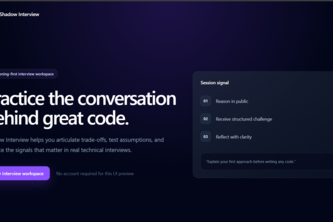
Shadow Interview is a self-reported Chrome extension that adds an AI-powered interview layer to LeetCode practice. The author states it aims to simulate real technical interviews by capturing spoken reasoning and code changes, offering Socratic follow-ups, and generating a final growth report.
What changed
The project was submitted as part of the OpenAI 2026 hackathon. It is described as a proof-of-concept built in a short timeframe (a hackathon), with no evidence of prior traction or commercial deployment.
Single most important open question
Is there any evidence that Shadow Interview has been used by real users beyond the author’s own practice, or that it has generated any measurable improvement in interview readiness?
What The Product Actually Is
The description states that Shadow Interview is a Chrome extension that runs on LeetCode problem pages. It includes:
- A floating launcher that injects into LeetCode
- Voice transcription (via browser speech recognition and Groq Whisper)
- Code snapshot capture with debounce
- AI-powered interviewer responses using OpenAI GPT-5.6, with fallback to Groq or mock mode
- A React-based evaluation dashboard showing interview score, timeline replay, and personalized roadmap
It is described as an interview engine built with FastAPI, not a CRUD API.
Inference The product appears to be a technical interview simulation tool, designed for solo LeetCode users aiming to improve their interview performance. It is not a marketplace or platform for hiring or training.
Positioning & Claim Evolution
The author states that Shadow Interview was inspired by the gap between solving a problem and communicating like an interview-ready engineer.
Claims
- It turns LeetCode practice into a realistic technical interview.
- It evaluates reasoning, uncertainty handling, and trade-off awareness.
- It provides feedback on interview readiness and growth.
Inference The positioning is that of a self-improvement tool for software engineers preparing for technical interviews, not a product for hiring managers or training platforms. The author frames it as a way to bridge the gap between problem-solving and communication in interviews.
Target Customer & ICP
The description states that Shadow Interview is built for LeetCode users — specifically, those practicing for technical interviews.
Inference The target customer is likely software engineers or job seekers preparing for technical interviews, particularly those using LeetCode as a practice platform. The ICP appears to be individuals focused on solo self-study and interview readiness.
Business Model & Pricing Evidence
There is no evidence in the description of any business model, pricing, monetization strategy, or customer acquisition plan.
Not evidenced
Technical & Delivery Signals
The project is built with:
- Frontend: Chrome Extension (Manifest V3), HTML, CSS, JavaScript, React, TailwindCSS, React Router, Vite
- Backend: FastAPI
- AI Infrastructure: OpenAI GPT-5.6, Groq, Groq Whisper, local mock fallback
- Delivery: Deployed via Render
Inference The technical stack suggests a lightweight, developer-focused tool, built for rapid prototyping and demonstration. The use of browser APIs and AI providers indicates an intent to be accessible without requiring backend infrastructure from the user.
Traction & Maturity Signals
There is no evidence of revenue, customers, or adoption beyond the author’s own use case.
Not evidenced
Competitive Context
The description does not mention any competitors. It is unclear whether similar tools exist in the market for technical interview practice or simulation.
Not evidenced
Open Questions & Risks
- No evidence of real-world usage or adoption
- Self-reported only: No third-party validation, customer data, or performance metrics
- Limited scope: Built as a hackathon project with no indication of scalability or long-term development plans
- AI dependency: Relies on external providers (OpenAI, Groq) that may not be reliable or cost-effective at scale
- Lack of commercialization strategy: No mention of monetization, pricing, or go-to-market approach
Questions the description leaves open
- Has Shadow Interview been used by anyone beyond the author?
- What is the current level of accuracy and reliability in voice transcription and reasoning analysis?
- Are there any plans to expand beyond LeetCode or support other platforms?
- How does the tool differentiate itself from existing interview prep resources (e.g., Pramp, Interviewing.io)?
- Is there a plan for monetization or commercial deployment?
Overall Assessment
Not evidenced
The project is described as a hackathon submission with no evidence of traction, revenue, or customer base. It is not clear whether it has moved beyond the prototype stage or has any commercial viability.
Given the self-reported nature of all information and lack of external validation, this is a highly speculative opportunity with no demonstrated commercial potential at this time.
User Stories BotA demo video on every pull request
Get a demo video on every new feature
GitHub App that watches your pull requests and records a narrated, captioned demo.
Save time on demo prep and make informed decisions faster with a video walkthrough of every new feature.
Source
Submitted to the OpenAI 2026 hackathon on Devpost. Project home on Devpost. Back to the full gallery on Devpost.
This competitive analysis was produced by top-founders.com (opens in a new tab)
Generated by a language model from this project's public Devpost page — its tagline, the author's own write-up and any built-with tags listed there — as captured in August 2026. Short quotations are the author's words. It is an opinion on the idea as a business, not on the people behind it, and it reflects the description as published then. If the project has moved on, request a correction below. The analysis is not independent research and contains no verified traction, revenue or customer data.
An independent guide by KFG International LLC — not affiliated with, endorsed by, or connected to Devpost or OpenAI.