

Archive position — measured, not model output
0 likes on Devpost
2,263 of the 7,850 archived projects have more likes, and 5,587 share exactly 0 — so this project's #6,640 place in the like-ranked listing is a tie-break inside that group, not a ranking.
Projects (log scale)
Likes on Devpost. ▲ marks this project's group.
Show the figures
| Likes | Projects | Share of archive |
|---|---|---|
| 0 | 5,587 | 71.2% |
| 1 | 1,758 | 22.4% |
| 2 | 284 | 3.6% |
| 3–4 | 132 | 1.7% |
| 5–9 | 75 | 1.0% |
| 10+ | 14 | 0.2% |
 User Stories BotA demo video on every pull request
Get a demo video on every new feature
GitHub App that watches your pull requests and records a narrated, captioned demo.
Save time on demo prep and make informed decisions faster with a video walkthrough of every new feature.
Executive Summary
What the company appears to be
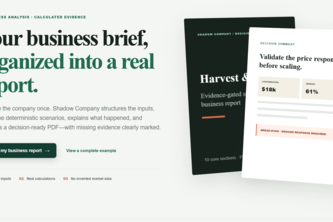
Shadow Comp is a self-reported business decision support tool that turns a business idea into an editable, evidence-based report. The description states it compares choices like pricing, hiring, and growth plans, then shows their operational impact on revenue, costs, churn, and runway. It generates downloadable PDFs and CSVs.
What changed
This is a hackathon submission with no demonstrated traction or commercial activity. The author describes building a simulation engine and AI-assisted business planning tool, but there's no evidence of revenue, customers, or product-market fit beyond the project itself.
Single most important open question
Is there any evidence that founders have actually used this tool to make real business decisions, or that it has been tested with actual users?
What The Product Actually Is
The description states Shadow Comp:
- Turns a business brief into an editable, evidence-based business decision report
- Helps compare choices such as pricing, usage limits, and hiring plans
- Shows possible impact on revenue, costs, churn, support workload, infrastructure pressure, and runway
- Generates downloadable PDF reports and model-data CSVs
- Uses TypeScript, a web dashboard, and a deterministic simulation engine
- Incorporates AI (Codex, GPT) for organizing briefs, identifying missing assumptions, research context, and explaining results
- Separates AI content from verified results through a calculation engine
Not evidenced: The actual functionality of the tool beyond its self-description, whether it's a working prototype or a proof-of-concept, or if any of these features are implemented.
Positioning & Claim Evolution
The description states:
- Shadow Comp was inspired by "letting teams rehearse their company’s future before making real-world decisions"
- It helps users compare business choices and see operational impacts
- The tool is positioned as more than generic AI advice, offering clear view of what is assumed, researched, or calculated
- It aims to be a "business decision platform" with smarter simulations, richer models, and better forecasting
Inferred: The positioning suggests it targets founders, startups, and decision-makers who need structured planning tools. However, no evidence shows how this differs from existing business planning frameworks or AI tools.
Target Customer & ICP
The description states:
- Targets founders, startups, and decision-makers
- Helps with major pricing, hiring, and growth decisions
- Aims to support "more business types" in the future
Not evidenced: No specific customer segments, personas, or use cases beyond general references to founders and startups. No evidence of target market research or user interviews.
Business Model & Pricing Evidence
The description states:
- The tool generates editable reports with PDF and CSV exports
- It is described as a business decision platform for planning and forecasting
- No pricing information or monetization strategy is mentioned
Inferred: If this becomes a commercial product, it would likely be SaaS-based, but there's no evidence of any pricing model, subscription tiers, or monetization approach.
Technical & Delivery Signals
The description states:
- Built with TypeScript, web dashboard, and deterministic simulation engine
- Uses Codex, GPT, CSS, HTML, Node.js, OpenAI, PDF.js, Railway, REST API, Supabase, Vitest
- Features include editable report inputs, industry KPI models, scenario comparisons, sourced research, report-confidence checks, PDF generation with PDFKit, and automated tests
- Challenges included PDF generation, incorrect values from mixed data sources, and unreliable features during development
Inferred: The technical stack suggests a web-based SaaS product with AI integration. However, no evidence of production deployment or scalability.
Traction & Maturity Signals
The description states:
- This is a hackathon submission (OpenAI 2026)
- Built by one person (Muhsin Abdul Kader)
- No revenue, customers, or adoption data are provided
- The team size is listed as 1
Not evidenced: No evidence of traction, user feedback, or product-market fit. The project appears to be a prototype or proof-of-concept.
Competitive Context
The description states:
- It aims to help with business decisions and forecasts
- It separates AI content from verified calculations
- It is positioned as more than generic AI advice
Not evidenced: No mention of competitors, market analysis, or competitive differentiation. The author does not reference existing tools in this space.
Open Questions & Risks
- The project is a hackathon submission with no commercial traction
- Only one team member (Muhsin Abdul Kader) is listed
- No evidence of revenue, customers, or product-market fit
- The tool is described as a prototype or proof-of-concept, not a production-ready solution
- AI integration is described but not demonstrated in functionality
- No clear business model or monetization strategy
Inferred: The lack of any commercial activity or user testing raises questions about viability and scalability.
Questions the description leaves open
- What specific business decisions have you used this tool to make?
- Have you tested the tool with actual users or potential customers?
- How do you plan to monetize this product if it becomes a commercial offering?
- What is your roadmap for scaling beyond the current prototype?
- How do you ensure accuracy of AI-generated content vs. deterministic calculations?
- What are the key assumptions in your simulation engine, and how are they validated?
Overall Assessment
The description states this is a hackathon submission with no commercial activity or traction. The author describes building a prototype but provides no evidence of revenue, customers, or product-market fit.
Assessment Not ready for investment or partnership consideration at this stage. This appears to be an early-stage idea or proof-of-concept with no demonstrated commercial viability or traction. The tool is described as a business decision platform, but there's no evidence of real-world usage or impact.
User Stories BotA demo video on every pull request
Get a demo video on every new feature
GitHub App that watches your pull requests and records a narrated, captioned demo.
Save time on demo prep and make informed decisions faster with a video walkthrough of every new feature.
Source
Submitted to the OpenAI 2026 hackathon on Devpost. Project home on Devpost. Back to the full gallery on Devpost.
This competitive analysis was produced by top-founders.com (opens in a new tab)
Generated by a language model from this project's public Devpost page — its tagline, the author's own write-up and any built-with tags listed there — as captured in August 2026. Short quotations are the author's words. It is an opinion on the idea as a business, not on the people behind it, and it reflects the description as published then. If the project has moved on, request a correction below. The analysis is not independent research and contains no verified traction, revenue or customer data.
An independent guide by KFG International LLC — not affiliated with, endorsed by, or connected to Devpost or OpenAI.