

Archive position — measured, not model output
1 like on Devpost
505 of the 7,850 archived projects have more likes, and 1,758 share exactly 1 — so this project's #753 place in the like-ranked listing is a tie-break inside that group, not a ranking.
Projects (log scale)
Likes on Devpost. ▲ marks this project's group.
Show the figures
| Likes | Projects | Share of archive |
|---|---|---|
| 0 | 5,587 | 71.2% |
| 1 | 1,758 | 22.4% |
| 2 | 284 | 3.6% |
| 3–4 | 132 | 1.7% |
| 5–9 | 75 | 1.0% |
| 10+ | 14 | 0.2% |
 User Stories BotA demo video on every pull request
Get a demo video on every new feature
GitHub App that watches your pull requests and records a narrated, captioned demo.
Save time on demo prep and make informed decisions faster with a video walkthrough of every new feature.
Executive Summary
Project: Campus Booth
Self-reported basis only — no independent verification of claims, traction, revenue, customers, or funding.
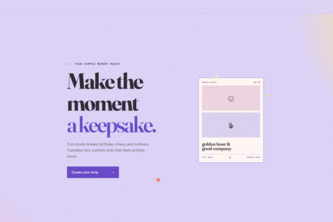
Commercial due-diligence read: The project appears to be a privacy-first, offline-first photo-strip maker for students and youth, built as a hackathon submission with no evidence of commercial traction or monetisation. The author states it is designed for campus events and everyday hangouts, but does not describe any actual users, revenue model, or customer acquisition strategy.
Single most important open question: Is there any evidence that this product has been used by students or youth beyond the developer's own testing?
What The Product Actually Is
The description states:
- Campus Booth is a photo booth app for students and youth.
- It enables users to capture or upload two photos, choose a campus-inspired theme and occasion, customise the strip with title, date, frames, stickers, and select or write a mood-matched caption.
- The final output is a shareable PNG that can be saved, printed, or shared on social media.
- All photos remain in the user’s browser — no sign-in, cloud storage, tracking, or paid API calls are required.
- It uses HTML, CSS, JavaScript, and a lightweight Node.js server.
- The app supports camera capture via MediaDevices API, photo uploads, and Canvas-based export as PNG.
Inference: The product is a browser-based tool for creating photo strips with minimal technical or privacy overhead. It is not described as a SaaS platform, nor does it appear to have any online infrastructure beyond local execution.
Positioning & Claim Evolution
The description states:
- Campus Booth is positioned as a privacy-first, offline-first photo-strip maker.
- It targets students and youth, focusing on campus events, study sessions, birthdays, and everyday hangouts.
- The app aims to be simple, fun, and accessible without requiring accounts or expensive tools.
- It is described as a “keepsake” tool for small moments in campus life.
Inference: The positioning is rooted in privacy, simplicity, and nostalgia, with an emphasis on campus-specific use cases. There is no indication of broader market expansion or branding beyond the student/youth demographic.
Target Customer & ICP
The description states:
- The app targets students and youth.
- It is designed for campus events, study sessions, birthdays, and everyday hangouts.
Inference: The primary customer segment appears to be young people aged 16–25, with a focus on campus-based social activities. No further segmentation or persona details are provided.
Business Model & Pricing Evidence
The description states:
- No sign-in, cloud storage, tracking, or paid API calls are required.
- All features are free to run and private by design.
- The app can be run locally with Node.js and a modern browser.
- Future optional features (e.g., AI caption enhancement) would remain optional and privacy-preserving.
Inference: There is no evidence of a monetisation strategy or pricing model. The app appears to be free-to-use, and any future paid features are described as optional and not part of the core offering.
Technical & Delivery Signals
The description states:
- Built with HTML, CSS, JavaScript, and a lightweight Node.js server.
- Uses MediaDevices API for camera capture, supports photo uploads.
- Uses Canvas API to compose and export final strips as PNG.
- Caption suggestions are generated locally from templates.
- AI assistance was used via Codex with GPT-5.6 during development.
Inference: The technical stack is minimal and self-contained, suggesting a lightweight, local-first approach. The use of AI for planning and development does not imply any AI-driven user-facing features in the final product.
Traction & Maturity Signals
The description states:
- This is a hackathon submission (OpenAI 2026).
- It was built by one person (nathan ・ᴗ・).
- The app can be run locally with Node.js and a modern browser.
- No mention of users, customers, or adoption metrics.
Inference: There is no evidence of traction, customers, or user engagement beyond the developer’s own use. It is a proof-of-concept or prototype, not a product in active use.
Competitive Context
The description does not provide any information about existing competitors or market positioning.
- No mention of similar tools, platforms, or products in the photo-strip or photo-booth space.
Inference: The competitive landscape is not evidenced. It is unclear whether this project addresses a gap or overlaps with existing solutions.
Open Questions & Risks
- No evidence of traction or users — it’s a hackathon submission, not a product in the market.
- No monetisation strategy — no revenue model, pricing, or customer acquisition plan.
- Single-person team — limited capacity for scaling or iterating beyond prototype stage.
- No external validation — no third-party reviews, testimonials, or usage data.
- Self-reported only — all claims are unverified and based on the author’s own description.
Questions the description leaves open
- Has the app been tested or used by students or youth beyond the developer?
- Are there any plans to monetise or scale this beyond a prototype?
- What is the intended path from prototype to product — e.g., user feedback, partnerships, or marketing?
- How does the team plan to acquire users if the app is not hosted or marketed online?
- Is there any intention to expand beyond campus-specific use cases?
Overall Assessment
The description states:
- This is a hackathon submission by one developer.
- It is not monetised, and no evidence of traction, customers, or revenue exists.
Inference: At this stage, the project is a prototype or proof-of-concept, not a viable investment or partnership opportunity. There is no commercial readiness, no customer base, and no business model to evaluate.
Assessment: Not evidenced as a commercial opportunity.
User Stories BotA demo video on every pull request
Get a demo video on every new feature
GitHub App that watches your pull requests and records a narrated, captioned demo.
Save time on demo prep and make informed decisions faster with a video walkthrough of every new feature.
Source
Submitted to the OpenAI 2026 hackathon on Devpost. Project home on Devpost. Back to the full gallery on Devpost.
This competitive analysis was produced by top-founders.com (opens in a new tab)
Generated by a language model from this project's public Devpost page — its tagline, the author's own write-up and any built-with tags listed there — as captured in August 2026. Short quotations are the author's words. It is an opinion on the idea as a business, not on the people behind it, and it reflects the description as published then. If the project has moved on, request a correction below. The analysis is not independent research and contains no verified traction, revenue or customer data.
An independent guide by KFG International LLC — not affiliated with, endorsed by, or connected to Devpost or OpenAI.