

Archive position — measured, not model output
0 likes on Devpost
2,263 of the 7,850 archived projects have more likes, and 5,587 share exactly 0 — so this project's #6,623 place in the like-ranked listing is a tie-break inside that group, not a ranking.
Projects (log scale)
Likes on Devpost. ▲ marks this project's group.
Show the figures
| Likes | Projects | Share of archive |
|---|---|---|
| 0 | 5,587 | 71.2% |
| 1 | 1,758 | 22.4% |
| 2 | 284 | 3.6% |
| 3–4 | 132 | 1.7% |
| 5–9 | 75 | 1.0% |
| 10+ | 14 | 0.2% |
 User Stories BotA demo video on every pull request
Get a demo video on every new feature
GitHub App that watches your pull requests and records a narrated, captioned demo.
Save time on demo prep and make informed decisions faster with a video walkthrough of every new feature.
Executive Summary
What the company appears to be
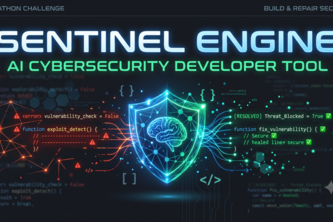
SENTINEL Engine v2.4 is a self-reported, hackathon-projected platform that claims to automate security vulnerability detection and remediation in codebases using a dual-agent AI system. It purports to scan for OWASP Top 10 issues, time complexity bottlenecks, memory leaks, and logical inconsistencies, then surgically "heals" the code and generates test suites to prove fixes.
What changed
The project was submitted as part of an OpenAI 2026 hackathon. It is described as a prototype built in a short timeframe with no evidence of commercial traction or product-market fit beyond its own self-reporting.
Single most important open question
Is there any evidence that this platform has moved beyond the prototype stage, or that it can reliably operate at scale without human intervention?
What The Product Actually Is
The description states that SENTINEL Engine v2.4 is a self-healing code platform powered by a dual-agent architecture:
- The Analysis Layer scans code for vulnerabilities (e.g., OWASP Top 10 issues, Big O bottlenecks) and generates a JSON audit report with severity scoring.
- The Execution Layer consumes that report to generate:
- A surgically "healed" version of the vulnerable code.
- A Jest or PyTest test suite to validate the fix and prevent regressions.
- It presents this in a "Hospital View", an interface featuring:
- Side-by-side diff editor.
- Threat-level badges.
- Sandbox test execution console.
This is described as an automated pipeline that bridges vulnerability identification and resolution, aiming to reduce context-switching for developers.
Inference The system appears to be a multi-agent AI platform, where one agent identifies issues and another fixes them, with structured outputs guiding the handoff.
Positioning & Claim Evolution
The author states that SENTINEL Engine is an autonomous "immune system" for codebases, designed to address the gap between vulnerability detection and resolution. It positions itself as a solution to:
- Slow, expensive security audits.
- Developer fatigue from lists of vulnerabilities without actionable fixes.
It claims to go beyond just identifying issues by:
- Providing surgically fixed code.
- Writing test suites to validate the fix.
- Offering an intuitive UI (Hospital View) that makes AI suggestions feel enterprise-grade.
The project is described as evolving from a hackathon prototype toward an enterprise-grade automated immune system, suggesting a long-term vision of product maturity and commercialization.
Inference Positioning is aimed at developer tooling and security automation, with a focus on reducing friction in the software development lifecycle by offering immediate, testable fixes.
Target Customer & ICP
The description states that SENTINEL Engine targets developers who are frustrated with traditional security audits that leave them with lists of problems rather than solutions. It aims to empower developers to fix critical issues instantly without context-switching.
It also implies a focus on enterprise-grade tools, given the mention of an "airtight, enterprise-grade automated immune system" in its future vision.
Inference The target customer is likely technical teams or individual developers working in software environments where security and performance are critical. The ICP appears to be security-conscious developers or DevOps engineers who want immediate, reliable fixes for vulnerabilities.
Business Model & Pricing Evidence
There is no evidence of a business model or pricing structure in the description. The project is described as a hackathon submission with no mention of monetization, licensing, or customer acquisition strategies.
Not evidenced.
Technical & Delivery Signals
The system is built using:
- Frontend: React, TypeScript, Tailwind CSS
- Backend: Node.js, Express
- AI Architecture: LLMs (simulating GPT-5.6 / Codex workflow), structured JSON outputs for agent handoffs
- Testing Frameworks: Jest, PyTest
- Security Standards: OWASP Top 10 compliance
The description mentions:
- A dual-agent architecture.
- Use of structured outputs to prevent hallucinations and ensure reliable agent communication.
- A custom "Elegant Dark" aesthetic inspired by modern developer tools.
- A side-by-side diff editor with threat-level badges and sandboxed test execution.
It also notes that the system was built in a tight hackathon timeframe, suggesting rapid prototyping rather than long-term engineering maturity.
Inference The technical stack is consistent with a developer tooling platform, and the use of structured outputs suggests an attempt to build robustness into AI workflows. However, no evidence of production-grade infrastructure or scalability is provided.
Traction & Maturity Signals
There is no evidence of any traction, revenue, customers, or adoption beyond the project's own self-description. The description explicitly notes that this was a hackathon submission and that no commercial data is available.
Not evidenced.
Competitive Context
The author does not mention specific competitors. However, the described functionality overlaps with:
- Automated vulnerability scanners (e.g., SonarQube, Snyk, Checkmarx).
- AI-powered code assistants (e.g., GitHub Copilot, Tabnine).
- Security automation tools that aim to fix vulnerabilities automatically.
The unique angle of the project is its dual-agent architecture, where one agent identifies and another fixes, with test generation as part of the output.
Inference It sits at the intersection of security automation, AI code assistance, and test-driven development, but lacks a clear differentiation or positioning in the market beyond its own claims.
Open Questions & Risks
- Prototype-only status: The project is described as a hackathon submission with no evidence of product-market fit or commercial traction.
- Unverified AI performance: No data or metrics on accuracy, reliability, or effectiveness of the AI agents in real-world codebases.
- No pricing or monetization strategy: No indication of how the platform would be sold or used commercially.
- Limited team size (2 members): Suggests a small team may not be able to scale beyond prototype stage without significant investment or growth.
- Self-reported claims only: All evidence is from the author’s own description, with no external validation.
Inference The project lacks commercial viability indicators and appears to be in an early-stage prototype phase. The AI system's reliability and scalability are unproven.
Questions the description leaves open
- What specific vulnerabilities has the system successfully identified and fixed in real-world code?
- How does it handle edge cases or ambiguous inputs from the Analysis Agent that could cause failures in the Execution Agent?
- Has the system been tested on large, complex codebases or only small prototypes?
- What is the current plan for monetization or commercial deployment?
- Are there any known limitations or blind spots in its ability to detect or fix certain types of vulnerabilities?
- How does it ensure that generated test suites are comprehensive and accurate?
Overall Assessment
Not evidenced.
The project is described as a hackathon submission with no evidence of traction, revenue, customers, or product-market fit. While the concept is intriguing, there is no indication that the platform has moved beyond prototype stage or demonstrated commercial viability.
Given the lack of external validation and the absence of any business model or customer data, this project does not appear to be ready for investment or partnership at this time.
Confidence Level Low.
Evidence Base
Self-reported only.
Commercial Read
Early-stage prototype with no proven traction or scalability.
User Stories BotA demo video on every pull request
Get a demo video on every new feature
GitHub App that watches your pull requests and records a narrated, captioned demo.
Save time on demo prep and make informed decisions faster with a video walkthrough of every new feature.
Source
Submitted to the OpenAI 2026 hackathon on Devpost. Project home on Devpost. Back to the full gallery on Devpost.
This competitive analysis was produced by top-founders.com (opens in a new tab)
Generated by a language model from this project's public Devpost page — its tagline, the author's own write-up and any built-with tags listed there — as captured in August 2026. Short quotations are the author's words. It is an opinion on the idea as a business, not on the people behind it, and it reflects the description as published then. If the project has moved on, request a correction below. The analysis is not independent research and contains no verified traction, revenue or customer data.
An independent guide by KFG International LLC — not affiliated with, endorsed by, or connected to Devpost or OpenAI.