

Archive position — measured, not model output
0 likes on Devpost
2,263 of the 7,850 archived projects have more likes, and 5,587 share exactly 0 — so this project's #2,699 place in the like-ranked listing is a tie-break inside that group, not a ranking.
Projects (log scale)
Likes on Devpost. ▲ marks this project's group.
Show the figures
| Likes | Projects | Share of archive |
|---|---|---|
| 0 | 5,587 | 71.2% |
| 1 | 1,758 | 22.4% |
| 2 | 284 | 3.6% |
| 3–4 | 132 | 1.7% |
| 5–9 | 75 | 1.0% |
| 10+ | 14 | 0.2% |
 User Stories BotA demo video on every pull request
Get a demo video on every new feature
GitHub App that watches your pull requests and records a narrated, captioned demo.
Save time on demo prep and make informed decisions faster with a video walkthrough of every new feature.
Executive Summary
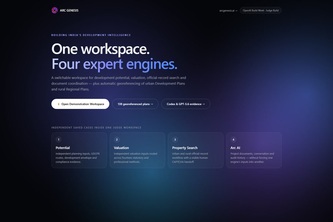
What the company appears to be: ARC GENESIS is a self-reported conversational workspace for land intelligence in India, designed to make planning maps, building potential, valuation and property search inspectable and accessible. It claims to integrate georeferencing, site potential calculation, valuation and property search into one platform using AI and deterministic engines.
What changed: The project was built from scratch over about two months by a small team (1 member) as part of the OpenAI 2026 hackathon. It is presented as an experimental prototype with limited operational coverage in Maharashtra.
The single most important open question: Does ARC GENESIS have any evidence of traction, revenue, customers or adoption beyond its own self-reported description?
Note: This analysis is based entirely on the author's own description — no external verification or historical data available. All claims are self-reported and unverified.
What The Product Actually Is
The description states that ARC GENESIS is a "conversational workspace over four engines, joined by a single project spine." These engines include:
- Georeferencing engine that places scanned Development and Regional Plans on the real world automatically using independent evidence channels (roads, water, railway lines, survey references).
- Site Potential engine that calculates permissible built-up area, setbacks, floorplates and number of floors based on UDCPR rules.
- Valuation engine that routes cases to appropriate methods from IBBI syllabus-mapped coverage and produces full computations.
- Property Search engine that prepares searches across rural 7/12 and urban Property Card systems, bringing users to correct government checkpoints.
The system also includes an Arc AI layer that carries conversation and documents, reading shared project state through tools. It runs on OpenAI GPT-5.6 at runtime.
Claim: The product is described as a single workspace where a property can travel through all four engines.
Evidence: Self-reported description only. No demonstration or live system provided.
Positioning & Claim Evolution
The author positions ARC GENESIS as a tool that makes land workflows "as easy to start as a conversation, but as inspectable as a professional file."
Key claims:
- It aims to reduce reliance on intermediaries for ordinary citizens.
- It seeks to save time for professionals like architects, valuers and lawyers.
- It emphasizes transparency, auditability and human control over AI outputs.
The project evolved from a question: "what if an Indian land workflow could be as easy to start as a conversation, but as inspectable as a professional file?"
Claim: The positioning is centered on accessibility, efficiency and legal compliance.
Evidence: Self-reported. No external validation or market positioning data.
Target Customer & ICP
The description identifies two main user groups:
- Ordinary citizens who own property but cannot locate it on development plans or understand what information exists.
- Professionals (architects, valuers, lawyers) who spend time collecting documents, repeating data entry and navigating administrative procedures.
It also mentions that the current operational coverage is limited to Maharashtra.
Claim: The target includes both end users and professionals in land-related fields.
Evidence: Self-reported. No customer segmentation or user research data provided.
Business Model & Pricing Evidence
No information about pricing, monetization or business model is included in the description.
Claim: There is no evidence of a defined business model or pricing structure.
Evidence: Not evidenced.
Technical & Delivery Signals
The system was built using:
- Tools: Claude, Codex, GPT-5.6, Leaflet.js, Node.js, OpenAI API, PHP, PostgreSQL, Python, PyTorch
- Methodology: Deterministic engines separate from conversational layer; AI handles gathering facts and explaining results, not performing authoritative decisions.
- Approach: Conversational interface gathers facts, deterministic engines perform calculations; every output remains inspectable.
The team built the system in about two months with a small team pairing coding agents (Codex + GPT-5.6 and Claude Code) with architects supplying domain rules and judgment.
Claim: The architecture separates AI from authority to maintain legal and professional boundaries.
Evidence: Self-reported. No technical documentation or architecture diagrams provided.
Traction & Maturity Signals
The description states:
- 138 Development and Regional Plans placed automatically across 21 districts.
- Georeferencing achieved best residual at 2.4 meters.
- Site Potential engine derives floors instead of asking for them.
- Valuation engine produces full visible computations.
- Property Search respects checkpoints built by the state.
However, it also notes:
- Operational coverage is currently limited to Maharashtra.
- Some records remain offline or incomplete.
- Every professional report still requires verification and responsibility from qualified signers.
- The project was built in about two months as a hackathon prototype.
Claim: There are early signs of functionality and operational capability.
Evidence: Self-reported. No user data, revenue, adoption metrics or performance tracking mentioned.
Competitive Context
The description does not mention any direct competitors or competitive landscape.
Claim: No evidence of competitive analysis or market positioning.
Evidence: Not evidenced.
Open Questions & Risks
- Unverified claims: The entire product is self-reported and unverified. No third-party validation, live demo or production system provided.
- Limited scope: Operational coverage is restricted to Maharashtra; many records remain offline or incomplete.
- Prototype nature: Built in two months as a hackathon project — no indication of long-term development or scalability.
- Legal boundary risks: While the description claims AI stays out of authoritative decisions, there’s no evidence of how this boundary will be maintained at scale or under pressure.
- No commercialization path: No mention of monetization, pricing, or customer acquisition strategy.
Inference: The lack of traction and commercial viability raises concerns about whether this is a viable product or just an experimental prototype.
Questions the description leaves open
- What are the actual legal and regulatory constraints that prevent full automation in land processes?
- How does the system ensure consistency and accuracy across different jurisdictions beyond Maharashtra?
- Can you provide any evidence of user testing, feedback loops or iteration history?
- What is your plan for scaling georeferencing and building regulation engines to cover all Indian states?
- Are there any partnerships with government agencies or legal institutions currently in place?
- How do you intend to transition from a hackathon prototype to a sustainable product or service?
Overall Assessment
Not evidenced
The description provides no information on revenue, customers, traction, funding, or market validation. The project is presented as an experimental prototype built during a hackathon with limited operational scope.
Assessment: Based solely on the self-reported description, there is insufficient evidence to assess commercial viability, scalability or investment potential. This appears to be an early-stage idea or proof-of-concept rather than a developed business.
User Stories BotA demo video on every pull request
Get a demo video on every new feature
GitHub App that watches your pull requests and records a narrated, captioned demo.
Save time on demo prep and make informed decisions faster with a video walkthrough of every new feature.
Source
Submitted to the OpenAI 2026 hackathon on Devpost. Project home on Devpost. Back to the full gallery on Devpost.
This competitive analysis was produced by top-founders.com (opens in a new tab)
Generated by a language model from this project's public Devpost page — its tagline, the author's own write-up and any built-with tags listed there — as captured in August 2026. Short quotations are the author's words. It is an opinion on the idea as a business, not on the people behind it, and it reflects the description as published then. If the project has moved on, request a correction below. The analysis is not independent research and contains no verified traction, revenue or customer data.
An independent guide by KFG International LLC — not affiliated with, endorsed by, or connected to Devpost or OpenAI.