

Archive position — measured, not model output
0 likes on Devpost
2,263 of the 7,850 archived projects have more likes, and 5,587 share exactly 0 — so this project's #6,624 place in the like-ranked listing is a tie-break inside that group, not a ranking.
Projects (log scale)
Likes on Devpost. ▲ marks this project's group.
Show the figures
| Likes | Projects | Share of archive |
|---|---|---|
| 0 | 5,587 | 71.2% |
| 1 | 1,758 | 22.4% |
| 2 | 284 | 3.6% |
| 3–4 | 132 | 1.7% |
| 5–9 | 75 | 1.0% |
| 10+ | 14 | 0.2% |
 User Stories BotA demo video on every pull request
Get a demo video on every new feature
GitHub App that watches your pull requests and records a narrated, captioned demo.
Save time on demo prep and make informed decisions faster with a video walkthrough of every new feature.
Executive Summary
What the company appears to be
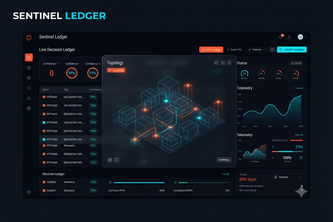
Sentinel Ledger is a self-reported full-stack AI system designed to automate real-time pricing and inventory decisions for small businesses. It uses LLMs (GPT-5.6, Groq) in a live pipeline to make autonomous decisions with visible reasoning, while routing high-risk changes to human review. The system includes a decision engine, safety interceptor, insights engine, and a 3D visualization frontend.
What changed
The author reports building the entire product solo over several days using AI tools like Codex and GPT-5.6, integrating LLMs into a real-time pipeline with structured outputs and fallback logic. The system was designed to be adaptable across business types (e.g., cafes, boutiques) and includes mechanisms for human override and audit logging.
Single most important open question
Is there evidence of actual business adoption or traction beyond the author’s solo development? The description states no revenue, customers, or real-world usage data are available — only a demo-level system built in a hackathon context.
What The Product Actually Is
The description states that Sentinel Ledger is:
- A live decision engine that ingests live sales, stock, and demand signals.
- A system with LLM reasoning, specifically using GPT-5.6 and Groq, integrated into a real-time pipeline.
- A decision-making tool that makes pricing and inventory decisions with plain-language justifications.
- A system that includes:
- A safety interceptor limiting autonomous actions to ±30% price changes.
- An insights engine mining decision history for patterns.
- A human-in-the-loop feature where overrides are logged and used for future decisions.
- A 3D inventory visualization frontend, built with React Three Fiber.
- The system is designed to be adaptable across different business types (e.g., hardware stores, bookstores) via an “adaptive schema.”
Inferred: The product is a demo-level prototype, not yet deployed in production. It was built for a hackathon and includes no real-world data ingestion or live integration.
Positioning & Claim Evolution
The author claims that Sentinel Ledger:
- Is not a retrospective analytics tool.
- Is a decision-maker that acts on current events, not past data.
- Provides visible reasoning for every decision.
- Allows human override, which becomes part of the learning process.
- Is designed to be trustworthy by showing evidence instead of just answers.
The positioning evolves from:
- A gut-feeling-based loop in a business owner’s head → to a live, automated system with paper trail.
- From AI chatbot-style assistance → to an autonomous decision engine with safety guards.
- From a one-off AI answer → to a system that gets smarter over time.
Inferred: The positioning is based on the author’s own self-perception and not validated by external users or data.
Target Customer & ICP
The description states:
- Sentinel Ledger targets small business owners.
- It is designed for businesses with live sales, stock, and demand signals.
- It supports a wide range of business types including cafes, boutiques, pharmacies, bookstores, hardware stores.
Inferred: The ICP appears to be small business owners or entrepreneurs who make frequent pricing/inventory decisions and are looking for automation with transparency. No specific customer segments or personas are defined beyond this generalization.
Business Model & Pricing Evidence
The description states:
- A billing system is already built into the product, suggesting a paid model.
- The author mentions pricing tiers are already implemented, though no details are given.
- The system supports real POS integration (Square, Shopify, Toast) as a future feature.
Inferred: There is a potential paid model, but no evidence of pricing structure, revenue, or customer acquisition. The billing system is built-in, but not yet live or tested in the real world.
Technical & Delivery Signals
The description states:
- Built solo using Codex and GPT-5.6.
- Uses a Node.js/Express backend, React frontend, and WebSocket event pipeline.
- Includes 3D visualization with React Three Fiber and GSAP animations.
- Integrates GPT-5.6 and Groq with fallback logic.
- Uses HMAC-signed audit records for logging decisions.
- Has a structured-output prompt engineering approach to avoid templated responses.
- Includes circuit breakers, rate limiting, and per-item throttling due to early misbehavior.
Inferred: The system is technically complex, with multiple LLM integrations and safety features. However, it is a demo-level prototype, not yet integrated with real data sources or production systems.
Traction & Maturity Signals
The description states:
- The project was built in a hackathon.
- It includes simulated ingestion layer for demo purposes.
- No real-world data or live integration is mentioned.
- No evidence of revenue, customers, or adoption beyond the author’s solo development.
Not evidenced: No traction, no customer base, no usage metrics, no product-market fit signals. The system is described as a proof-of-concept, not a mature product.
Competitive Context
The description does not mention any competitors or direct market positioning against other tools.
Inferred: Sentinel Ledger appears to be in the AI-powered pricing and inventory decision space, which may overlap with tools like:
- Pricing optimization platforms (e.g., Price2Spy, Pricefx)
- Inventory management systems (e.g., TradeGecko, Zoho Inventory)
- AI decision-making tools for business operations
However, no competitive analysis or differentiation is provided.
Open Questions & Risks
The description states:
- The system was built solo, with no team.
- It includes early-stage safety mechanisms (e.g., circuit breakers) due to early misbehavior.
- It uses GPT-5.6 and Groq, which may be expensive or rate-limited.
- The author reports burning through quotas in early testing, suggesting potential scalability issues.
Open questions:
- No real-world usage or customer feedback.
- No evidence of product-market fit or traction.
- No team, no funding, no external validation.
- The system is described as a demo-level prototype, not a production-ready tool.
Questions the description leaves open
- What is the actual business model? Are there any pricing tiers or revenue plans?
- Has the system been tested with real businesses or data?
- How does it handle edge cases or unexpected inputs in live environments?
- What are the actual costs of running this system at scale (e.g., LLM API usage)?
- Is there any plan to integrate with real POS systems like Square or Shopify?
- How is the human-in-the-loop feature implemented and how does it affect decision accuracy?
- Are there any plans for team expansion or product development beyond the current prototype?
Overall Assessment
The description states that Sentinel Ledger is a self-built hackathon project with no evidence of traction, revenue, or real-world adoption.
Inferred: The project is in an early-stage prototype phase, likely not ready for investment or partnership. It shows technical capability and ambition but lacks commercial validation, team, or product-market fit signals.
Assessment Not ready for investment or partnership at this time. Requires further development, traction, and evidence of real-world usage before any serious consideration.
User Stories BotA demo video on every pull request
Get a demo video on every new feature
GitHub App that watches your pull requests and records a narrated, captioned demo.
Save time on demo prep and make informed decisions faster with a video walkthrough of every new feature.
Source
Submitted to the OpenAI 2026 hackathon on Devpost. Project home on Devpost. Back to the full gallery on Devpost.
This competitive analysis was produced by top-founders.com (opens in a new tab)
Generated by a language model from this project's public Devpost page — its tagline, the author's own write-up and any built-with tags listed there — as captured in August 2026. Short quotations are the author's words. It is an opinion on the idea as a business, not on the people behind it, and it reflects the description as published then. If the project has moved on, request a correction below. The analysis is not independent research and contains no verified traction, revenue or customer data.
An independent guide by KFG International LLC — not affiliated with, endorsed by, or connected to Devpost or OpenAI.