

Archive position — measured, not model output
1 like on Devpost
505 of the 7,850 archived projects have more likes, and 1,758 share exactly 1 — so this project's #736 place in the like-ranked listing is a tie-break inside that group, not a ranking.
Projects (log scale)
Likes on Devpost. ▲ marks this project's group.
Show the figures
| Likes | Projects | Share of archive |
|---|---|---|
| 0 | 5,587 | 71.2% |
| 1 | 1,758 | 22.4% |
| 2 | 284 | 3.6% |
| 3–4 | 132 | 1.7% |
| 5–9 | 75 | 1.0% |
| 10+ | 14 | 0.2% |
 User Stories BotA demo video on every pull request
Get a demo video on every new feature
GitHub App that watches your pull requests and records a narrated, captioned demo.
Save time on demo prep and make informed decisions faster with a video walkthrough of every new feature.
Executive Summary
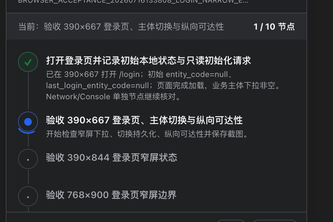
What the company appears to be: A self-reported, single-person project named browser-test-progress, built as a plugin for ChatGPT/Codex. The author describes it as a tool that displays execution status and results of browser crawling tasks using navigation nodes, without navigating internal node entries.
What changed: This is a personal project submitted to the OpenAI 2026 hackathon. It was not previously known or reported elsewhere; there is no evidence of prior development, funding, or commercial activity.
Single most important open question: Is this plugin intended for broader use beyond the author’s own debugging workflow? The description does not indicate any public distribution, customer base, or commercial intent.
Analysis basis: All information comes from a self-reported project description submitted to Devpost. No external verification, traction data, revenue figures, or third-party sources are available.
What The Product Actually Is
- The description states that browser-test-progress is a plugin for ChatGPT/Codex.
- It uses navigation nodes to show the execution status and results of built-in browser crawling tasks.
- It does not navigate internal items within those nodes.
- The implementation includes:
- An MCP server (Node.js-based) using Model Context Protocol SDK, Zod schemas, and state persistence.
- A frontend component in HTML/CSS/JS for display.
- Tools for starting a task, updating a node, attaching a report, acknowledging result delivery, reading current state, and reopening the panel.
- State management with atomic file writes, JSON-based storage, and validation rules.
- It is packaged as a repository-scoped Codex marketplace plugin, including a prebuilt distribution bundle.
Inference: The product appears to be a developer-focused tool for managing browser automation tasks within AI-assisted development environments. However, it is not demonstrated to have any commercial or public usage beyond the author’s own workflow.
Positioning & Claim Evolution
- The author claims this plugin was built to improve debugging workflows on an Intel Mac where direct VS Code integration isn’t possible.
- It aims to provide more intuitive feedback than what Codex offers natively.
- The project positions itself as a solution for AI-assisted browser testing and task tracking, tailored specifically to the author's needs.
Claim vs Fact: The description states that this is a personal tool built during a hackathon. There is no evidence of positioning toward a larger market or audience beyond the author’s own use case.
Target Customer & ICP
- Not evidenced.
- No mention in the description of target customers, personas, or ideal customer profiles.
- The project seems to be designed for individual developers or users working with AI-assisted browser automation tools like ChatGPT/Codex.
Absence of evidence: There is no indication of who else might use this tool, nor any segmentation or targeting strategy described.
Business Model & Pricing Evidence
- Not evidenced.
- No pricing information, monetization model, or business structure mentioned.
- The project is presented as a personal hackathon submission with no commercial intent indicated.
Absence of evidence: There is no evidence of any revenue streams, pricing plans, or business model beyond the author’s own use.
Technical & Delivery Signals
- Built using:
- Node.js
- MCP (Model Context Protocol)
- Zod schemas
- esbuild for bundling
- HTML/CSS/JS frontend
- Uses atomic file writes and JSON-based state persistence.
- Implements a task-state machine with validation logic.
- Supports light/dark themes, accessibility features, PiP mode, and polling for updates.
- Includes automated tests covering both source code and built distribution.
Inference: The technical stack suggests a developer-oriented tool that integrates into AI-assisted workflows. It shows attention to reliability and user experience in state management and UI behavior.
Traction & Maturity Signals
- Not evidenced.
- No evidence of users, customers, downloads, or adoption metrics.
- The project is described as a personal hackathon submission with no indication of prior traction or growth.
Absence of evidence: There are no signs of product-market fit, user engagement, or market validation.
Competitive Context
- Not evidenced.
- No mention of competitors or similar tools in the description.
- The author does not reference existing browser automation or AI-assisted debugging solutions.
Absence of evidence: No competitive landscape or differentiation strategy is described.
Open Questions & Risks
- Single-person development: Only one team member listed (the author), which may limit scalability and long-term maintenance.
- No public distribution or feedback loop: The tool is presented as a personal solution with no indication of broader availability or user input.
- Limited commercialization: No evidence of monetization, partnerships, or strategic direction beyond the hackathon submission.
- Unclear market relevance: The product seems tailored to one specific use case (debugging on Intel Macs), which may limit its appeal.
Inference: While technically sound, the lack of traction, audience, and commercial intent raises questions about scalability and viability as a product or business.
Questions the description leaves open
- What is your long-term vision for this tool? Is it intended to evolve into something more broadly useful?
- Have you considered how users outside of your own workflow might interact with or benefit from this plugin?
- Are there any plans to open-source the project or make it available beyond the Codex marketplace?
- How do you plan to validate whether others find value in this tool, given its narrow focus?
- What are the barriers to adoption for other developers who may want to integrate or extend this plugin?
Overall Assessment
- Not evidenced.
- No financials, valuation, funding history, or partnership opportunities mentioned.
- The project is described as a personal hackathon effort with no indication of investment potential or strategic value.
Conclusion: Based on the self-reported description alone, browser-test-progress appears to be a narrowly scoped tool developed by one person for personal use. There is no evidence of traction, commercialization, or scalability. It cannot be evaluated as an investment or partnership opportunity without further data.
User Stories BotA demo video on every pull request
Get a demo video on every new feature
GitHub App that watches your pull requests and records a narrated, captioned demo.
Save time on demo prep and make informed decisions faster with a video walkthrough of every new feature.
Source
Submitted to the OpenAI 2026 hackathon on Devpost. Project home on Devpost. Back to the full gallery on Devpost.
This competitive analysis was produced by top-founders.com (opens in a new tab)
Generated by a language model from this project's public Devpost page — its tagline, the author's own write-up and any built-with tags listed there — as captured in August 2026. Short quotations are the author's words. It is an opinion on the idea as a business, not on the people behind it, and it reflects the description as published then. If the project has moved on, request a correction below. The analysis is not independent research and contains no verified traction, revenue or customer data.
An independent guide by KFG International LLC — not affiliated with, endorsed by, or connected to Devpost or OpenAI.