

Archive position — measured, not model output
1 like on Devpost
505 of the 7,850 archived projects have more likes, and 1,758 share exactly 1 — so this project's #738 place in the like-ranked listing is a tie-break inside that group, not a ranking.
Projects (log scale)
Likes on Devpost. ▲ marks this project's group.
Show the figures
| Likes | Projects | Share of archive |
|---|---|---|
| 0 | 5,587 | 71.2% |
| 1 | 1,758 | 22.4% |
| 2 | 284 | 3.6% |
| 3–4 | 132 | 1.7% |
| 5–9 | 75 | 1.0% |
| 10+ | 14 | 0.2% |
 User Stories BotA demo video on every pull request
Get a demo video on every new feature
GitHub App that watches your pull requests and records a narrated, captioned demo.
Save time on demo prep and make informed decisions faster with a video walkthrough of every new feature.
Executive Summary
What the company appears to be
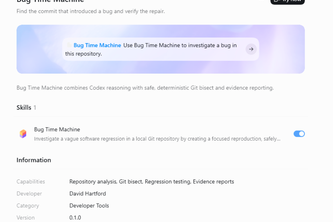
Bug Time Machine is a self-reported ChatGPT plugin that claims to help developers find bugs in Git repositories by turning vague bug reports into reproducible tests, locating the commit that introduced the issue, and verifying a repair.
What changed
The project description states this was built for the OpenAI 2026 hackathon. It is described as a first-time plugin creation using ChatGPT/Codex tools, with no prior revenue or customer traction evidenced.
Single most important open question
Is there any evidence of actual usage, testing or adoption beyond the author's own demonstration? The description does not indicate whether the plugin works in real-world scenarios or has been tested outside of a demo environment.
What The Product Actually Is
The description states that Bug Time Machine is a ChatGPT plugin designed to investigate bugs in Git repositories. It uses GPT-5.6 Sol, Codex, and Python/Git tools to:
- Take a user's bug report in natural language
- Create or select a focused test
- Search the Git history for the first commit where behavior changed from working to broken
- Explain why the change caused the bug
- Propose a repair and verify it works
It also claims to use Git bisect and temporary Git worktrees to isolate and investigate changes without affecting the user’s active project.
The plugin is said to be built using Codex, which allows it to interact directly with files in ChatGPT, write code, run tests, and generate reports.
Evidence
- The author states: “Bug Time Machine helps find a bug that was introduced somewhere in a Git repository’s commit history.”
- It uses GPT-5.6 Sol, Codex, Python, Git, HTML5, CSS3, JavaScript.
- It claims to use Git bisect and worktrees for safe investigation.
Inference The plugin appears to be a proof-of-concept or hackathon project built with AI tools, not a commercial product.
Positioning & Claim Evolution
The author states that the idea came from wanting to explore how ChatGPT plugins could help with coding problems. The plugin is positioned as a tool for developers to automate bug investigation using natural language input and Git history.
It claims to be a first-time plugin creation by the author, built entirely within ChatGPT using Codex.
Evidence
- “I chose this project because I had never created a plugin for ChatGPT before.”
- “This is the first program and plugin I created with ChatGPT from inside ChatGPT.”
Inference The positioning is that of an experimental AI-powered developer tool, not a commercial product or scalable solution.
Target Customer & ICP
The description does not state who the target customer is. It implies the user is a developer working with Git repositories and using ChatGPT for coding assistance.
It suggests the plugin is intended to help developers investigate bugs more efficiently, especially when they have vague bug reports.
Evidence
- “A user describes the problem in normal language.”
- “It helps the user understand what changed, explains why the change caused the bug.”
Inference The ICP appears to be technical users or developers who work with Git and use ChatGPT for coding tasks. No specific segment or persona is defined.
Business Model & Pricing Evidence
There is no evidence of a business model or pricing structure in the description.
Evidence
- The project was submitted to a hackathon.
- No mention of monetization, subscriptions, or fees.
Inference The plugin appears to be non-commercial, built for demonstration or personal use only.
Technical & Delivery Signals
The author states that the plugin uses:
- GPT-5.6 Sol for reasoning
- Codex for code generation and interaction with files
- Python and Git tools
- Git bisect to locate bad commits
- Temporary Git worktrees to avoid disrupting the user’s project
It also claims to generate an HTML evidence report and run automated tests.
Evidence
- “I built the project with prompts using Codex and GPT-5.6 Sol.”
- “Git bisect helps locate the first bad commit, while temporary Git worktrees protect the user’s active project during the investigation.”
Inference The technical stack is a mix of AI (GPT/Codex), Git, Python, and web technologies. It is not clear if this is a full product or just a prototype.
Traction & Maturity Signals
There is no evidence of traction, customers, or adoption beyond the author’s own demonstration.
Evidence
- “Team size: 0”
- “No revenue, customer or traction data is available beyond what they state.”
- The project was submitted to a hackathon.
Inference This is an early-stage prototype, not a product with real-world usage or market validation.
Competitive Context
The description does not mention any competitors or similar tools. It does not reference existing bug-finding, Git history analysis, or AI-assisted debugging tools.
Evidence
- No mention of competitors.
- No comparison to other tools in the space.
Inference No competitive context is evident. The tool may be unique in its approach (AI + Git plugin), but there is no evidence of a market or existing solutions.
Open Questions & Risks
- No traction or adoption: The project is described as a hackathon submission with no real-world usage.
- Unverified claims: The author states the plugin works, but no independent verification or testing is provided.
- Limited scope: It’s a demo or prototype, not a scalable product.
- Dependency on AI tools: Relies heavily on GPT/Codex, which may not be stable or available in all environments.
Evidence
- “No revenue, customer or traction data is available beyond what they state.”
- “I used ChatGPT all the time to help me with coding...”
- “The biggest issue I faced was getting the ChatGPT desktop application working.”
Inference This project is experimental, not a commercial-grade tool. Risks include lack of scalability, dependency on AI tools, and no real-world validation.
Questions the description leaves open
- Is this plugin available for public use or only in demo form?
- Has it been tested outside the author’s own environment (e.g., on other operating systems or Git repositories)?
- What is the actual workflow for a user to interact with the plugin?
- Are there any known limitations or edge cases where it might fail?
- How does it handle complex or multi-file bugs?
- Is there any plan to commercialize this tool, or is it purely experimental?
Overall Assessment
Not evidenced
The project description provides no evidence of revenue, customers, traction, or a viable business model. It is described as a hackathon submission, built by one person using AI tools for personal use.
There is no indication that this is a product ready for investment or partnership. It is an experimental prototype with no commercial viability or scalability evident from the description.
Inference This project is not suitable for investment or partnership at this stage. It may be a starting point for future development, but it lacks any commercial due-diligence signals.
User Stories BotA demo video on every pull request
Get a demo video on every new feature
GitHub App that watches your pull requests and records a narrated, captioned demo.
Save time on demo prep and make informed decisions faster with a video walkthrough of every new feature.
Source
Submitted to the OpenAI 2026 hackathon on Devpost. Project home on Devpost. Back to the full gallery on Devpost.
This competitive analysis was produced by top-founders.com (opens in a new tab)
Generated by a language model from this project's public Devpost page — its tagline, the author's own write-up and any built-with tags listed there — as captured in August 2026. Short quotations are the author's words. It is an opinion on the idea as a business, not on the people behind it, and it reflects the description as published then. If the project has moved on, request a correction below. The analysis is not independent research and contains no verified traction, revenue or customer data.
An independent guide by KFG International LLC — not affiliated with, endorsed by, or connected to Devpost or OpenAI.