

Archive position — measured, not model output
1 like on Devpost
505 of the 7,850 archived projects have more likes, and 1,758 share exactly 1 — so this project's #740 place in the like-ranked listing is a tie-break inside that group, not a ranking.
Projects (log scale)
Likes on Devpost. ▲ marks this project's group.
Show the figures
| Likes | Projects | Share of archive |
|---|---|---|
| 0 | 5,587 | 71.2% |
| 1 | 1,758 | 22.4% |
| 2 | 284 | 3.6% |
| 3–4 | 132 | 1.7% |
| 5–9 | 75 | 1.0% |
| 10+ | 14 | 0.2% |
 User Stories BotA demo video on every pull request
Get a demo video on every new feature
GitHub App that watches your pull requests and records a narrated, captioned demo.
Save time on demo prep and make informed decisions faster with a video walkthrough of every new feature.
Executive Summary
What the company appears to be
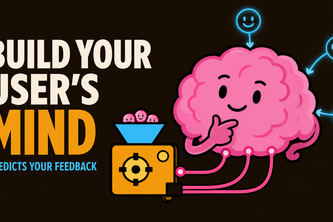
The project described by the caller is build-your-users-mind, a self-reported local-first recipe (a method + scripts + document templates) that aims to build an empirical, evidence-cited model of how users decide when interacting with AI agents. It is not a framework or product but a set of deterministic scripts and tools designed to enable agents to learn from their own interaction logs and predict user feedback.
What changed
The project was submitted as part of the OpenAI 2026 hackathon. The description indicates it emerged from prompt-archaeology work, where thousands of real human-AI interactions were classified into recurring patterns. It is presented as a method for turning interaction logs into a “living preference model” that can predict feedback before it’s given.
The single most important open question
Is there any evidence of traction, adoption, or commercial use beyond the hackathon submission? The project is described as a recipe, not a product — and no revenue, customers, or usage data are provided.
Note: This analysis is based entirely on the self-reported, unverified description supplied by the caller. No third-party verification, archived history, or independent sources are available. All claims are attributed to the author’s own account.
What The Product Actually Is
The description states that build-your-users-mind is:
- A local-first recipe, defined as a method + scripts + document templates.
- Not a framework or product.
- Designed to allow an AI agent to turn its own authorized interaction logs into a living preference model.
- The pipeline includes: extract → merge → chunk → classify → aggregate.
- Uses deterministic scripts that pull only user-typed prompts, redact secrets, and bind manifests to SHA-256 of the corpus.
- Includes a feedback precognition loop with confidence levels (🟢 consistent, 🟡 context-dependent, 🔴 no pattern).
- Supports multiple agents (Claude Code, Codex CLI, Gemini/Antigravity, Kimi) through source adapters.
- Provides offline demo and scoring tools (score_predictions.py, Cohen’s-κ helper).
Inference: The project is a toolset for building user preference models from logs, not a commercial product or service. It is built with deterministic principles and privacy as a core design constraint.
Positioning & Claim Evolution
The description states:
- The project aims to solve the problem of AI agents forgetting user decisions.
- It introduces an agent that builds an empirical, evidence-cited model of how users decide.
- The method is rooted in prompt-archaeology work and classification of thousands of interactions.
- It emphasizes predicting feedback before it’s given, rather than guessing.
- The system escalates when unsure (no false confidence).
- It is built to be agent-agnostic, with adapters for multiple platforms.
- It is described as measurable, not mystical — with tools to score predictions and validate inter-rater agreement.
Inference: The positioning is that of a privacy-first, deterministic, user preference modeling toolset. It positions itself as an alternative to memory systems that rely on text storage or LLMs for recall, instead using structured logs and classification.
Target Customer & ICP
The description does not explicitly state target customers or personas. However, it implies:
- AI agent developers or teams who want to improve agent behavior through user modeling.
- Users of multiple AI agents (e.g., Claude, Codex, Kimi) who want a unified preference model across tools.
- Developers building local-first systems, where privacy and deterministic behavior are key.
Inference: The ICP likely includes developers or teams working on AI agent personalization or interaction optimization, particularly those prioritizing local-first, privacy-conscious design.
Business Model & Pricing Evidence
The description does not provide any evidence of:
- A pricing model.
- Revenue streams.
- Monetization strategy.
- Commercial product offerings.
Inference: No business model is evident. The project is described as a recipe or toolset — not a commercial offering.
Technical & Delivery Signals
The description states:
- Built with stdlib-only Python.
- Uses TDD (73 deterministic tests).
- CI on Windows/Linux.
- Deterministic-first architecture: the model only sees reduced, redacted corpus.
- Uses source adapters for Claude Code, Codex CLI, Gemini/Antigravity, Kimi.
- Includes a one-command synthetic demo that runs offline.
- Privacy as architecture, not promise: fail-closed extraction, redaction before write, aggressive .gitignore.
- Codex wrote its own adapter, and GPT-5.6 in Codex reviewed the system.
- The project includes documentation in six languages.
Inference: The technical approach is deterministic, privacy-focused, and test-driven. It uses minimal dependencies and emphasizes offline capability and data integrity.
Traction & Maturity Signals
The description does not provide evidence of:
- Revenue.
- Customers or users.
- Adoption or usage metrics.
- Product-market fit.
- Commercial traction beyond the hackathon.
Inference: There is no evidence of traction or maturity beyond a hackathon submission. The project is described as a prototype or proof-of-concept.
Competitive Context
The description does not mention:
- Competitors.
- Market positioning relative to other tools.
- Prior art or similar solutions in the space.
Inference: No competitive context is provided. The project appears to be self-contained and not positioned against existing products or services.
Open Questions & Risks
Key risks and open questions based on the description:
- The project is not a product, but a recipe/toolset — which may limit commercial viability.
- It is self-reported with no independent verification.
- The semantic quality is flagged as low (κ≈0.24), indicating that the classification system is not fully reliable.
- The system is built for offline use, which may limit scalability or integration with cloud-based agents.
- The team size is 1, suggesting limited development capacity.
Inference: The project is a proof-of-concept with strong technical design but no commercial traction, and it may face challenges in scaling or monetizing.
Questions the description leaves open
- What are the real-world use cases for this toolset? Has it been tested beyond the hackathon?
- How does it integrate into existing AI agent workflows?
- Is there any plan to commercialize or scale this beyond a prototype?
- What is the long-term vision for the project — is it meant to be a product, a framework, or a research tool?
- How do you plan to address the low inter-rater agreement (κ≈0.24) in practical use?
- Are there any plans to support more agents or platforms beyond the current ones?
Overall Assessment
The project is described as a local-first, deterministic, privacy-conscious recipe for building user preference models from AI agent logs. It is not a product or service but a toolset designed to enable agents to learn from their own behavior.
Assessment: Not evidenced as a viable investment or partnership opportunity at this stage. The project lacks commercial traction, revenue, customers, or clear monetization strategy. It is a prototype with strong technical design and privacy principles, but no evidence of adoption or scalability beyond the hackathon submission.
User Stories BotA demo video on every pull request
Get a demo video on every new feature
GitHub App that watches your pull requests and records a narrated, captioned demo.
Save time on demo prep and make informed decisions faster with a video walkthrough of every new feature.
Source
Submitted to the OpenAI 2026 hackathon on Devpost. Project home on Devpost. Back to the full gallery on Devpost.
This competitive analysis was produced by top-founders.com (opens in a new tab)
Generated by a language model from this project's public Devpost page — its tagline, the author's own write-up and any built-with tags listed there — as captured in August 2026. Short quotations are the author's words. It is an opinion on the idea as a business, not on the people behind it, and it reflects the description as published then. If the project has moved on, request a correction below. The analysis is not independent research and contains no verified traction, revenue or customer data.
An independent guide by KFG International LLC — not affiliated with, endorsed by, or connected to Devpost or OpenAI.