

Archive position — measured, not model output
1 like on Devpost
505 of the 7,850 archived projects have more likes, and 1,758 share exactly 1 — so this project's #742 place in the like-ranked listing is a tie-break inside that group, not a ranking.
Projects (log scale)
Likes on Devpost. ▲ marks this project's group.
Show the figures
| Likes | Projects | Share of archive |
|---|---|---|
| 0 | 5,587 | 71.2% |
| 1 | 1,758 | 22.4% |
| 2 | 284 | 3.6% |
| 3–4 | 132 | 1.7% |
| 5–9 | 75 | 1.0% |
| 10+ | 14 | 0.2% |
 User Stories BotA demo video on every pull request
Get a demo video on every new feature
GitHub App that watches your pull requests and records a narrated, captioned demo.
Save time on demo prep and make informed decisions faster with a video walkthrough of every new feature.
Executive Summary
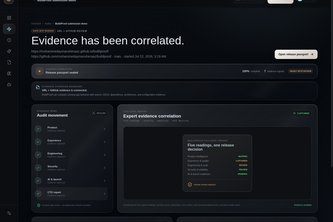
What the company appears to be: BuildProof is a self-reported SaaS product that claims to automate application security and readiness verification using a multi-agent AI system. The author states it runs a sequence of specialist agents against a repository and staging URL, producing an evidence-backed assessment on whether an app is ready to ship.
What changed: The project description shows a single-person build effort completed in under two days for a hackathon, with no revenue or customer data. It presents a self-described tool that operates as a security audit pipeline, integrating AI agents and a custom frontend.
Single most important open question: Is there any evidence of actual product-market fit, traction, or commercial viability beyond the author's own account?
Analysis basis: This report is based entirely on the self-reported project description provided by the caller. No external verification, archived data, or third-party sources are available. All claims in this document are attributed to the author’s own submission and are unverified.
What The Product Actually Is
The description states that BuildProof:
- Takes a repository and staging URL as inputs
- Runs ten specialist agents in sequence to evaluate application readiness
- Produces an evidence-backed assessment (ship, review, or hold)
- Uses GPT-5.6 as the reasoning layer for synthesizing results into a final report
- Operates without storing platform-wide keys or plaintext secrets
- Is built with Next.js, Supabase, Postgres, and React
Inference: The product appears to be an automated security and quality assurance pipeline designed to run before application release. It is described as a SaaS tool that integrates AI agents for various checks including UI/UX testing, functional QA, performance, backend/cloud/database engineering, security, DevOps, and optional AI feature evaluation.
Not evidenced: No information on actual functionality beyond the author's claims, no demonstration of real-world use cases, or evidence of integration with existing CI/CD pipelines.
Positioning & Claim Evolution
The author positions BuildProof as:
- A tool to close the gap between "AI-built apps" and verified safety
- An alternative to traditional code review that fails to catch real-world vulnerabilities
- A solution for developers who want automated, human-readable security audits
Claim evolution: The project evolves from a hackathon idea into what the author describes as “the early version of a company I'd actually want to run.” This suggests an ambition to scale beyond a prototype.
Inference: The positioning reflects a shift from a demo tool to a commercial product aimed at developers and teams who prioritize security in their development lifecycle.
Not evidenced: No evidence of prior market research, customer feedback, or competitive positioning beyond the author’s own narrative.
Target Customer & ICP
The description states:
- The target audience is people building applications using AI coding assistants
- These users often lack tools to verify what they’ve built before shipping
- The tool aims to bridge a gap between fast development and safe deployment
Inference: The ideal customer profile (ICP) likely includes:
- Developers or engineering teams working with AI-assisted code generation
- Startups or small companies lacking dedicated security or QA resources
- Teams looking for automated verification before launch
Not evidenced: No explicit segmentation, user personas, or customer validation data.
Business Model & Pricing Evidence
The description states:
- Users connect their own model keys rather than relying on a shared key
- The tool does not store platform-wide keys or plaintext secrets
- It is described as a SaaS product with no mention of pricing tiers or monetization strategy
Inference: The business model appears to be SaaS-based, possibly subscription-based, though the exact structure isn’t detailed.
Not evidenced: No pricing information, revenue model, or monetization strategy beyond the self-reported product design.
Technical & Delivery Signals
The description states:
- Built with Next.js, Supabase, Postgres, React, and TypeScript
- Uses GPT-5.6 as a reasoning layer for agent outputs
- Implements a scroll-driven cinematic frontend using GSAP and Three.js
- Operates in continuous build threads via Codex
- Has row-level security and no shared keys
Inference: The technical stack suggests a modern, cloud-native SaaS product with strong focus on user experience and data isolation.
Not evidenced: No details about scalability, infrastructure, or delivery mechanisms beyond the author’s own account.
Traction & Maturity Signals
The description states:
- Built by one person in under two days
- Runs against real repositories and staging URLs
- Produces actual release assessments, not canned ones
- Has a security model closer to production SaaS than typical hackathon projects
Inference: The product shows early maturity in terms of functionality and design, but lacks any evidence of user adoption or market traction.
Not evidenced: No customer data, usage metrics, revenue, or growth indicators beyond the author’s own claims.
Competitive Context
The description does not reference competitors directly. However, it implies a space involving:
- AI-powered code review tools
- Application security platforms
- Automated QA and testing tools
- DevOps and CI/CD verification systems
Inference: The product competes in the growing market for automated software quality and security assurance, particularly where AI is used to enhance traditional scanning methods.
Not evidenced: No competitive analysis, benchmarking, or differentiation from existing tools.
Open Questions & Risks
Key risks identified:
- Single-person development: No team, no validation, no operational structure
- Unproven market fit: No evidence of demand or customer traction
- AI dependency risk: Reliance on GPT-5.6 raises questions about consistency and control
- Limited scope: Only one fixed pipeline; no customization options mentioned
- Hackathon origin: Likely not yet mature for enterprise use
Open questions:
- No pricing, monetization, or go-to-market strategy
- No evidence of real-world testing or integration with existing workflows
- No mention of compliance, scalability, or long-term roadmap
Questions the description leaves open
- What specific problems are you solving that current tools don’t?
- How do you plan to scale beyond a single-person build?
- Have you validated your product with any real users or teams?
- What is the path from this prototype to a commercial product?
- How will you handle edge cases in agent behavior or model hallucinations?
- Are there any known limitations of the current architecture that could block adoption?
- What are your plans for integrating with CI/CD pipelines and existing toolchains?
Overall Assessment
Confidence level: Low — based entirely on self-reported evidence.
Assessment: BuildProof is a conceptually interesting, early-stage prototype built by one individual in a hackathon setting. It shows promise in addressing a real gap in developer workflows but lacks any evidence of traction, revenue, or commercial viability. The author’s claims about functionality and design are compelling but unverified.
Investment/Partnership recommendation: Not ready for investment or partnership at this stage. Requires further validation through customer feedback, product-market fit testing, and team development before considering deeper engagement.
User Stories BotA demo video on every pull request
Get a demo video on every new feature
GitHub App that watches your pull requests and records a narrated, captioned demo.
Save time on demo prep and make informed decisions faster with a video walkthrough of every new feature.
Source
Submitted to the OpenAI 2026 hackathon on Devpost. Project home on Devpost. Back to the full gallery on Devpost.
This competitive analysis was produced by top-founders.com (opens in a new tab)
Generated by a language model from this project's public Devpost page — its tagline, the author's own write-up and any built-with tags listed there — as captured in August 2026. Short quotations are the author's words. It is an opinion on the idea as a business, not on the people behind it, and it reflects the description as published then. If the project has moved on, request a correction below. The analysis is not independent research and contains no verified traction, revenue or customer data.
An independent guide by KFG International LLC — not affiliated with, endorsed by, or connected to Devpost or OpenAI.