

Archive position — measured, not model output
0 likes on Devpost
2,263 of the 7,850 archived projects have more likes, and 5,587 share exactly 0 — so this project's #4,668 place in the like-ranked listing is a tie-break inside that group, not a ranking.
Projects (log scale)
Likes on Devpost. ▲ marks this project's group.
Show the figures
| Likes | Projects | Share of archive |
|---|---|---|
| 0 | 5,587 | 71.2% |
| 1 | 1,758 | 22.4% |
| 2 | 284 | 3.6% |
| 3–4 | 132 | 1.7% |
| 5–9 | 75 | 1.0% |
| 10+ | 14 | 0.2% |
 User Stories BotA demo video on every pull request
Get a demo video on every new feature
GitHub App that watches your pull requests and records a narrated, captioned demo.
Save time on demo prep and make informed decisions faster with a video walkthrough of every new feature.
Executive Summary
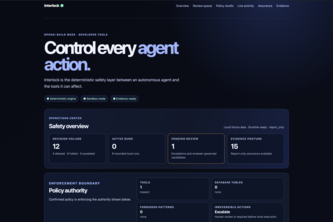
What the company appears to be: InterLock is a self-reported deterministic authorization layer for AI agents that sits between an agent and tools it can affect. The system allows a human to review and confirm a policy draft generated by a model, then enforces that policy through a deterministic engine without model or network calls.
What changed: The author states they built this as a response to incidents where AI agents took unintended actions despite explicit instructions, aiming for "the boring, reliable layer underneath" — a system that says no when actions are not explicitly authorized.
Single most important open question: Is there evidence of any real-world usage or testing beyond the author's own development and evaluation?
What The Product Actually Is
The description states InterLock is:
- A deterministic authorization layer for autonomous agents
- Designed to sit between an agent and tools it can affect
- A system that allows a human to review and confirm a policy draft generated by a model, then enforces that policy through a deterministic engine without model or network calls
- A system where the model suggests but never decides
The author describes it as:
- Having one hard boundary
- Two model-mediated paths: policy drafting and demo agent, neither in enforcement path
- A deterministic engine that imports no model client or network client
- Built with FastAPI backend, SQLite audit log, Next.js dashboard, sandboxed local tools, and Azure/GitHub OIDC deployment foundations
Evidence: The author's own description of the system architecture and components.
Inference: The system appears to be a proof-of-concept or prototype built for a hackathon, not yet deployed in production.
Positioning & Claim Evolution
The author states:
- The product is positioned as a "deterministic safety gate" that stops AI agents from taking actions you never approved
- It is described as a "boring, reliable layer underneath"
- The core claim is: "the model is allowed to suggest, but it is never allowed to decide"
- The system aims to be "genuinely safe to put an agent near the things you cannot afford to lose"
Evidence: Self-reported claims from the author's own submission.
Inference: The positioning reflects a shift from probabilistic safety (relying on prompts or model checks) to deterministic enforcement, based on explicit human authorization.
Target Customer & ICP
The description states:
- The system is designed for AI agents that interact with real tools
- It is intended for use cases where "you cannot afford to lose" things like data, systems, or money
- The target includes developers or organizations using AI agents in production environments
Evidence: Author's own claims about the problem space and intended use.
Inference: The ICP appears to be developers or teams building or deploying AI agents that interact with real systems — but no specific customer segments or personas are named.
Business Model & Pricing Evidence
The description states:
- No pricing information is provided
- No business model is described beyond the author's own development and demonstration
- The system is presented as a prototype for a hackathon
Evidence: Not evidenced.
Inference: There is no evidence of any monetization strategy or pricing structure, which is consistent with it being a hackathon project.
Technical & Delivery Signals
The description states:
- Built with Codex using GPT-5.6 as the coding agent
- Uses FastAPI backend, SQLite audit log, Next.js dashboard
- Sandboxed local tools to prevent real system access
- Azure and GitHub OIDC deployment foundations
- 25-scenario safety evaluation runs in CI on every push/pull request
- Tamper-evident evidence bundle with command-line verifier
Evidence: Author's own technical description.
Inference: The system is built for demonstration and testing, not production use. The architecture shows deliberate separation of concerns but lacks real-world deployment details.
Traction & Maturity Signals
The description states:
- The project was submitted to the OpenAI 2026 hackathon
- It includes a 25-scenario safety evaluation that passes
- There is no mention of any customers, revenue, or adoption beyond the author’s own development
Evidence: Author's own claims about the hackathon submission and evaluation.
Inference: No evidence of traction, customers, or real-world deployment. The project appears to be a prototype or proof-of-concept.
Competitive Context
The description states:
- No mention of competitors
- No reference to existing tools or platforms in this space
- The author frames the problem as one where "people often try to control it with better prompts, louder warnings, or a second model checking the first" — which they reject as insufficient
Evidence: Not evidenced.
Inference: There is no evidence of competitive analysis or awareness of existing solutions. This suggests either limited market research or that the author has not yet considered the broader space.
Open Questions & Risks
The description states:
- The system is built for a hackathon and lacks real-world deployment details
- It uses a single developer (Myan Gupta) as the entire team
- No evidence of any real-world usage or testing beyond the author’s own development
- The system is described as a "deterministic engine" but no information about scalability, performance, or integration with existing systems
Evidence: Author's own description and lack of external data.
Inference: The biggest risk is that this is a prototype, not a product. There are no signs of commercial viability or real-world adoption.
Questions the description leaves open
- What specific real-world use cases have you identified for InterLock?
- Have you tested the system with any external agents or tools beyond your own sandboxed demo?
- How would you scale this system to support multiple concurrent users or agents?
- What is the plan for integrating InterLock into existing AI agent frameworks or platforms?
- Are there any known limitations in terms of policy complexity or action types that the deterministic engine cannot handle?
- What are your thoughts on how to make this product commercially viable beyond a hackathon prototype?
Overall Assessment
The description states:
- InterLock is a self-reported hackathon project
- It is not evidenced to have any revenue, customers, or traction
- The author is the only team member
- No business model or pricing information is provided
Evidence: Author's own claims and lack of external data.
Inference: This appears to be a prototype or proof-of-concept with no demonstrated commercial viability. It is not ready for investment or partnership at this stage.
User Stories BotA demo video on every pull request
Get a demo video on every new feature
GitHub App that watches your pull requests and records a narrated, captioned demo.
Save time on demo prep and make informed decisions faster with a video walkthrough of every new feature.
Source
Submitted to the OpenAI 2026 hackathon on Devpost. Project home on Devpost. Back to the full gallery on Devpost.
This competitive analysis was produced by top-founders.com (opens in a new tab)
Generated by a language model from this project's public Devpost page — its tagline, the author's own write-up and any built-with tags listed there — as captured in August 2026. Short quotations are the author's words. It is an opinion on the idea as a business, not on the people behind it, and it reflects the description as published then. If the project has moved on, request a correction below. The analysis is not independent research and contains no verified traction, revenue or customer data.
An independent guide by KFG International LLC — not affiliated with, endorsed by, or connected to Devpost or OpenAI.