

Archive position — measured, not model output
1 like on Devpost
505 of the 7,850 archived projects have more likes, and 1,758 share exactly 1 — so this project's #744 place in the like-ranked listing is a tie-break inside that group, not a ranking.
Projects (log scale)
Likes on Devpost. ▲ marks this project's group.
Show the figures
| Likes | Projects | Share of archive |
|---|---|---|
| 0 | 5,587 | 71.2% |
| 1 | 1,758 | 22.4% |
| 2 | 284 | 3.6% |
| 3–4 | 132 | 1.7% |
| 5–9 | 75 | 1.0% |
| 10+ | 14 | 0.2% |
 User Stories BotA demo video on every pull request
Get a demo video on every new feature
GitHub App that watches your pull requests and records a narrated, captioned demo.
Save time on demo prep and make informed decisions faster with a video walkthrough of every new feature.
Executive Summary
What the company appears to be
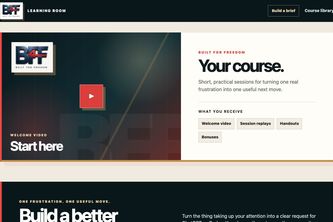
Built for Freedom Learning Room is a self-reported educational tool designed to help nontechnical business owners translate real frustrations into actionable AI build briefs using ChatGPT or Codex. It is described as a prototype built during an OpenAI hackathon, with no current revenue, customers, or verified traction.
What changed
The project was submitted as part of the OpenAI 2026 hackathon and is presented as a working prototype. The author states that it is not yet sold, enrolled, or outcome-validated, but rather a testable, focused product built to demonstrate a method for AI education.
Single most important open question
Is there evidence of any real-world usage or feedback from users beyond the author’s own experience and testing?
What The Product Actually Is
The description states that Built for Freedom Learning Room is a tool that helps nontechnical business owners turn one messy frustration into a clear, bounded AI build brief. It uses a guided flow to collect input on:
- The burden they want to reduce
- The smallest useful result
- Information the AI may use
- What it must not change or do
- Acceptance criteria before trusting the result
It then creates and allows the user to review, copy, or download this brief.
The tool is described as using responsive HTML, CSS, JavaScript, a small ES module for the guided flow, Node's built-in test runner, and Cloudflare Pages for the live demo. It does not send or store learner input.
Evidence
- The author describes how it works in detail.
- The tool uses specific technologies (HTML, CSS, JS, Node, Cloudflare).
- No data is sent or stored by the tool.
Inference The tool is a prototype built for demonstration and testing purposes, not production use.
Positioning & Claim Evolution
The author positions the product as a method to help business owners who feel overwhelmed by AI tools. It is framed around the idea of starting small, taking action, learning while doing, and building identity through use rather than prior knowledge.
Key claims:
- “You do not need to understand every tool before you begin.”
- “Start with one frustration. Build the smallest thing that gives you some relief.”
- The tool teaches a method for AI education: naming pressure, clearing noise, choosing a result, giving context, setting boundaries, inspecting and building, reviewing, and saving.
Evidence
- These are self-reported claims in the author's own words.
- No external validation or customer feedback is provided.
Inference The positioning is based on personal experience and narrative rather than market data or user testing.
Target Customer & ICP
The target customer is described as a nontechnical business owner who feels behind with AI. The author notes that such users often feel overwhelmed by the number of tools, models, and prompt packs available.
Evidence
- “I keep meeting smart, capable business owners who feel like they are already behind with AI.”
- “The learner can arrive overwhelmed, choose one familiar situation, and leave with a useful brief.”
Inference The ICP is defined by the author’s own experience and perception of user needs, not by data or market research.
Business Model & Pricing Evidence
There is no evidence of any pricing model or business model in the description. The tool is described as a prototype submitted for a hackathon and is not represented as sold, enrolled, or outcome-validated.
Evidence
- “It is not represented as sold, enrolled, or outcome-validated.”
- No mention of monetization, subscriptions, or pricing.
Inference No business model or pricing structure is evident from the description.
Technical & Delivery Signals
The tool is built using:
- Responsive HTML, CSS, and JavaScript
- A small ES module for the guided flow
- Node’s built-in test runner
- Dependency-free local server
- Cloudflare Pages for live demo
It passes five Freedom Builder tests plus static-integrity, asset, learner-language, and local-first privacy checks. The source application also passes 49 tests and current desktop and mobile browser QA.
Evidence
- The author describes the tech stack.
- Tests and QA are mentioned as part of the build process.
Inference The tool is built with a focus on testing and privacy, but this does not indicate production readiness or scalability.
Traction & Maturity Signals
There is no evidence of traction, revenue, customers, or adoption. The project is described as a prototype submitted for a hackathon and is explicitly stated to be “not represented as sold, enrolled, or outcome-validated.”
Evidence
- “It is not represented as sold, enrolled, or outcome-validated.”
- “The current submission is a working education-product prototype prepared for a founding cohort.”
Inference No traction or user feedback is reported.
Competitive Context
There is no mention of competitors in the description. The author does not reference existing tools or platforms that offer similar functionality.
Evidence
- No competitive analysis or references to other products.
Inference The competitive landscape is unknown from this description.
Open Questions & Risks
- No traction or validation: The tool is a prototype, not a product with users or outcomes.
- Unverified claims: All positioning and value propositions are self-reported.
- Single-person team: Only one member (Nathan Wildman) is listed.
- No pricing or monetization model: No indication of how the product would be monetized.
- Limited scope: The author explicitly states that the vision extends beyond what was built, but only the current version is submitted.
Evidence
- All of the above are stated in the description.
Questions the description leaves open
- What specific user feedback or testing has been done beyond your own experience?
- How do you plan to validate the utility and adoption of this tool before scaling?
- Are there any plans for monetization, and how does that align with the current prototype?
- What is the roadmap for expanding beyond the current scope, and what are the key milestones?
- How do you intend to reach your target audience of nontechnical business owners?
Overall Assessment
Not evidenced
The description provides no evidence of revenue, customers, traction, or validated market demand. It is a self-reported prototype submitted for a hackathon with no indication of commercial viability or scalability.
This project is not ready for investment or partnership consideration based on the information provided. The author’s claims are unverified and lack supporting data.
Confidence Low
Reasoning
The description is entirely self-reported, and there is no evidence of any commercial activity, user engagement, or market validation.
User Stories BotA demo video on every pull request
Get a demo video on every new feature
GitHub App that watches your pull requests and records a narrated, captioned demo.
Save time on demo prep and make informed decisions faster with a video walkthrough of every new feature.
Source
Submitted to the OpenAI 2026 hackathon on Devpost. Project home on Devpost. Back to the full gallery on Devpost.
This competitive analysis was produced by top-founders.com (opens in a new tab)
Generated by a language model from this project's public Devpost page — its tagline, the author's own write-up and any built-with tags listed there — as captured in August 2026. Short quotations are the author's words. It is an opinion on the idea as a business, not on the people behind it, and it reflects the description as published then. If the project has moved on, request a correction below. The analysis is not independent research and contains no verified traction, revenue or customer data.
An independent guide by KFG International LLC — not affiliated with, endorsed by, or connected to Devpost or OpenAI.