

Archive position — measured, not model output
1 like on Devpost
505 of the 7,850 archived projects have more likes, and 1,758 share exactly 1 — so this project's #741 place in the like-ranked listing is a tie-break inside that group, not a ranking.
Projects (log scale)
Likes on Devpost. ▲ marks this project's group.
Show the figures
| Likes | Projects | Share of archive |
|---|---|---|
| 0 | 5,587 | 71.2% |
| 1 | 1,758 | 22.4% |
| 2 | 284 | 3.6% |
| 3–4 | 132 | 1.7% |
| 5–9 | 75 | 1.0% |
| 10+ | 14 | 0.2% |
 User Stories BotA demo video on every pull request
Get a demo video on every new feature
GitHub App that watches your pull requests and records a narrated, captioned demo.
Save time on demo prep and make informed decisions faster with a video walkthrough of every new feature.
Executive Summary
What the company appears to be
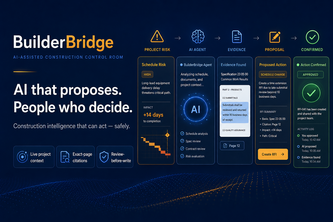
BuilderBridge is a self-reported construction project management OS that integrates schedules, tasks, documents, and RFIs into one workspace with an AI assistant that proposes changes but requires human approval before applying them.
What changed
The author states they rebuilt the system from an initial version that allowed direct AI updates to a new flow where all changes are proposed and approved by users. This change was driven by trust concerns around AI making decisions without human oversight.
Single most important open question
Is there evidence of actual construction team adoption or usage beyond the single founder's development work? The description contains no information about customers, revenue, traction, or real-world deployment.
The analysis is based entirely on self-reported author statements. There is no evidence of revenue, customers, partnerships, or market validation. The project appears to be a proof-of-concept built by one person for a hackathon with no demonstrated commercial traction.
What The Product Actually Is
The description states BuilderBridge is:
- A "OS for construction sites" that helps with scheduling and project-controls workspace
- A system that brings schedules, tasks, weekly plans, roadblocks, RFIs, submittals, drawings, and project documents into one place
- An application that uses AI to answer questions using live project data
- A system that supports integrations such as Procore
- A full-stack web application built with Next.js, React, TypeScript, Prisma, PostgreSQL, and Neon
The author describes it as a "project aware agent" that can search uploaded documents and point users to source pages behind answers. The assistant helps prepare actions like updating tasks or creating schedule-impact items, but does not apply changes automatically - instead creates proposals for human approval.
Positioning & Claim Evolution
The description states BuilderBridge grew from the tension between:
- AI helping connect fragmented construction information
- Not wanting AI to make important construction decisions by itself
The positioning evolved from an initial version that "allowed the assistant to update project data too directly" to a current model where:
- All changes are proposed and require human approval
- Every approved action is checked against user permissions
- Activity logs record all changes
- The assistant can answer questions using live project data but must point to source documents
The author claims this approach "gives the assistant a useful role without giving it unlimited authority" and that the proposal workflow allows users to see what will change before it happens, reject incorrect proposals, and review approved actions later.
Target Customer & ICP
The description states BuilderBridge targets:
- Construction teams (office and field teams)
- Users who work with schedules, tasks, weekly commitments, roadblocks, RFIs, submittals, drawings, and project documents
- Teams that need to understand the same version of what is happening between office and field teams
The author identifies two main user groups:
- Office teams who manage schedules and project controls
- Field teams who work on actual construction tasks
The system appears designed for construction project managers, coordinators, or supervisors who need to coordinate between different information systems.
Business Model & Pricing Evidence
The description states BuilderBridge includes:
- Subscription billing through Stripe
- Organization roles and project level permissions
- Project and portfolio analytics
- Support for organizations and multiple projects
However, there is no evidence provided about pricing tiers, subscription costs, or specific business model details. The author mentions "subscription billing" but does not describe actual pricing structure or revenue model.
Technical & Delivery Signals
The description states BuilderBridge was built as a full-stack web application using:
- Next.js, React, TypeScript
- Prisma, PostgreSQL, Neon
- Better Auth with Google OAuth for authentication
- OpenRouter compatible AI gateway
- Structured actions to validate AI responses before applying changes
- Document processing pipeline with OCR support for scanned documents
- Integration with Procore API
- Transactional emails through Resend
- Monitoring and error reporting through Sentry
The system includes features like:
- Construction schedules and task dependencies
- Weekly Work Plans and commitments
- Progress updates and roadblocks
- RFIs and submittals
- Drawings and project files
- Project and portfolio analytics
Traction & Maturity Signals
Not evidenced.
The description contains no information about:
- Customers or users
- Revenue or financial performance
- Market traction or adoption
- Product usage metrics
- Customer feedback or testimonials
- Deployment in real construction projects
- Any form of commercial validation
The project is described as a hackathon submission built by one person, with no evidence of market presence or user base.
Competitive Context
Not evidenced.
The description does not mention:
- Direct competitors in the construction software space
- Market positioning relative to existing solutions
- Competitive advantages or differentiators
- Market size or addressable market
- Industry trends or competitive landscape
The author only describes their own solution and its features, without reference to what already exists in the market.
Open Questions & Risks
Inferences based on self-reported information:
- Single-founder risk: The project is built by one person (Akash Kumar Prasad) with no evidence of team expansion or commercial traction.
- Unproven market demand: No evidence of actual construction teams using the product beyond the founder's development work.
- Technical implementation risks: The author notes they had to rebuild the system multiple times due to trust issues, suggesting technical complexity and potential instability.
- AI reliability concerns: The system requires structured actions and proposal workflows because plain text responses were deemed unreliable for working with real project records.
- Limited validation: The author states that "a convincing demo and a dependable product are very different things" and that many improvements came from asking "Would I trust this on a real project?" suggesting the solution may not yet be production-ready.
- Hackathon context: The project was submitted to a hackathon, indicating it's likely in early development rather than a mature commercial offering.
Questions the description leaves open
- What specific construction teams or organizations have shown interest in using BuilderBridge beyond the founder's own development work?
- How many actual construction projects are currently using this system versus just being tested?
- What is the current user feedback from any construction teams who have tried it?
- Can you provide evidence of any revenue generation, even if minimal?
- What specific challenges have you faced in getting construction teams to adopt or trust this system?
- How do you plan to scale beyond a single developer's capacity?
- What is the timeline for moving from prototype to production-ready solution?
- Have you identified specific market segments or regions where you expect adoption?
- What are your plans for addressing the technical challenges around stale data checks and concurrent edits?
- How do you plan to monetize the subscription model beyond just basic access?
Overall Assessment
Not evidenced.
The description provides no information about:
- Financial performance or revenue
- Customer base or market traction
- Commercial viability or scalability
- Founders' track record or team capabilities beyond one person
- Market opportunity size or competitive positioning
- Any form of investment interest or partnership discussions
This appears to be a hackathon project built by one individual with no demonstrated commercial traction, customers, or revenue. The author describes significant technical challenges and implementation issues that suggest the solution is not yet production-ready. There is no evidence of market validation or commercial viability beyond the single developer's own work.
The project shows technical capability in building a complex system with AI integration, but lacks any evidence of real-world adoption or commercial success. Any investment or partnership decision would require additional evidence of traction, customer validation, and market demand that is not present in this self-reported description.
User Stories BotA demo video on every pull request
Get a demo video on every new feature
GitHub App that watches your pull requests and records a narrated, captioned demo.
Save time on demo prep and make informed decisions faster with a video walkthrough of every new feature.
Source
Submitted to the OpenAI 2026 hackathon on Devpost. Project home on Devpost. Back to the full gallery on Devpost.
This competitive analysis was produced by top-founders.com (opens in a new tab)
Generated by a language model from this project's public Devpost page — its tagline, the author's own write-up and any built-with tags listed there — as captured in August 2026. Short quotations are the author's words. It is an opinion on the idea as a business, not on the people behind it, and it reflects the description as published then. If the project has moved on, request a correction below. The analysis is not independent research and contains no verified traction, revenue or customer data.
An independent guide by KFG International LLC — not affiliated with, endorsed by, or connected to Devpost or OpenAI.