

Archive position — measured, not model output
0 likes on Devpost
2,263 of the 7,850 archived projects have more likes, and 5,587 share exactly 0 — so this project's #4,667 place in the like-ranked listing is a tie-break inside that group, not a ranking.
Projects (log scale)
Likes on Devpost. ▲ marks this project's group.
Show the figures
| Likes | Projects | Share of archive |
|---|---|---|
| 0 | 5,587 | 71.2% |
| 1 | 1,758 | 22.4% |
| 2 | 284 | 3.6% |
| 3–4 | 132 | 1.7% |
| 5–9 | 75 | 1.0% |
| 10+ | 14 | 0.2% |
 User Stories BotA demo video on every pull request
Get a demo video on every new feature
GitHub App that watches your pull requests and records a narrated, captioned demo.
Save time on demo prep and make informed decisions faster with a video walkthrough of every new feature.
Executive Summary
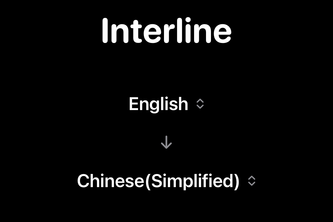
The company appears to be a solo developer project named Interline, an offline bilingual simultaneous interpreter for iOS devices. The author states it uses Apple Intelligence and on-device frameworks to provide real-time transcription, translation, and captioning with contextual refinement. It is described as a personal project submitted to the OpenAI 2026 hackathon.
What changed: This is a self-reported developer prototype, not a commercial product. There is no evidence of prior versions, funding, or market traction.
The single most important open question: Is there any evidence that this project has moved beyond a personal hackathon submission into a viable business or product?
What The Product Actually Is
The description states that Interline is an on-device bilingual captioning app for iPhone and iPad. It continuously transcribes speech, translates it in real time, and aligns both languages.
It uses:
- SwiftUI
- Apple’s Speech, Translation, Foundation Models, AVFoundation, and SwiftData frameworks
Key features include:
- Real-time transcription and translation
- Context-aware refinement using Apple Intelligence
- Searchable conversation history
- Export of transcripts as TXT or SRT files
- Audio playback with synchronized captions
Inference: The app is built for iOS devices only and relies on Apple’s on-device AI capabilities.
Positioning & Claim Evolution
The author states that Interline was inspired by the need for better translation experiences during long, continuous sessions. It positions itself as:
- An offline bilingual simultaneous interpreter
- A tool that improves upon existing iOS translation tools
- A solution that prioritizes contextual understanding, privacy, and accessibility
It claims to use Apple Intelligence to improve translations by:
- Understanding conversational context
- Resolving ambiguous references
- Applying glossary terms
- Correcting speech-recognition errors
Inference: The positioning is focused on improving accessibility for international students or professionals who need long-term interpretation support.
Target Customer & ICP
The description states that the project was inspired by the author’s experience as an international student, suggesting a user base of:
- International students
- Professionals requiring real-time interpretation
- Users seeking offline, private translation tools
There is no evidence of specific customer segments or personas beyond this self-reported inspiration.
Inference: The ICP appears to be individuals needing on-device, bilingual interpretation in educational or professional settings.
Business Model & Pricing Evidence
The description does not contain any information about:
- Revenue model
- Pricing strategy
- Monetization plans
- Paid features or tiers
Not evidenced
Technical & Delivery Signals
The app is built using:
- SwiftUI
- Apple’s Speech, Translation, Foundation Models, AVFoundation, and SwiftData frameworks
It implements a two-stage design:
- Fast translation via Apple’s Translation framework
- Context-aware refinement using Apple Intelligence
Key technical features:
- Language-aware buffering and segmentation
- Structured prompts for AI refinement
- Adaptive refinement frequency based on device performance
- Support for long sessions with fallbacks
Inference: The app is designed to be efficient, responsive, and resilient to device limitations.
Traction & Maturity Signals
The description states that this was a hackathon submission (OpenAI 2026). There is no evidence of:
- Customers or users
- Revenue or monetization
- Product-market fit
- Market traction
- Prior versions or iterations
Not evidenced
Competitive Context
There is no mention in the description of:
- Competitors
- Existing solutions in the market
- Competitive advantages or differentiation
Not evidenced
Open Questions & Risks
- Solo developer project: The team size is listed as 1, indicating a high risk of limited execution capacity.
- Hackathon prototype: No evidence of product-market fit or commercial viability beyond a personal project.
- Limited scope: The app is only for iOS devices and focuses on specific languages (Chinese, Japanese, Korean).
- No monetization strategy: No indication of how the project will generate revenue.
- Technical limitations: Challenges with speech recognition in certain languages are noted as unresolved.
Inference: The project lacks commercial readiness and scalability.
Questions the description leaves open
- What is your plan for scaling beyond a single-person hackathon project?
- Have you tested the app with real users or in real-world settings?
- Are there any plans to expand beyond iOS or support more languages?
- How do you intend to monetize this product, if at all?
- What are the technical limitations that prevent broader adoption?
Overall Assessment
Not evidenced
The description is a self-reported account of a hackathon project with no evidence of commercial traction, revenue, or customer adoption. It is not clear whether this represents a viable business opportunity or just an experimental prototype.
The author states the app is built for iOS devices and uses Apple Intelligence to provide real-time translation and captioning. However, there is no indication that it has moved beyond a personal project into a product or service with market demand.
Confidence: Low — based entirely on self-reported information without any independent verification or evidence of traction.
User Stories BotA demo video on every pull request
Get a demo video on every new feature
GitHub App that watches your pull requests and records a narrated, captioned demo.
Save time on demo prep and make informed decisions faster with a video walkthrough of every new feature.
Source
Submitted to the OpenAI 2026 hackathon on Devpost. Project home on Devpost. Back to the full gallery on Devpost.
This competitive analysis was produced by top-founders.com (opens in a new tab)
Generated by a language model from this project's public Devpost page — its tagline, the author's own write-up and any built-with tags listed there — as captured in August 2026. Short quotations are the author's words. It is an opinion on the idea as a business, not on the people behind it, and it reflects the description as published then. If the project has moved on, request a correction below. The analysis is not independent research and contains no verified traction, revenue or customer data.
An independent guide by KFG International LLC — not affiliated with, endorsed by, or connected to Devpost or OpenAI.