

Archive position — measured, not model output
0 likes on Devpost
2,263 of the 7,850 archived projects have more likes, and 5,587 share exactly 0 — so this project's #2,703 place in the like-ranked listing is a tie-break inside that group, not a ranking.
Projects (log scale)
Likes on Devpost. ▲ marks this project's group.
Show the figures
| Likes | Projects | Share of archive |
|---|---|---|
| 0 | 5,587 | 71.2% |
| 1 | 1,758 | 22.4% |
| 2 | 284 | 3.6% |
| 3–4 | 132 | 1.7% |
| 5–9 | 75 | 1.0% |
| 10+ | 14 | 0.2% |
 User Stories BotA demo video on every pull request
Get a demo video on every new feature
GitHub App that watches your pull requests and records a narrated, captioned demo.
Save time on demo prep and make informed decisions faster with a video walkthrough of every new feature.
Executive Summary
What the company appears to be
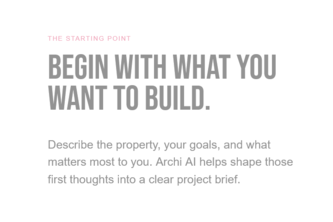
Archi AI is an architectural decision agent built as a hackathon project, powered by GPT-5 and structured JSON outputs. It guides users through building decisions by organizing information, identifying unknowns, and preparing them for professional conversations.
What changed
The project was developed during Build Week (OpenAI 2026 hackathon), with the goal of making architectural knowledge more accessible to homeowners and stakeholders. It evolved from an idea into a working prototype that includes conversational AI, dynamic project roadmaps, and downloadable PDF reports.
Single most important open question
Is there evidence of traction or early adoption beyond the hackathon context? The description does not state whether any users have engaged with Archi AI beyond its initial development phase.
Note: This analysis is based solely on the self-reported, unverified project description provided by the authors. No external verification, revenue data, customer base, or usage metrics are available.
What The Product Actually Is
The description states that Archi AI is an architectural decision agent that transforms open-ended building ideas into structured preliminary project roadmaps through guided conversation.
It uses:
- OpenAI Responses API
- GPT-5 model
- Structured JSON outputs for both conversational responses and dynamic project roadmap generation
Key features include:
- Guided conversation to clarify goals, identify considerations, and highlight uncertainties
- Generation of a living project brief that can be downloaded as a branded PDF
- Integration with Codex for rapid development and UI/UX design
- Migration to PHP backend and API integration
Inference: The product appears to be a conversational AI tool designed specifically for architectural decision-making, not a general-purpose AI assistant.
Positioning & Claim Evolution
The description states that Archi AI was inspired by the challenge of turning building ideas into reality, where information is scattered across multiple sources and stakeholders. It aims to help users navigate this complexity by organizing information, identifying unknowns, and preparing them for professional conversations.
Key claims:
- “Archi AI helps people arrive at professional conversations better informed and better prepared.”
- “Everyone should be able to access the knowledge they need to create the built environment they dream about.”
Claim vs. Fact: These are positioning statements rather than evidence of traction or adoption. The project has not demonstrated real-world use beyond its hackathon prototype.
Target Customer & ICP
The description identifies two main user groups:
- Homeowners
- Project stakeholders
It also mentions architects as part of the team and implies they are a key audience for the tool’s functionality.
Inference: The target customer is likely homeowners or non-expert users who want to understand architectural processes, but the description does not specify how these users would be reached or engaged beyond the initial prototype.
Business Model & Pricing Evidence
Not evidenced.
The description does not mention any pricing model, monetization strategy, or business model. It focuses entirely on the technical and conceptual aspects of the product.
Absence of evidence: No indication of how Archi AI intends to generate revenue or whether it plans to charge users or partners.
Technical & Delivery Signals
The project was built using:
- GPT-5 via OpenAI Responses API
- Codex for development assistance
- HTML5, CSS3, JavaScript, PHP, JSON, PDF generation
- Structured outputs to support conversational and roadmap functionality
Key technical elements:
- Real-time dynamic project roadmap generation
- Conversational interface with professional guardrails
- Responsive UI built with Codex
- Backend migration to PHP
- API integration for deployment
Inference: The team used modern tools and frameworks, suggesting a capable development approach. However, no production data or scalability details are provided.
Traction & Maturity Signals
Not evidenced.
There is no mention of:
- Users or customers
- Revenue or monetization
- Product adoption or engagement metrics
- Post-hackathon usage or feedback
Absence of evidence: No indication that Archi AI has moved beyond the prototype stage or gained traction outside of its hackathon context.
Competitive Context
Not evidenced.
The description does not reference existing competitors, similar tools, or market positioning relative to other AI-powered architectural or planning platforms.
Absence of evidence: No competitive landscape is described or implied.
Open Questions & Risks
- No traction or user base: The project exists only as a hackathon prototype with no evidence of real-world usage.
- Unproven business model: There is no indication of how the product will be monetized or scaled.
- Limited team size: Only two team members are listed, which may limit execution capacity.
- Dependency on AI models: Reliance on GPT-5 and Codex raises questions about long-term sustainability and control over the technology stack.
- Unclear path to market: No evidence of go-to-market strategy or customer acquisition plans.
Inference: Without traction, a clear business model, or scalable execution plan, Archi AI remains an unproven concept.
Questions the description leaves open
- What is the current status of Archi AI beyond the hackathon? Has it been tested with real users?
- Are there any plans for monetization or revenue streams?
- How does the team intend to scale the product beyond its initial prototype?
- What are the technical dependencies and risks associated with using GPT-5 and Codex long-term?
- Have you identified specific customer segments or use cases outside of the hackathon context?
- Is there a plan for integrating public planning or permitting data as mentioned in “What’s next”?
Overall Assessment
Not evidenced.
There is no evidence of:
- Revenue, ARR, or funding
- Customer traction or adoption
- Market validation or competitive positioning
Assessment: Based on the self-reported description alone, Archi AI appears to be a promising hackathon idea with strong initial design and technical execution. However, it lacks any demonstrated traction, business model, or market readiness for investment or partnership consideration.
User Stories BotA demo video on every pull request
Get a demo video on every new feature
GitHub App that watches your pull requests and records a narrated, captioned demo.
Save time on demo prep and make informed decisions faster with a video walkthrough of every new feature.
Source
Submitted to the OpenAI 2026 hackathon on Devpost. Project home on Devpost. Back to the full gallery on Devpost.
This competitive analysis was produced by top-founders.com (opens in a new tab)
Generated by a language model from this project's public Devpost page — its tagline, the author's own write-up and any built-with tags listed there — as captured in August 2026. Short quotations are the author's words. It is an opinion on the idea as a business, not on the people behind it, and it reflects the description as published then. If the project has moved on, request a correction below. The analysis is not independent research and contains no verified traction, revenue or customer data.
An independent guide by KFG International LLC — not affiliated with, endorsed by, or connected to Devpost or OpenAI.