

Archive position — measured, not model output
0 likes on Devpost
2,263 of the 7,850 archived projects have more likes, and 5,587 share exactly 0 — so this project's #6,629 place in the like-ranked listing is a tie-break inside that group, not a ranking.
Projects (log scale)
Likes on Devpost. ▲ marks this project's group.
Show the figures
| Likes | Projects | Share of archive |
|---|---|---|
| 0 | 5,587 | 71.2% |
| 1 | 1,758 | 22.4% |
| 2 | 284 | 3.6% |
| 3–4 | 132 | 1.7% |
| 5–9 | 75 | 1.0% |
| 10+ | 14 | 0.2% |
 User Stories BotA demo video on every pull request
Get a demo video on every new feature
GitHub App that watches your pull requests and records a narrated, captioned demo.
Save time on demo prep and make informed decisions faster with a video walkthrough of every new feature.
Executive Summary
What the company appears to be
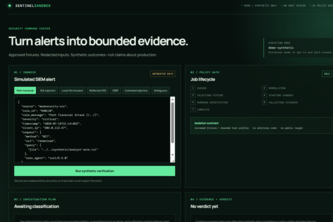
SentinelSandbox is a self-reported agentic security tool that uses GPT-5.6 and Codex to verify raw SIEM alerts by spinning up ephemeral Docker sandboxes and dynamically replaying exploit payloads. It claims to provide SOC teams with automated, risk-free attack pattern verification in isolated environments.
What changed
The project was submitted as part of the OpenAI 2026 hackathon on Devpost. The author describes it as a proof-of-concept or prototype built over a short timeframe, with no evidence of commercial deployment or traction.
Single most important open question
Is there any evidence that SentinelSandbox has been deployed in production environments or used by actual security teams for triage purposes?
What The Product Actually Is
The description states that SentinelSandbox is an agentic security tool designed to verify SIEM alerts using GPT-5.6 and Codex. It ingests simulated SIEM alerts, redacts sensitive data, and verifies attack patterns through:
- Redaction & Normalization of alert payloads
- Deterministic policy gating based on versioned synthetic fixtures (e.g., Path Traversal, SQL Injection)
- Hardened ephemeral verification via Docker sandboxes with strict isolation
- Return of explicit assessments (e.g., SYNTHETIC_REPRODUCTION_SUCCESSFUL)
- Custom mirror fixtures for organizations
- Audit logging without raw payloads
The system is built using Python 3.11+, FastAPI, React, Docker SDK for Python, and other technologies listed in the author’s write-up.
Inference This appears to be a prototype or hackathon project focused on safe, automated triage of security alerts, not a commercial product with customers or revenue.
Positioning & Claim Evolution
The description states that SentinelSandbox bridges a gap between low-fidelity SIEM alerts and the risks of manual investigation or live exploit payloads. It positions itself as:
- A risk-free alternative to traditional sandboxing
- An automated triage tool for SOC analysts
- A zero-trust system that avoids prompt injection traps and external targeting
It also claims to offer:
- Deterministic safety boundaries
- Adversarial Docker isolation proofs
- Zero raw-data audit trail
- Polished UX with real-time job tracking
Inference The positioning is centered on security automation, risk mitigation, and compliance-friendly operations. It does not claim to replace full incident response or remediation workflows.
Target Customer & ICP
The description states that SentinelSandbox targets Security Operations Center (SOC) analysts who are overwhelmed by low-fidelity SIEM alerts and need a way to safely verify attack patterns without risking production systems.
It also mentions:
- Admins can bind reviewed vulnerability logic to specific route shapes
- The tool is intended for use in enterprise security environments
Inference The ICP likely includes SOC teams within large enterprises or organizations with DevSecOps practices, but no evidence of actual customers or user base exists.
Business Model & Pricing Evidence
There is no mention of pricing models, monetization strategies, or business model details in the description. The project appears to be a self-reported hackathon submission without any indication of commercial viability or revenue streams.
Inference No evidence suggests that SentinelSandbox has a defined business model or pricing structure at this time.
Technical & Delivery Signals
The system is built using:
- Backend: Python 3.11+, FastAPI, Pydantic v2, SQLite
- Container Architecture: Docker SDK for Python, hardened containers with no network egress, read-only rootfs, dropped capabilities
- Frontend: React with TypeScript, Vite, Tailwind-style dark mode
- Testing: Pytest, Vitest, React Testing Library, MSW
Key technical features include:
- Ephemeral sandbox execution with strict resource caps and timeouts
- Deterministic policy gating to prevent LLM-driven actions
- Zero-trust architecture for handling untrusted inputs
- Audit logging that avoids storing raw payloads
Inference The tool shows strong engineering rigor in its design, particularly around container isolation and deterministic decision-making. However, it remains a prototype.
Traction & Maturity Signals
There is no evidence of:
- Revenue or ARR
- Customers or partnerships
- Product adoption or usage metrics
- Deployment in production environments
- Any form of traction beyond the hackathon submission
Inference This is a pre-commercial prototype, likely built for demonstration purposes rather than operational use.
Competitive Context
The description does not reference competitors directly. However, it implies a space involving:
- SIEM alert verification tools
- Sandboxing solutions for security automation
- DevSecOps platforms that integrate with SOC workflows
It also mentions potential future integrations with Splunk, Microsoft Sentinel, Elastic SIEM, and Shuffle SOAR — suggesting alignment with existing security tooling ecosystems.
Inference SentinelSandbox operates in a competitive market of security automation and sandboxing tools, but no evidence exists that it competes with or integrates with any established players.
Open Questions & Risks
- Unverified claims: All descriptions are self-reported and unverified.
- No traction or revenue: No evidence of commercial adoption or monetization.
- Prototype nature: Built for a hackathon, not intended for production use.
- Limited scope: Only mentions support for certain exploit types (Path Traversal, SQL Injection, etc.) — no indication of broader coverage.
- AI integration is reserved: GPT-5.6 integration is marked as "Phase 2" and behind a feature flag.
Inference The project lacks commercial readiness or market validation. It may be a promising idea but has not yet demonstrated real-world utility or scalability.
Questions the description leaves open
- What is the current status of SentinelSandbox? Is it being used internally or tested in any environment?
- How does the deterministic policy layer prevent adversarial inputs from bypassing controls?
- Has the team considered how to scale this solution beyond a single developer’s prototype?
- Are there plans to integrate with existing SIEM or SOAR platforms, and what are the technical challenges involved?
- What is the roadmap for moving from ephemeral Docker sandboxes to microVMs, and why is that necessary?
Overall Assessment
Not evidenced
There is no evidence of:
- Revenue
- Customers
- Product-market fit
- Commercial traction
- Funding or investor interest
The project is described as a hackathon submission, with no indication of commercial viability, scalability, or strategic positioning.
Inference At this stage, SentinelSandbox is best described as an idea or prototype, not a viable investment or partnership opportunity. It may evolve into something more substantial, but there is no evidence to support that today.
User Stories BotA demo video on every pull request
Get a demo video on every new feature
GitHub App that watches your pull requests and records a narrated, captioned demo.
Save time on demo prep and make informed decisions faster with a video walkthrough of every new feature.
Source
Submitted to the OpenAI 2026 hackathon on Devpost. Project home on Devpost. Back to the full gallery on Devpost.
This competitive analysis was produced by top-founders.com (opens in a new tab)
Generated by a language model from this project's public Devpost page — its tagline, the author's own write-up and any built-with tags listed there — as captured in August 2026. Short quotations are the author's words. It is an opinion on the idea as a business, not on the people behind it, and it reflects the description as published then. If the project has moved on, request a correction below. The analysis is not independent research and contains no verified traction, revenue or customer data.
An independent guide by KFG International LLC — not affiliated with, endorsed by, or connected to Devpost or OpenAI.