

Archive position — measured, not model output
0 likes on Devpost
2,263 of the 7,850 archived projects have more likes, and 5,587 share exactly 0 — so this project's #6,599 place in the like-ranked listing is a tie-break inside that group, not a ranking.
Projects (log scale)
Likes on Devpost. ▲ marks this project's group.
Show the figures
| Likes | Projects | Share of archive |
|---|---|---|
| 0 | 5,587 | 71.2% |
| 1 | 1,758 | 22.4% |
| 2 | 284 | 3.6% |
| 3–4 | 132 | 1.7% |
| 5–9 | 75 | 1.0% |
| 10+ | 14 | 0.2% |
 User Stories BotA demo video on every pull request
Get a demo video on every new feature
GitHub App that watches your pull requests and records a narrated, captioned demo.
Save time on demo prep and make informed decisions faster with a video walkthrough of every new feature.
Executive Summary
What the company appears to be
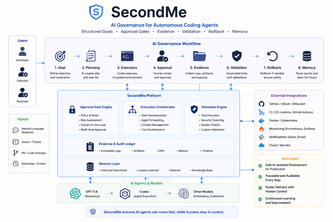
SecondMe Safe Agent Relay is a self-reported governance platform for AI coding agents. The author states it provides a structured workflow that coordinates autonomous AI agents while keeping humans in control of critical decisions, using a lifecycle including goal-setting, planning, execution, approval, evidence collection, validation, rollback, and memory.
What changed
The project was submitted as part of the OpenAI 2026 hackathon. It represents an early-stage concept focused on AI governance rather than building another coding assistant.
Single most important open question
Is there any evidence of real-world usage or traction beyond the hackathon submission?
What The Product Actually Is
The description states that SecondMe is a governance layer for AI coding agents, designed to coordinate autonomous agents while maintaining human oversight. It describes a structured workflow with these steps:
- Goal
- Planning
- Execution
- Approval
- Evidence
- Validation
- Rollback (if necessary)
- Memory
It uses GPT-5.6 and Codex for reasoning and implementation, built with Python, FastAPI, PostgreSQL, Linux, Systemd, and Nginx.
Inference The system appears to be a workflow engine that enforces governance over AI agent actions in software development environments.
Not evidenced No actual product functionality or live deployment is described. The project is presented as a hackathon submission with no mention of production use or integration into existing systems.
Positioning & Claim Evolution
The author states that SecondMe was built to answer the question:
“How can AI move faster without sacrificing production safety?”
It positions itself not as another coding assistant, but as a governance platform between AI and production systems. The goal is to allow AI agents to be productive while ensuring accountability.
Claims include:
- AI agents can execute tasks efficiently while humans remain in control.
- It enables collaboration between AI and humans instead of replacement.
- It establishes a reusable execution lifecycle that scales across future agents and models.
Inference The positioning reflects an intent to build a governance framework for AI systems, not just a tool for generating code.
Not evidenced No evidence of market positioning beyond the hackathon context. No competitor analysis or differentiation strategy is provided.
Target Customer & ICP
The description does not identify specific customer segments or personas. It implies that the target is organizations using AI coding agents, particularly those concerned with production safety and accountability.
It mentions a vision to support:
- Multi-agent collaboration
- Cross-model governance
- Enterprise deployment
Inference The intended users may be enterprise software teams or developers working with autonomous AI systems, but no explicit ICP is defined.
Not evidenced No customer data, user interviews, or buyer personas are included. No indication of who would pay for this platform.
Business Model & Pricing Evidence
There is no evidence in the description of a business model or pricing structure.
The author focuses on the technical architecture and workflow design but does not describe how SecondMe would generate revenue or what customers would pay for.
Inference If this evolves into a commercial product, it might be sold as a SaaS platform or integrated into existing development workflows, but no such plans are stated.
Not evidenced No pricing tiers, subscription models, or monetization strategies are mentioned.
Technical & Delivery Signals
The system is built using:
- Python
- FastAPI
- PostgreSQL
- Linux
- Systemd
- Nginx
It integrates GPT-5.6 and Codex for reasoning and implementation.
During the hackathon, the team focused on refining the governance workflow rather than adding more autonomous behaviors.
Inference The tech stack suggests a lightweight, scalable backend with API-first design and containerized deployment capabilities.
Not evidenced No details about scalability, performance metrics, or production readiness. No mention of security features or data handling practices.
Traction & Maturity Signals
The project is described as a hackathon submission, built during Build Week.
It was submitted to the OpenAI 2026 hackathon on Devpost.
Not evidenced There is no evidence of:
- Revenue
- Customers
- Product usage
- Market traction
- Any form of pilot or early adopter engagement
The author states that the project shows a practical governance workflow, but this is not validated by external data or adoption metrics.
Competitive Context
There is no mention in the description of existing competitors or similar products.
The author does not reference other AI governance platforms, coding assistants, or workflow automation tools.
Inference The competitive landscape is unknown. This may be a novel idea or one that overlaps with existing solutions, but no evidence supports either claim.
Not evidenced No competitive analysis, market sizing, or positioning relative to other players in the space.
Open Questions & Risks
- No traction or revenue: The project is only described as a hackathon submission.
- Unproven commercial viability: No business model or pricing strategy is evident.
- Limited team size: Only one member (Bo Old) is listed, raising questions about execution capacity.
- Self-reported only: All claims are unverified and lack external corroboration.
- Unclear differentiation: Without a clear understanding of the market or competitors, it's hard to assess whether this addresses a real need.
Inference The project lacks commercial maturity and may be in early conceptual stages.
Questions the description leaves open
- What specific pain points are you solving for in production environments?
- Have you identified any potential customers or use cases beyond the hackathon?
- How do you plan to monetize this platform if it becomes a product?
- What is your roadmap for moving from a prototype to a scalable solution?
- Are there any existing tools or platforms that already address these governance needs?
- How will you ensure trust and accountability in a multi-agent system?
Overall Assessment
Not evidenced: There is no evidence of commercial traction, revenue, or customer validation.
The project is described as a hackathon submission with no indication of product-market fit, scalability, or business viability.
Confidence level Low. The description is self-reported and lacks any verifiable data on performance, adoption, or financials.
Assessment This appears to be an early-stage concept with potential for further development, but there is insufficient evidence to support investment or partnership interest at this time.
User Stories BotA demo video on every pull request
Get a demo video on every new feature
GitHub App that watches your pull requests and records a narrated, captioned demo.
Save time on demo prep and make informed decisions faster with a video walkthrough of every new feature.
Source
Submitted to the OpenAI 2026 hackathon on Devpost. Project home on Devpost. Back to the full gallery on Devpost.
This competitive analysis was produced by top-founders.com (opens in a new tab)
Generated by a language model from this project's public Devpost page — its tagline, the author's own write-up and any built-with tags listed there — as captured in August 2026. Short quotations are the author's words. It is an opinion on the idea as a business, not on the people behind it, and it reflects the description as published then. If the project has moved on, request a correction below. The analysis is not independent research and contains no verified traction, revenue or customer data.
An independent guide by KFG International LLC — not affiliated with, endorsed by, or connected to Devpost or OpenAI.