

Archive position — measured, not model output
0 likes on Devpost
2,263 of the 7,850 archived projects have more likes, and 5,587 share exactly 0 — so this project's #6,600 place in the like-ranked listing is a tie-break inside that group, not a ranking.
Projects (log scale)
Likes on Devpost. ▲ marks this project's group.
Show the figures
| Likes | Projects | Share of archive |
|---|---|---|
| 0 | 5,587 | 71.2% |
| 1 | 1,758 | 22.4% |
| 2 | 284 | 3.6% |
| 3–4 | 132 | 1.7% |
| 5–9 | 75 | 1.0% |
| 10+ | 14 | 0.2% |
 User Stories BotA demo video on every pull request
Get a demo video on every new feature
GitHub App that watches your pull requests and records a narrated, captioned demo.
Save time on demo prep and make informed decisions faster with a video walkthrough of every new feature.
Executive Summary
What the company appears to be
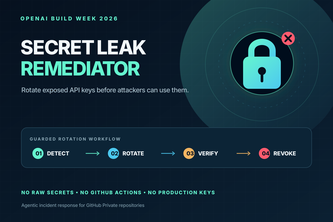
The project described by the caller is Secret Leak Remediator, a self-reported agentic workflow designed to detect leaked API keys, rotate them, verify replacements, and revoke compromised credentials — all within a controlled, observable process.
What changed
This is a single-person hackathon project submitted to the OpenAI 2026 hackathon. It was built as a serverless TypeScript application using Cloudflare Workers and integrates with various credential management systems via provider boundaries. The author states that it uses Codex and GPT-5.6 during development.
The single most important open question
Is there any evidence of real-world usage, traction, or revenue beyond the self-reported demo and hackathon submission?
What The Product Actually Is
The description states that Secret Leak Remediator is an agentic security workflow that:
- Detects exposed API keys.
- Creates replacements with minimal permissions.
- Verifies new credentials before revoking old ones.
- Updates secure storage.
- Revokes compromised credentials only after verification.
- Generates sanitized incident reports.
It is implemented as a serverless TypeScript application, using:
- Cloudflare Workers
- Hono for HTTP routing
- Provider boundaries isolating systems like GitHub, Vault, Vercel
- A mock provider in the public demo
The system is designed to work without GitHub Actions and accepts signed webhooks directly.
Inference The product appears to be a prototype or proof-of-concept built for demonstration purposes, not a production-ready tool.
Positioning & Claim Evolution
The description states that this project was inspired by manual incident-response workflows, where operators perform multiple steps manually, increasing risk. It positions itself as an automated solution that enforces strict safety rules such as:
verify(new credential) → revoke(old credential)
It claims to turn a secret leak into a controlled, observable, and reversible recovery process.
The author also notes that the system was built with security boundaries, including:
- No raw credentials stored in logs or dashboards
- Sanitized event data
- Isolated provider adapters
Inference The positioning is focused on DevSecOps automation, particularly around credential lifecycle management and reducing human error in response to leaks.
Target Customer & ICP
The description does not explicitly identify a customer segment or ideal customer profile (ICP). However, it implies that the intended users are:
- Security teams
- DevOps engineers
- Developers managing API keys in CI/CD pipelines
- Organizations using credential management tools like HashiCorp Vault, GitHub, Vercel
It is implied that these users would benefit from an automated workflow to handle secret leaks.
Inference The target audience likely includes security-conscious software teams, especially those working with cloud infrastructure and DevOps toolchains.
Business Model & Pricing Evidence
There is no evidence of a business model or pricing structure in the description. The project is presented as a hackathon submission, and no mention is made of monetization, licensing, or subscription models.
Not evidenced
Technical & Delivery Signals
The system is built using:
- Cloudflare Workers
- TypeScript
- Hono (HTTP routing)
- Provider boundaries for GitHub, Vault, Vercel
- Mock provider in public demo
- No GitHub Actions dependency
It uses:
- Codex and GPT-5.6 during development
- Webhooks for detection
- Health checks before revocation
The architecture is described as:
- Serverless
- Designed to work without CI/minute limitations
- Uses disposable sandbox paths for live testing
Inference The technical stack suggests a lightweight, serverless approach suitable for integration into existing DevOps pipelines.
Traction & Maturity Signals
There is no evidence of traction or adoption beyond the hackathon submission and public demo. The project:
- Was submitted to a hackathon
- Has a public demo that uses synthetic data and mock providers
- Is not connected to any real production systems
- Has no customer base, revenue, or usage metrics
Not evidenced
Competitive Context
The description does not reference specific competitors or similar tools. However, it implies alignment with:
- DevSecOps automation
- Credential rotation workflows
- Incident response platforms
It is positioned as a tool that automates and secures the process of rotating secrets after exposure — a niche but growing area in security.
Inference The project competes in the space of automated secret management and incident response, though no direct competitors are named.
Open Questions & Risks
Key risks and open questions based on the description:
- The system is presented only as a demo or prototype, not a production-grade tool.
- No real credentials or live integrations are involved in the public demo.
- The project has no traction, no customers, and no revenue.
- It was built by a single person for a hackathon — no team or organizational backing.
- The use of GPT-5.6 and Codex is described as part of development, not runtime functionality.
Inference The risk of misalignment between the project's stated goals and its actual utility in real-world environments is high.
Questions the description leaves open
- What is the current status of the prototype? Is it being used internally or tested with any partners?
- How does the system handle edge cases, such as failed health checks or revoked replacement credentials?
- Are there plans to integrate with real production systems beyond the sandboxed demo?
- Has the team considered scalability and performance under load?
- What are the actual security assumptions made in the design? How is trust established between components?
Overall Assessment
The project described is a single-person hackathon submission that presents a concept for automating secret leak remediation using agentic workflows.
It shows:
- A clear understanding of DevSecOps challenges
- Use of modern tooling (Cloudflare Workers, TypeScript)
- Thoughtful safety boundaries and design decisions
However, there is no evidence of traction, customers, or revenue. It remains a prototype with no production use or commercialization.
Assessment Not ready for investment or partnership at this stage. The idea has merit, but the project lacks real-world validation or business momentum. A follow-up on progress and potential product-market fit would be necessary before considering deeper engagement.
User Stories BotA demo video on every pull request
Get a demo video on every new feature
GitHub App that watches your pull requests and records a narrated, captioned demo.
Save time on demo prep and make informed decisions faster with a video walkthrough of every new feature.
Source
Submitted to the OpenAI 2026 hackathon on Devpost. Project home on Devpost. Back to the full gallery on Devpost.
This competitive analysis was produced by top-founders.com (opens in a new tab)
Generated by a language model from this project's public Devpost page — its tagline, the author's own write-up and any built-with tags listed there — as captured in August 2026. Short quotations are the author's words. It is an opinion on the idea as a business, not on the people behind it, and it reflects the description as published then. If the project has moved on, request a correction below. The analysis is not independent research and contains no verified traction, revenue or customer data.
An independent guide by KFG International LLC — not affiliated with, endorsed by, or connected to Devpost or OpenAI.