

Archive position — measured, not model output
0 likes on Devpost
2,263 of the 7,850 archived projects have more likes, and 5,587 share exactly 0 — so this project's #2,676 place in the like-ranked listing is a tie-break inside that group, not a ranking.
Projects (log scale)
Likes on Devpost. ▲ marks this project's group.
Show the figures
| Likes | Projects | Share of archive |
|---|---|---|
| 0 | 5,587 | 71.2% |
| 1 | 1,758 | 22.4% |
| 2 | 284 | 3.6% |
| 3–4 | 132 | 1.7% |
| 5–9 | 75 | 1.0% |
| 10+ | 14 | 0.2% |
 User Stories BotA demo video on every pull request
Get a demo video on every new feature
GitHub App that watches your pull requests and records a narrated, captioned demo.
Save time on demo prep and make informed decisions faster with a video walkthrough of every new feature.
Executive Summary
The company appears to be a single-person project (Gustavo Melogno) submitted to the OpenAI 2026 hackathon. The author describes a modular business application platform intended to connect sales, payments, operations, delivery, and printing in one system. It is built with no prior programming experience and uses AI tools like ChatGPT and Codex for development.
The single most important open question is: What is the actual commercial viability of this platform? The description lacks evidence of revenue, customers, or adoption — only a self-reported concept, workflow design, and demo build.
What The Product Actually Is
- The description states that App-modular is a modular business platform.
- It is designed to connect the entire order workflow, including:
- Product catalog
- Checkout
- Payments
- Preparation times
- Internal operations
- Delivery management
- Thermal printing
- The system includes separate interfaces for:
- Customers (to browse, order, pay)
- Operations panel (to manage status, delays, delivery assignment)
- Delivery drivers (to take orders)
- It supports modular adaptation to different business types by changing the catalog and enabling specific modules.
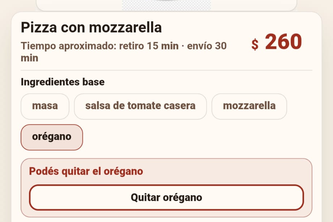
- The current demo includes both a restaurant profile and an optical store profile.
- The author built it using no prior programming experience, with help from AI tools like ChatGPT and Codex.
Note: This is a self-reported description. No evidence of actual product functionality, performance, or deployment exists beyond the author’s account.
Positioning & Claim Evolution
- The author positions App-modular as a modular business application that integrates multiple operational functions into one system.
- It is described as a platform for connecting sales, payments, operations, delivery, and printing, with an emphasis on order workflow automation.
- The platform is said to be adaptable to different industries (e.g., restaurants and optical stores), suggesting a multi-industry modular approach.
- The author claims the system was built by someone with no prior programming experience, which may imply a low-barrier-to-entry or no-code positioning.
Inference: The positioning suggests an intent to offer a simplified, scalable solution for small businesses managing order workflows. However, this is not substantiated by any evidence of traction or adoption.
Target Customer & ICP
- The author states that the platform supports different business types, including:
- Restaurants
- Optical stores
- It is described as a system for managing order workflows across sales, payments, operations, and delivery.
- No specific customer segments or personas are named.
Not evidenced: There is no evidence of target customer identification, segmentation, or ICP beyond the author’s self-description. The platform is not shown to have been tested with actual users or businesses.
Business Model & Pricing Evidence
- The description does not state any business model (e.g., SaaS, freemium, licensing).
- There is no mention of pricing, revenue streams, or monetization strategy.
- No evidence of a customer acquisition plan or go-to-market approach.
Not evidenced: The business model and pricing are not described. The author does not indicate whether the platform will be sold, licensed, or offered as a service.
Technical & Delivery Signals
- The author built the application using no prior programming experience, relying on AI tools like ChatGPT and Codex.
- The system includes:
- A customer-facing interface
- An operations panel
- A delivery driver interface
- Thermal printing capabilities
- It is described as a modular structure, allowing for adaptation to different business types.
- The project was submitted to the OpenAI 2026 hackathon.
Inference: The use of AI tools and lack of prior experience may suggest a rapid prototyping or proof-of-concept approach, rather than a fully developed, scalable system. No evidence of technical architecture, scalability, or deployment is provided.
Traction & Maturity Signals
- The project is described as a demo submitted to a hackathon.
- There is no evidence of:
- Customers
- Revenue
- Product usage
- Market testing
- Adoption
- The author states that the system was built by a single person with no prior programming experience.
Not evidenced: No traction or maturity signals are evident. The project appears to be in an early-stage concept or prototype phase.
Competitive Context
- The description does not mention any direct competitors.
- It is unclear whether App-modular is positioned against existing platforms like:
- Shopify
- Square
- Zoho
- Other order management systems
- No evidence of competitive analysis or differentiation strategy is provided.
Not evidenced: There is no indication of the competitive landscape or how this platform would differ from existing solutions.
Open Questions & Risks
- The project is described as a single-person effort with no prior programming experience, which raises questions about:
- Scalability
- Technical robustness
- Long-term maintenance
- It is a hackathon submission, not a commercial product.
- No evidence of:
- Revenue
- Customers
- Product-market fit
- Go-to-market strategy
- The use of AI tools for development may indicate a prototype or proof-of-concept, rather than a production-ready system.
Inference: The lack of technical depth, traction, and commercial viability raises significant risk that this is an early-stage idea, not a viable business.
Questions the description leaves open
- What specific industries or use cases are you targeting beyond restaurants and optical stores?
- How do you plan to monetize the platform?
- Have you tested the system with real users or businesses?
- What is your roadmap for scaling beyond the current demo?
- How do you intend to handle technical maintenance, updates, and support?
- What is the long-term vision for App-modular — is it a product or a service?
Overall Assessment
- The project is described as a single-person hackathon submission with no evidence of traction, revenue, or adoption.
- It is positioned as a modular business platform, but lacks commercial viability indicators.
- The author’s lack of prior programming experience and reliance on AI tools suggest this is an early-stage concept.
Assessment: Not evidenced. This appears to be a conceptual or prototype-level idea with no demonstrated commercial potential. It does not meet the criteria for investment or partnership at this stage.
User Stories BotA demo video on every pull request
Get a demo video on every new feature
GitHub App that watches your pull requests and records a narrated, captioned demo.
Save time on demo prep and make informed decisions faster with a video walkthrough of every new feature.
Source
Submitted to the OpenAI 2026 hackathon on Devpost. Project home on Devpost. Back to the full gallery on Devpost.
This competitive analysis was produced by top-founders.com (opens in a new tab)
Generated by a language model from this project's public Devpost page — its tagline, the author's own write-up and any built-with tags listed there — as captured in August 2026. Short quotations are the author's words. It is an opinion on the idea as a business, not on the people behind it, and it reflects the description as published then. If the project has moved on, request a correction below. The analysis is not independent research and contains no verified traction, revenue or customer data.
An independent guide by KFG International LLC — not affiliated with, endorsed by, or connected to Devpost or OpenAI.