

Archive position — measured, not model output
0 likes on Devpost
2,263 of the 7,850 archived projects have more likes, and 5,587 share exactly 0 — so this project's #4,639 place in the like-ranked listing is a tie-break inside that group, not a ranking.
Projects (log scale)
Likes on Devpost. ▲ marks this project's group.
Show the figures
| Likes | Projects | Share of archive |
|---|---|---|
| 0 | 5,587 | 71.2% |
| 1 | 1,758 | 22.4% |
| 2 | 284 | 3.6% |
| 3–4 | 132 | 1.7% |
| 5–9 | 75 | 1.0% |
| 10+ | 14 | 0.2% |
 User Stories BotA demo video on every pull request
Get a demo video on every new feature
GitHub App that watches your pull requests and records a narrated, captioned demo.
Save time on demo prep and make informed decisions faster with a video walkthrough of every new feature.
Executive Summary
The company appears to be a solo project named Inkform, self-described as a tool that turns handwriting into downloadable digital fonts using browser-side Rust processing. The author, LeAnne Branch, built it for personal use and as a demonstration of Rust programming skills, with no evidence of revenue, customers or product traction.
What changed: This is an early-stage prototype submitted to a hackathon — not a commercial product. It represents one person's technical exploration of handwriting-to-font conversion using WebAssembly and Rust.
Single most important open question: Is there any evidence that Inkform has moved beyond the prototype stage, or whether it will be developed into a commercial offering?
What The Product Actually Is
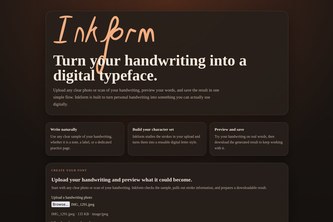
The description states that Inkform "turns a handwriting photo into a downloadable TrueType font". Users upload an image, provide visible text from that image, preview their style on real words, and download the result.
It uses a browser-side Rust font engine, with no server-side processing required. The core functionality is implemented in a shared Rust module (inkform-core) which handles validation, stroke extraction, glyph synthesis, and TTF assembly. This engine is exposed to the frontend via WebAssembly (inkform-wasm), and the UI is built using Next.js on Vercel.
The current version focuses on Latin Extended coverage. It uses a deterministic engine that validates samples, extracts stroke signals, synthesizes outlines, and assembles a browser-compatible TTF.
Inference: The product is a browser-based handwriting-to-font converter with no backend services or persistent data storage.
Positioning & Claim Evolution
The author positions Inkform as a tool to make handwriting into fonts without requiring printing character sheets, creating accounts, or uploading private writing to servers. It emphasizes local processing and privacy.
It also claims to be a "working, locally processed creative tool", not a static mockup, and that it adapts visible details such as cursive loops, entry strokes, terminal strokes, width, and spacing from the sample.
The project is described as being built by someone who specializes in Rust programming projects (Youtuber @Neoravit), suggesting a technical demonstration rather than a commercial product.
Inference: The positioning reflects a niche creative tool for individuals wanting to convert personal handwriting into digital fonts — not a scalable SaaS offering.
Target Customer & ICP
The description states that the author is a writer who uses many notebooks, and that Inkform is a "nice nod" to how she creates and processes information. This implies a personal use case rather than a business or enterprise audience.
There is no mention of specific customer segments, buyer personas, or commercial use cases beyond personal handwriting conversion.
Inference: The target customer appears to be individuals with personal handwriting, likely writers or artists, who want to digitize their own handwriting into fonts — not a B2B or mass-market audience.
Business Model & Pricing Evidence
There is no evidence of pricing or business model in the description. The project is presented as a hackathon submission and a technical demonstration with no indication of monetization or paid features.
The author states that the tool works locally in the browser, with no backend required, which suggests no recurring revenue model or subscription-based service.
Inference: No business model or pricing structure is evident. The project appears to be non-commercial in nature.
Technical & Delivery Signals
The project is built using:
- Rust for core font engine (
inkform-core) - WebAssembly (
inkform-wasm) for browser delivery - Next.js for frontend UI, deployed on Vercel Hobby
- No always-on backend required
It uses a deterministic engine that validates samples and derives stroke signals. It includes:
- Transcript-aligned letter validation
- Safety checks around continuity and topology
- Glyph grammar fallbacks for ambiguous characters
- Browser-compatible TTF generation with FreeType verification
The author notes use of Codex (GPT-5.6) in development, including architecture design, debugging, test coverage, and polish.
Inference: The technical stack is advanced for a solo developer, but the delivery is limited to browser-side processing without backend or cloud services.
Traction & Maturity Signals
There is no evidence of traction, customers, users, or adoption beyond the author’s own description. The project is described as a hackathon submission and a prototype, not a product in use.
The author states that it is a working tool, but there are no metrics on usage, downloads, or user feedback.
Inference: No traction signals exist. This is an early-stage prototype with no commercial validation.
Competitive Context
There is no mention of competitors in the description. The project does not reference existing tools for handwriting-to-font conversion, nor does it compare itself to any market offerings.
The author’s focus on local processing and privacy may differentiate it from cloud-based alternatives, but no such alternatives are named or described.
Inference: No competitive landscape is evident. The project appears to be in a niche space with no known direct competitors.
Open Questions & Risks
- Solo developer project: With only one member (LeAnne Branch), there is limited capacity for scaling, iteration, or product development.
- No commercial traction: No evidence of users, revenue, or adoption beyond the author’s own use case.
- Prototype nature: The project is described as a hackathon submission and not a commercial product.
- Limited scope: Current functionality is restricted to Latin Extended coverage and lacks support for other scripts.
- Unverified claims: All descriptions are self-reported and unverified.
Inference: The risk of failure or lack of commercial viability is high due to the prototype nature, lack of traction, and limited team capacity.
Questions the description leaves open
- What is the actual use case for this tool beyond personal handwriting?
- Are there any plans to expand beyond Latin Extended characters or support other writing systems?
- Is there any intention to monetize or commercialize Inkform?
- How does the tool handle variability in handwriting styles, especially when a transcript is not available?
- Has the author considered how this might scale or be integrated into larger workflows or platforms?
Overall Assessment
Not evidenced.
There is no evidence of revenue, customers, traction, or commercial viability to support an investment or partnership decision. The project is a technical prototype, not a product in the market.
The author describes it as a personal tool and hackathon submission, with no indication of a business model or commercial intent.
Inference: No basis for investment or partnership at this stage. This is a solo developer’s experimental project, not a scalable venture.
User Stories BotA demo video on every pull request
Get a demo video on every new feature
GitHub App that watches your pull requests and records a narrated, captioned demo.
Save time on demo prep and make informed decisions faster with a video walkthrough of every new feature.
Source
Submitted to the OpenAI 2026 hackathon on Devpost. Project home on Devpost. Back to the full gallery on Devpost.
This competitive analysis was produced by top-founders.com (opens in a new tab)
Generated by a language model from this project's public Devpost page — its tagline, the author's own write-up and any built-with tags listed there — as captured in August 2026. Short quotations are the author's words. It is an opinion on the idea as a business, not on the people behind it, and it reflects the description as published then. If the project has moved on, request a correction below. The analysis is not independent research and contains no verified traction, revenue or customer data.
An independent guide by KFG International LLC — not affiliated with, endorsed by, or connected to Devpost or OpenAI.