

Archive position — measured, not model output
0 likes on Devpost
2,263 of the 7,850 archived projects have more likes, and 5,587 share exactly 0 — so this project's #4,640 place in the like-ranked listing is a tie-break inside that group, not a ranking.
Projects (log scale)
Likes on Devpost. ▲ marks this project's group.
Show the figures
| Likes | Projects | Share of archive |
|---|---|---|
| 0 | 5,587 | 71.2% |
| 1 | 1,758 | 22.4% |
| 2 | 284 | 3.6% |
| 3–4 | 132 | 1.7% |
| 5–9 | 75 | 1.0% |
| 10+ | 14 | 0.2% |
 User Stories BotA demo video on every pull request
Get a demo video on every new feature
GitHub App that watches your pull requests and records a narrated, captioned demo.
Save time on demo prep and make informed decisions faster with a video walkthrough of every new feature.
Executive Summary
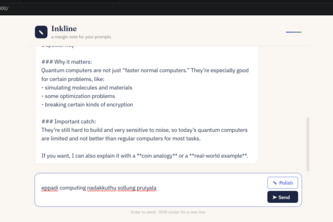
Inkline is a self-reported prompt-polishing tool for AI chat interfaces, designed to improve grammar, translation, and clarity before sending prompts to AI models. The author states it uses GPT-5.6 for optimization and a custom word-level LCS algorithm for redline diffs. It is presented as a browser extension or keyboard overlay with a focus on user control and visual feedback.
The project appears to be a single-person effort built with React, Node.js, TailwindCSS, Vercel, and OpenAI APIs. The description does not contain evidence of revenue, customers, or traction beyond the hackathon submission.
Key open question: Is there any evidence that users actually need this functionality, or that it solves a real problem beyond what existing tools like Grammarly offer?
What The Product Actually Is
The description states that Inkline is a tool that polishes prompts before sending them to AI chat interfaces. It claims to:
- Accept prompts in any language and with any grammar.
- Translate if needed.
- Restructure for clarity.
- Show a redline diff (before/after) of changes made.
- Allow users to accept or discard the polished version.
It is described as being built using React, Node.js, TailwindCSS, Vercel, and OpenAI APIs. The author mentions using GPT-5.6 for optimization and a custom algorithm for redline diffs.
Inference: The tool appears to be a frontend interface that integrates with AI services to improve prompt quality before submission.
Positioning & Claim Evolution
The author states the inspiration is rooted in real-world problems: people typing into chatbots in their native language with typos or vague phrasing, resulting in suboptimal responses. They claim that existing tools like Grammarly do not fix prompts the same way everywhere you type them.
Inference: The positioning is that Inkline addresses a gap in prompt quality control for AI interactions, particularly for non-native speakers or those who struggle with clarity.
Target Customer & ICP
The description does not explicitly identify a target customer segment. It implies a broad audience of users interacting with AI chat interfaces, especially those who type in their native language and may have grammar or clarity issues.
Inference: The likely ICP includes individuals using AI chat tools regularly, particularly non-native speakers or those seeking better prompt clarity.
Business Model & Pricing Evidence
There is no evidence provided about a business model or pricing structure. The description focuses on the technical implementation and user experience but does not mention monetization, subscriptions, or fees.
Not evidenced
Technical & Delivery Signals
The project is built with:
- Frontend: React, TailwindCSS
- Backend: Node.js, Vercel
- AI: GPT-5.6, OpenAI APIs
- Algorithm: Custom word-level LCS (Longest Common Subsequence) for redline diff view
- Tools: Codex used for scaffolding/debugging
The author mentions challenges in making the diff feel like an editor's markup and handling non-Latin scripts correctly.
Inference: The tool is technically feasible, with a focus on UI/UX for prompt editing and visual feedback. It appears to be a lightweight, frontend-heavy solution.
Traction & Maturity Signals
The project was submitted to the OpenAI 2026 hackathon on Devpost. There is no evidence of revenue, customers, or product adoption beyond this submission.
Not evidenced
Competitive Context
The author states that existing tools like Grammarly do not fix prompts in the same way across platforms. They imply that Inkline offers a unique value proposition through its redline diff and control features.
Inference: The competitive landscape includes general writing tools (e.g., Grammarly) but lacks specific mention of prompt-specific tools or AI interaction interfaces.
Open Questions & Risks
- Lack of traction or monetization strategy: No evidence of revenue, customers, or adoption.
- Single-person development: Limited capacity for scaling or iterating quickly.
- Unproven market need: The author claims a problem exists but does not provide data or user feedback to validate this.
- Technical challenges: Handling non-Latin scripts and latency are noted as issues, which may impact usability.
Questions the description leaves open
- What specific user pain points did you observe that led to building this tool?
- Have you tested the tool with real users? If so, what feedback did you get?
- How do you plan to monetize or scale this product beyond a hackathon submission?
- What are the technical limitations of your current redline diff algorithm, and how do they impact user experience?
- Are there any existing tools in the market that solve similar problems, and how does Inkline differ?
Overall Assessment
The description is self-reported and unverified. There is no evidence of revenue, customers, or traction beyond a hackathon submission. The tool appears to be a proof-of-concept with technical innovation in UI/UX for prompt editing.
Confidence: Low. The project lacks commercial due-diligence signals such as user feedback, market validation, or monetization strategy.
Assessment: Not ready for investment or partnership without further evidence of traction, user need, and business model.
User Stories BotA demo video on every pull request
Get a demo video on every new feature
GitHub App that watches your pull requests and records a narrated, captioned demo.
Save time on demo prep and make informed decisions faster with a video walkthrough of every new feature.
Source
Submitted to the OpenAI 2026 hackathon on Devpost. Project home on Devpost. Back to the full gallery on Devpost.
This competitive analysis was produced by top-founders.com (opens in a new tab)
Generated by a language model from this project's public Devpost page — its tagline, the author's own write-up and any built-with tags listed there — as captured in August 2026. Short quotations are the author's words. It is an opinion on the idea as a business, not on the people behind it, and it reflects the description as published then. If the project has moved on, request a correction below. The analysis is not independent research and contains no verified traction, revenue or customer data.
An independent guide by KFG International LLC — not affiliated with, endorsed by, or connected to Devpost or OpenAI.