

Archive position — measured, not model output
0 likes on Devpost
2,263 of the 7,850 archived projects have more likes, and 5,587 share exactly 0 — so this project's #6,603 place in the like-ranked listing is a tie-break inside that group, not a ranking.
Projects (log scale)
Likes on Devpost. ▲ marks this project's group.
Show the figures
| Likes | Projects | Share of archive |
|---|---|---|
| 0 | 5,587 | 71.2% |
| 1 | 1,758 | 22.4% |
| 2 | 284 | 3.6% |
| 3–4 | 132 | 1.7% |
| 5–9 | 75 | 1.0% |
| 10+ | 14 | 0.2% |
 User Stories BotA demo video on every pull request
Get a demo video on every new feature
GitHub App that watches your pull requests and records a narrated, captioned demo.
Save time on demo prep and make informed decisions faster with a video walkthrough of every new feature.
Executive Summary
Project: SeedGeist
Self-reported basis: Author's own description of a hackathon submission to OpenAI 2026
Confidence level: Low — this is a single unverified self-description with no evidence of traction, revenue, customers or product-market fit.
SeedGeist is described as an OS for creating intellectual property (IP) using AI and semantic structures. The author claims it enables procedural reconstruction of IP assets including documentation, with a focus on local-first architecture and rights ownership. It integrates AI generation with human-in-the-loop processes and uses a suite of 28 applications to manage research, semantic analysis, and IP production.
Key commercial due-diligence read:
The author states that SeedGeist is an OS for IP creation using AI and semantic structures, but there is no evidence of product-market fit, revenue, or customer traction. The project appears to be a conceptual prototype built during a hackathon with no commercial deployment or adoption.
Single most important open question:
Is there any evidence that SeedGeist has moved beyond the hackathon stage into a viable product or business model?
What The Product Actually Is
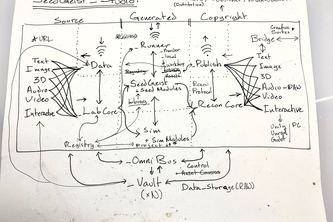
The description states that SeedGeist is an OS for creating IP using AI and semantic structures. It coordinates research, semantic analysis, reusable creative modules, production planning, simulation, reconstruction, review, and publication preparation across 28 local applications.
It includes:
- Project Seed Colony: A compilation of research-derived semantic modules that direct AI generation and post-AI generation reconstruction of IP assets.
- OmniBus: The suite cockpit for managing data sources and rights.
- Lab family: Turns approved material into reviewable evidence modules.
- Library: Manages reusable modules.
- Studio: Owns creative Seed truth.
- Registry: Indexes descriptors and safe references.
- Vault: Owns physical storage.
The system is described as local-first, with AI accelerating IP work without silently becoming the owner of data or decisions. It integrates with host providers and applications on the market for producing IP with AI.
Inference: The product appears to be a conceptual framework for managing IP creation workflows using AI and semantic structures, but there is no evidence of actual deployment or usage.
Positioning & Claim Evolution
The author states that SeedGeist is inspired by Blue Ocean Strategy, where competition is minimized by breaking the cost/value hierarchy. It aims to flip the focus from AI generation as the main value proposition to integrating AI with human-in-the-loop processes and rights ownership.
It positions itself as a local-first creative intelligence operating system where AI accelerates IP work without silently becoming the owner of data or decisions.
Inference: The positioning is conceptual and not yet validated in the market. It claims to offer a different model from current AI solutions, but there is no evidence of adoption or traction.
Target Customer & ICP
The description does not explicitly state target customers or ideal customer profiles (ICP). However, it implies that SeedGeist is aimed at users who create IP assets and want to maintain rights ownership through AI generation and procedural reconstruction.
Inference: The target audience likely includes creators, researchers, and IP professionals who are concerned about rights ownership and want to use AI in a controlled, human-in-the-loop manner. However, this is inferred from the description and not substantiated by evidence.
Business Model & Pricing Evidence
The description does not provide any information on business model or pricing. It mentions that the URL domain name was acquired and will be the central point of exchange for modules and seeds, but no details are given about monetization or pricing strategies.
Inference: There is no evidence of a defined business model or pricing structure. The project appears to be in early conceptual stages with no commercial implementation.
Technical & Delivery Signals
The system is built using TypeScript and React monorepo with pnpm, Vite, Node local services, Zod contracts, Vitest, Turborepo, DuckDB-backed data tooling, ESLint, Prettier, Gitleaks, and GitHub Actions. Windows 11 is the authoritative desktop platform, with Linux verification in CI.
It uses Codex and GPT-5.6 for building and auditing the monorepo, implementing reliability and launchability extensions, and managing system hardening.
Inference: The technical stack suggests a modern, local-first approach with strong emphasis on data integrity and process authority. However, this is based on a hackathon prototype and not validated in production.
Traction & Maturity Signals
The description states that the project was built during an OpenAI 2026 hackathon and that a fully working version will be released in the coming months with a set of module packs to start users off. It also mentions that the current iteration is a complete rebuild of the first iteration, which started on 7/11 and continued through 7/15.
There is no evidence of revenue, customers, or product-market fit beyond the hackathon submission.
Inference: The project is in early development stages and has not yet achieved commercial traction or maturity. It is described as a prototype with potential for future release.
Competitive Context
The description states that most companies and researchers are focused on using AI as a means to a final output, and there is not a lot of reference for a system like this. This makes almost all aspects of the applications within the suite non-competitive with others on the field.
Inference: The competitive landscape is unclear because the project is in early stages and has no commercial presence or market validation. It claims to be different from current AI solutions, but there is no evidence of competition or market positioning.
Open Questions & Risks
- Unproven concept: The project is described as a hackathon prototype with no evidence of product-market fit or commercial traction.
- No revenue or customers: There is no evidence of any revenue generation or customer base.
- Limited team size: Only one team member is mentioned, which may limit development capacity.
- Unclear business model: No information on how the project will monetize or generate value.
- High technical complexity: The system involves complex local-first architecture and AI integration, which may pose implementation challenges.
Inference: The main risk is that the project has not yet demonstrated viability in the market. It remains a conceptual prototype with no evidence of commercial success or scalability.
Questions the description leaves open
- What specific IP creation workflows does SeedGeist address, and how do they differ from existing solutions?
- How does SeedGeist ensure rights ownership and provenance in AI-generated content?
- What is the current development timeline for a commercial release?
- Are there any early adopters or pilot users of the system?
- What are the key technical challenges that remain to be solved before commercial deployment?
- How does the team plan to monetize the product, and what is the go-to-market strategy?
Overall Assessment
Assessment: Not evidenced.
The description provides no evidence of revenue, customers, or traction. The project appears to be a conceptual prototype built during a hackathon with no commercial deployment or adoption. There is insufficient information to assess its investment or partnership potential at this stage.
Inference: Without further evidence of product-market fit, commercial viability, or team execution capability, it is premature to consider SeedGeist for investment or partnership.
User Stories BotA demo video on every pull request
Get a demo video on every new feature
GitHub App that watches your pull requests and records a narrated, captioned demo.
Save time on demo prep and make informed decisions faster with a video walkthrough of every new feature.
Source
Submitted to the OpenAI 2026 hackathon on Devpost. Project home on Devpost. Back to the full gallery on Devpost.
This competitive analysis was produced by top-founders.com (opens in a new tab)
Generated by a language model from this project's public Devpost page — its tagline, the author's own write-up and any built-with tags listed there — as captured in August 2026. Short quotations are the author's words. It is an opinion on the idea as a business, not on the people behind it, and it reflects the description as published then. If the project has moved on, request a correction below. The analysis is not independent research and contains no verified traction, revenue or customer data.
An independent guide by KFG International LLC — not affiliated with, endorsed by, or connected to Devpost or OpenAI.