

Archive position — measured, not model output
0 likes on Devpost
2,263 of the 7,850 archived projects have more likes, and 5,587 share exactly 0 — so this project's #4,641 place in the like-ranked listing is a tie-break inside that group, not a ranking.
Projects (log scale)
Likes on Devpost. ▲ marks this project's group.
Show the figures
| Likes | Projects | Share of archive |
|---|---|---|
| 0 | 5,587 | 71.2% |
| 1 | 1,758 | 22.4% |
| 2 | 284 | 3.6% |
| 3–4 | 132 | 1.7% |
| 5–9 | 75 | 1.0% |
| 10+ | 14 | 0.2% |
 User Stories BotA demo video on every pull request
Get a demo video on every new feature
GitHub App that watches your pull requests and records a narrated, captioned demo.
Save time on demo prep and make informed decisions faster with a video walkthrough of every new feature.
Executive Summary
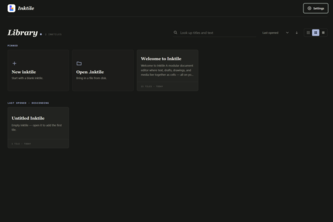
Inktile is a self-reported desktop application that allows users to create documents composed of modular "tiles" — flexible, reorganizable content blocks (text, image, video, audio) arranged in a dynamic grid layout. The app integrates with AI agents via a "meta harness" called Inkjet, enabling these agents to edit documents directly from within the interface using existing subscriptions or API keys.
The author states that Inktile was built for the OpenAI 2026 hackathon and is currently a solo project by Max Chung. It uses technologies such as Claude, Codex, React, Tauri, and TypeScript. The app is described as freeform and agent-enabled, with no evidence of revenue, customers, or traction.
Key open question: Is there any evidence that Inktile has moved beyond the prototype stage, or whether it has begun to attract users or developers who might be interested in its functionality?
What The Product Actually Is
The description states that Inktile is a freeform document canvas composed of modular "tiles" — content blocks that can be arranged dynamically. It allows users to create documents with mixed media (text, image, video, audio) and reorganize them into flexible layouts.
It also includes an agent harness called Inkjet, which enables AI coding CLIs like Codex, Claude, and Opencode to edit documents directly inside the app without requiring setup or additional configuration. The system is described as using a "headless agent" that interacts with the document through a controlled interface.
Evidence:
- Inktile uses a modular tile-based layout.
- Inkjet allows AI agents to edit documents via CLI tools.
- The app is built with React, Tauri, TypeScript, and integrates with Claude/Codex.
- It is described as a desktop application.
Not evidenced:
- Whether the product is functional beyond prototype.
- Whether it has been used by anyone other than the author.
- Any UI or UX details beyond the tile concept.
Positioning & Claim Evolution
The author positions Inktile as an alternative to traditional document editors like Google Docs and Microsoft Word, which are described as rigid and linear. Inktile is presented as offering more freedom for creative layouts, mixed media support, and collaboration with AI agents.
It claims to offer a "meta harness" that allows AI agents to edit documents directly, without needing additional setup or API keys — implying ease of integration and use. The app is also described as lightweight and leveraging existing subscriptions for AI tools.
Evidence:
- The app is positioned as a freeform alternative to traditional editors.
- It integrates with AI coding CLIs out-of-the-box.
- It uses headless agents to interact with documents.
- It is described as lightweight and easy to use with existing subscriptions.
Inferred:
- The product may appeal to creators or developers who want more flexibility than standard tools.
- The agent integration could be a differentiator in AI-enhanced productivity tools.
Target Customer & ICP
The description does not clearly define a target customer or ideal customer profile (ICP). It is implied that the app is aimed at users who value creative layout freedom, mixed media support, and AI collaboration — but no specific persona, use case, or audience segment is named.
Evidence:
- The app is described as for users wanting more flexibility than traditional editors.
- It supports AI agents, suggesting a potential audience of developers or creators working with AI tools.
Not evidenced:
- No defined customer segments.
- No evidence of early adopters or user feedback.
- No indication of market size or target industries.
Business Model & Pricing Evidence
The description does not provide any information about pricing, monetization, or business model. It is stated that Inktile is freeform and agent-enabled, but no details are given on how it would be sold, whether it will have a freemium model, or if there are plans for paid features.
Evidence:
- The app is described as "freeform" and built with AI tools.
- No mention of pricing, subscriptions, or monetization strategy.
Not evidenced:
- No pricing information.
- No indication of business model (e.g., freemium, SaaS, one-time purchase).
- No evidence of revenue streams or customer acquisition plans.
Technical & Delivery Signals
The app is built using React, Tauri, and TypeScript. It integrates with AI tools like Claude, Codex, and Opencode via CLI. The author mentions that the agent integration was developed using headless agents to sandbox access and ensure safety.
It also uses a "meta harness" (Inkjet) to expose document tools to agents in a controlled way, allowing them to inspect and modify documents without full system access.
Evidence:
- Built with React, Tauri, TypeScript.
- Integrates with AI CLIs like Claude, Codex, Opencode.
- Uses headless agents for safe interaction.
- Inkjet exposes document tools via a limited interface.
Not evidenced:
- No evidence of performance or scalability.
- No UI/UX details beyond tile layout.
- No information on deployment or delivery mechanism beyond local desktop use.
Traction & Maturity Signals
There is no evidence of traction, adoption, or user feedback. The project is described as a solo effort by Max Chung and submitted to a hackathon. It is not clear if the app has been tested with users, released publicly, or used beyond the author’s own development.
Evidence:
- Submitted to OpenAI 2026 hackathon.
- Built by one person (Max Chung).
- No mention of users, customers, or feedback.
Not evidenced:
- No user data, reviews, or usage metrics.
- No public release or distribution details.
- No evidence of product maturity beyond prototype.
Competitive Context
The description does not provide any information about competitors. It is implied that Inktile competes with traditional document editors like Google Docs and Microsoft Word, but no comparison to existing tools or market positioning is made.
Evidence:
- The app is described as an alternative to Google Docs and Microsoft Word.
- No mention of direct competitors or market analysis.
Not evidenced:
- No competitive landscape.
- No evidence of differentiation from existing tools.
- No indication of market share or competitive advantage.
Open Questions & Risks
Several risks are implied by the self-reported nature of the project:
- Solo development: The app is built by a single developer, which raises questions about scalability and long-term maintenance.
- Prototype stage: It is described as a hackathon submission with no evidence of further development or user adoption.
- Limited integration scope: Only a few AI tools (Claude, Codex, Opencode) are mentioned — this could limit its appeal.
- No monetization plan: No indication of how the product will be monetized or whether it has a sustainable business model.
Evidence:
- Solo team (Max Chung).
- Hackathon submission.
- No pricing or revenue model.
- Limited AI tool support.
Inferred:
- Risk of limited market appeal due to narrow integration scope.
- Risk of being abandoned due to lack of team or resources.
Questions the description leaves open
- What is the current status of Inktile — is it a working prototype, or has it been released?
- Have you tested Inktile with users beyond yourself? If so, what feedback have you received?
- How do you plan to monetize the product? Is there a business model in mind?
- What are your plans for expanding support for AI tools beyond Claude, Codex, and Opencode?
- Do you have any plans for scaling or team expansion?
- How do you intend to ensure security and sandboxing of agents in a production environment?
Overall Assessment
Not evidenced.
The project is described as a solo hackathon submission with no evidence of traction, revenue, or user adoption. The author states that the app is freeform and agent-enabled but provides no data on its commercial viability or market potential.
Given the lack of evidence for product-market fit, customer feedback, or business model, there is insufficient basis to recommend investment or partnership at this stage.
Confidence: Low — based entirely on self-reported description with no external validation.
User Stories BotA demo video on every pull request
Get a demo video on every new feature
GitHub App that watches your pull requests and records a narrated, captioned demo.
Save time on demo prep and make informed decisions faster with a video walkthrough of every new feature.
Source
Submitted to the OpenAI 2026 hackathon on Devpost. Project home on Devpost. Back to the full gallery on Devpost.
This competitive analysis was produced by top-founders.com (opens in a new tab)
Generated by a language model from this project's public Devpost page — its tagline, the author's own write-up and any built-with tags listed there — as captured in August 2026. Short quotations are the author's words. It is an opinion on the idea as a business, not on the people behind it, and it reflects the description as published then. If the project has moved on, request a correction below. The analysis is not independent research and contains no verified traction, revenue or customer data.
An independent guide by KFG International LLC — not affiliated with, endorsed by, or connected to Devpost or OpenAI.