

Archive position — measured, not model output
0 likes on Devpost
2,263 of the 7,850 archived projects have more likes, and 5,587 share exactly 0 — so this project's #4,643 place in the like-ranked listing is a tie-break inside that group, not a ranking.
Projects (log scale)
Likes on Devpost. ▲ marks this project's group.
Show the figures
| Likes | Projects | Share of archive |
|---|---|---|
| 0 | 5,587 | 71.2% |
| 1 | 1,758 | 22.4% |
| 2 | 284 | 3.6% |
| 3–4 | 132 | 1.7% |
| 5–9 | 75 | 1.0% |
| 10+ | 14 | 0.2% |
 User Stories BotA demo video on every pull request
Get a demo video on every new feature
GitHub App that watches your pull requests and records a narrated, captioned demo.
Save time on demo prep and make informed decisions faster with a video walkthrough of every new feature.
Executive Summary
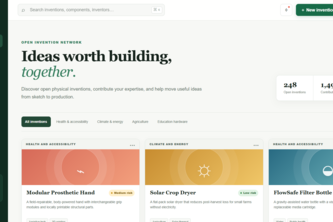
The company appears to be a solo-built project named "innventionhub" (also referred to as "InnovationHub") that self-reports as a version-controlled platform for physical and product inventions. The author states the goal is to bring GitHub-style workflows to hardware innovation, enabling users to commit design iterations, fork and remix ideas, submit pull requests, and track contributions. It is described as built for makers and inventors.
What changed
The project description indicates a transition from an idea (inspired by GitHub) to a working prototype, with the author describing how they mapped GitHub concepts onto physical invention workflows, built core data models and UI, and addressed challenges in versioning physical designs. It was submitted as part of a hackathon.
The single most important open question
Is there evidence of traction, revenue, or customer adoption beyond the solo builder's self-report? The description contains no information on actual users, customers, or monetization.
What The Product Actually Is
The description states that InnovationHub is a version-controlled platform for physical and product inventions. Users can create "repos" for their inventions and commit design iterations — including sketches, CAD files, bills of materials (BOMs), and test results — as the design evolves.
Anyone can fork an invention, open issues to flag design flaws, and submit pull requests to propose improvements. Every invention carries a full, public history of who contributed what and why.
The platform is described as mapping GitHub's metaphor onto physical invention: repos became invention projects, commits became design iterations, and pull requests became proposed design changes with reviewable diffs.
Inference The product appears to be a web-based tool designed for makers and inventors to collaborate on physical designs using version control concepts borrowed from software development. It is not described as a marketplace or commercial platform but rather a tool for managing the lifecycle of inventions.
Positioning & Claim Evolution
The author states that "Software has GitHub — a shared home where every idea, no matter how small, gets version-controlled, forked, and improved by anyone willing to contribute." The claim is that physical invention lacks such a system.
The project positions itself as an attempt to replicate the collaborative, iterative workflow of open-source software for physical innovation. It aims to solve problems like:
- Isolated work (sketches in notebooks, CAD files emailed back and forth)
- Re-inventing prototypes from scratch because prior work cannot be found or built on
Inference The positioning is that of a tool for collaborative hardware development, inspired by open-source software practices. It is not positioned as a marketplace or commercial platform but as an infrastructure tool for inventors.
Target Customer & ICP
The description states that the product is "built for makers and inventors."
It also mentions that the author was inspired by the idea of bringing GitHub-style workflows to physical invention, suggesting that the target audience includes individuals or teams working on hardware projects who may be familiar with software development practices.
Inference The ICP appears to be makers, inventors, and hardware developers, particularly those who might benefit from version control and collaboration tools similar to those used in open-source software.
Business Model & Pricing Evidence
The description does not contain any information about pricing or business model. It is self-reported that the product is a prototype built for a hackathon.
Not evidenced.
Technical & Delivery Signals
The author states that they "started by mapping the core GitHub metaphor onto physical invention", and designed a data model including:
- repos
- versions
- files
- issues
- contributors
They also mention building an interface around three core workflows:
- Publishing a new design iteration
- Forking an existing invention
- Reviewing a proposed change
The author notes that they "prioritized a clean, minimal UI so the focus stays on the invention itself rather than the tooling."
They also state that they "had to design a simplified versioning model that captures meaningful change (dimensions, materials, test results) without requiring deep CAD-diffing tools."
Inference The technical approach is to map software concepts onto physical design workflows. It appears to be a web-based platform with UI focused on usability for non-developers. The tooling is described as being in prototype form.
Traction & Maturity Signals
The description contains no evidence of traction, revenue, or customer adoption beyond the solo builder's own account. It was submitted to a hackathon and is described as a prototype.
Not evidenced.
Competitive Context
The description does not mention any competitors or existing platforms in this space. The author states that physical invention lacks a system like GitHub, implying that there may be no direct equivalent.
Not evidenced.
Open Questions & Risks
- No traction or revenue: The project is described as a solo-built hackathon submission with no evidence of customers or monetization.
- Unproven market demand: The author claims physical invention lacks GitHub-style tools, but there is no evidence that this is a significant problem or that users would adopt such a platform.
- Technical challenges: The description notes that "diffing" for physical objects is much harder than for text, and that they had to simplify versioning models — suggesting technical limitations or complexity in execution.
- Solo builder risk: The team size is listed as one, which raises questions about scalability and long-term development capacity.
Questions the description leaves open
- What specific problems are you solving for inventors that existing tools do not address?
- Have you validated demand from potential users beyond your own experience?
- How do you plan to monetize this platform, if at all?
- What is the current state of the product — how far along is it in terms of development and usability?
- Are there any early adopters or pilot users who are actively using the platform?
Overall Assessment
Not evidenced.
The description provides no information on revenue, customers, traction, or business model. The project appears to be a solo-built prototype submitted for a hackathon with no evidence of commercial viability or market validation.
The author states that the product is built for makers and inventors, but there is no indication of whether this represents a scalable market opportunity or if users would pay for such a service.
Confidence: Low. The entire analysis is based on self-reported information with no external verification or evidence of traction.
User Stories BotA demo video on every pull request
Get a demo video on every new feature
GitHub App that watches your pull requests and records a narrated, captioned demo.
Save time on demo prep and make informed decisions faster with a video walkthrough of every new feature.
Source
Submitted to the OpenAI 2026 hackathon on Devpost. Project home on Devpost. Back to the full gallery on Devpost.
This competitive analysis was produced by top-founders.com (opens in a new tab)
Generated by a language model from this project's public Devpost page — its tagline, the author's own write-up and any built-with tags listed there — as captured in August 2026. Short quotations are the author's words. It is an opinion on the idea as a business, not on the people behind it, and it reflects the description as published then. If the project has moved on, request a correction below. The analysis is not independent research and contains no verified traction, revenue or customer data.
An independent guide by KFG International LLC — not affiliated with, endorsed by, or connected to Devpost or OpenAI.