

Archive position — measured, not model output
0 likes on Devpost
2,263 of the 7,850 archived projects have more likes, and 5,587 share exactly 0 — so this project's #4,644 place in the like-ranked listing is a tie-break inside that group, not a ranking.
Projects (log scale)
Likes on Devpost. ▲ marks this project's group.
Show the figures
| Likes | Projects | Share of archive |
|---|---|---|
| 0 | 5,587 | 71.2% |
| 1 | 1,758 | 22.4% |
| 2 | 284 | 3.6% |
| 3–4 | 132 | 1.7% |
| 5–9 | 75 | 1.0% |
| 10+ | 14 | 0.2% |
 User Stories BotA demo video on every pull request
Get a demo video on every new feature
GitHub App that watches your pull requests and records a narrated, captioned demo.
Save time on demo prep and make informed decisions faster with a video walkthrough of every new feature.
Executive Summary
What the company appears to be
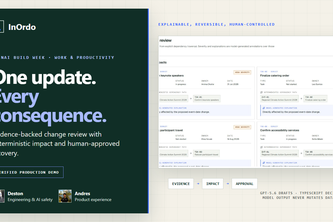
InOrdo is a self-reported project that aims to manage project updates by making the impact of changes visible and controllable through structured workflows. It uses AI (GPT-5.6) for interpretation and drafting, but keeps decision-making and data mutation under human control.
What changed
The description was submitted as part of an OpenAI 2026 hackathon entry. No prior version or evolution is described; this is a single self-reported project with no evidence of prior development or traction.
Single most important open question
Is there any evidence that InOrdo has moved beyond the prototype stage, or that it has been tested in real-world conditions with actual users?
What The Product Actually Is
The description states that InOrdo is a Next.js 16 App Router application built using React 19, TypeScript, Tailwind CSS, Supabase Postgres and Auth, and the OpenAI Responses API. It uses GPT-5.6 for interpreting updates and proposing recovery actions, but not for directly mutating data.
It includes:
- A workflow that preserves evidence of project updates.
- Structured change interpretation via GPT-5.6.
- Deterministic traversal of dependencies using pure TypeScript.
- Human approval required before any action is applied.
- Reversible history with compensating operations.
The system enforces separation between AI interpretation and data mutation through server contracts, row-level security, and authorization checks.
Inference This appears to be a proof-of-concept or prototype built for a hackathon, not a production-ready product. The use of synthetic data and read-only access in the demo suggests limited real-world testing.
Positioning & Claim Evolution
The description states that InOrdo is not trying to replace broad work-management platforms, but instead focuses on a narrow trust boundary: “when new evidence invalidates part of an existing plan.”
It positions itself as:
- A tool for turning unstructured updates into structured workflows.
- A system where AI interprets and drafts, but never autonomously acts.
- A solution that makes impact chains visible and controllable.
Inference The positioning is clearly defined in the context of a hackathon submission. There is no indication of prior market positioning or evolution beyond this single self-reported version.
Target Customer & ICP
The description does not name specific customer segments or personas. However, it implies that InOrdo targets small teams managing complex projects, where changes can ripple across multiple dependencies and require careful coordination.
It suggests a use case involving:
- Project planning.
- Managing interdependent records (e.g., event dates, speaker confirmations).
- Need for traceability and reversibility of changes.
Inference The target is inferred from the problem space described, but no explicit ICP or customer profile is provided. The system appears designed for internal project teams rather than external clients or end-users.
Business Model & Pricing Evidence
There is no evidence in the description of a business model or pricing structure. The project is presented as a hackathon submission with no mention of monetization, subscriptions, or paid features.
Inference The lack of any commercial detail indicates that this is not yet a commercial product, nor does it have a defined revenue path.
Technical & Delivery Signals
The system is built using:
- Frontend: Next.js 16 App Router, React 19, TypeScript, Tailwind CSS
- Backend: Supabase Postgres and Auth, OpenAI API (GPT-5.6)
- AI Layer: GPT-5.6 used server-side only; no write authority or tools
- Dependency Engine: Pure TypeScript for deterministic graph traversal
- Security: Row-level security, server-side authorization, role boundaries
- Testing: 514 passing unit and component tests, two guarded Playwright journeys
Inference The technical stack is modern and well-documented. The separation of AI from data mutation and the use of deterministic logic suggest a strong engineering foundation for a prototype. However, no evidence of production deployment or scaling beyond the demo.
Traction & Maturity Signals
There is no evidence of traction, customers, revenue, or adoption beyond the author’s own submission. The project is described as a hackathon entry with:
- A synthetic workspace.
- Read-only access for judges.
- Disabled controls and limited functionality.
- No real-world usage or user feedback.
Inference This is a prototype or proof-of-concept, not a mature product in the market.
Competitive Context
The description does not mention any competitors. It positions itself as distinct from general work-management platforms, but does not specify what other tools it might compete with.
Inference No competitive analysis or positioning against existing products is evident. The project appears to be in a niche space, possibly overlapping with change management, dependency tracking, or AI-assisted workflow tools, but no direct comparison is made.
Open Questions & Risks
- Prototype-only: No evidence of real-world deployment or user testing.
- No commercial viability: No pricing, monetization, or business model described.
- Limited scope: Only one synthetic workspace; no support for file imports or integrations.
- AI dependency: Relies heavily on GPT-5.6, which may not be scalable or cost-effective in a real product.
- No user feedback: No mention of early adopters or customer interviews.
Inference The project is at a very early stage and lacks any commercial or operational signals. It is not ready for investment or partnership without further development and validation.
Questions the description leaves open
- What is the intended path from this prototype to a production-ready product?
- Has there been any user testing beyond the hackathon demo?
- How would you scale the AI dependency (GPT-5.6) in a real-world setting?
- Are there plans to support integrations with existing project management tools?
- What are the key assumptions about user behavior and adoption?
- How do you plan to monetize this product if it moves beyond a prototype?
Overall Assessment
Not evidenced: There is no evidence of revenue, customers, traction, or commercial viability.
Confidence level: Very low — based entirely on a self-reported hackathon submission with no external validation.
Assessment:
This project is a prototype or proof-of-concept, not a product ready for investment or partnership. It has strong technical foundations and a clear idea, but lacks any evidence of real-world usage, market traction, or commercial readiness. The author states that this is a single submission to a hackathon — no prior development or testing beyond the demo is evident.
Inference:
If this were to evolve into a product, it would require significant development, user validation, and commercial planning before any serious due diligence could be conducted.
User Stories BotA demo video on every pull request
Get a demo video on every new feature
GitHub App that watches your pull requests and records a narrated, captioned demo.
Save time on demo prep and make informed decisions faster with a video walkthrough of every new feature.
Source
Submitted to the OpenAI 2026 hackathon on Devpost. Project home on Devpost. Back to the full gallery on Devpost.
This competitive analysis was produced by top-founders.com (opens in a new tab)
Generated by a language model from this project's public Devpost page — its tagline, the author's own write-up and any built-with tags listed there — as captured in August 2026. Short quotations are the author's words. It is an opinion on the idea as a business, not on the people behind it, and it reflects the description as published then. If the project has moved on, request a correction below. The analysis is not independent research and contains no verified traction, revenue or customer data.
An independent guide by KFG International LLC — not affiliated with, endorsed by, or connected to Devpost or OpenAI.