

Archive position — measured, not model output
1 like on Devpost
505 of the 7,850 archived projects have more likes, and 1,758 share exactly 1 — so this project's #717 place in the like-ranked listing is a tie-break inside that group, not a ranking.
Projects (log scale)
Likes on Devpost. ▲ marks this project's group.
Show the figures
| Likes | Projects | Share of archive |
|---|---|---|
| 0 | 5,587 | 71.2% |
| 1 | 1,758 | 22.4% |
| 2 | 284 | 3.6% |
| 3–4 | 132 | 1.7% |
| 5–9 | 75 | 1.0% |
| 10+ | 14 | 0.2% |
 User Stories BotA demo video on every pull request
Get a demo video on every new feature
GitHub App that watches your pull requests and records a narrated, captioned demo.
Save time on demo prep and make informed decisions faster with a video walkthrough of every new feature.
Executive Summary
What the company appears to be
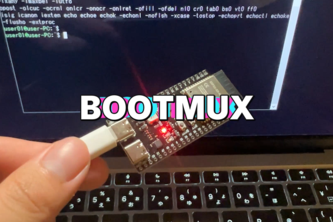
BOOTMUX is a self-reported physical-first bridge for AI assistance during early computer setup or recovery. It enables iPhone-based input (via BLE and ESP32-S3 USB HID) to reach a target machine, while output returns through an independently observed terminal path. The system was built using Codex as the implementation engine and GPT-5.6 for architecture and review.
What changed
The author describes BOOTMUX as a solution to a specific problem: AI tools like Codex are not usable during early setup or recovery phases when SSH, network paths, or even basic terminal access are unavailable. The system was developed over a Build Week period using an AI-assisted loop involving Codex and GPT-5.6.
Single most important open question
Is there any evidence of real-world usage, traction, or commercial viability beyond the author’s own demonstration? The description states that the project is not yet production-ready and does not include revenue, customers, or adoption data.
What The Product Actually Is
The description states that BOOTMUX is a physical-first bridge for AI assistance. It combines:
- An iPhone client (SwiftUI, CoreBluetooth)
- An ESP32-S3 device (BLE, USB HID)
- A target-side Companion written in Go
- Codex CLI integration
- Terminal session handling via PTY and WebSocket
The system enables two separate paths:
- Input path: iPhone → BLE → ESP32-S3 → USB HID keyboard input to the target machine.
- Output path: Target PTY / Codex → Companion → WebSocket → iPhone terminal output.
It is described as not being an SSH client, but rather a way to get AI assistance before a computer is ready for AI tools like Codex.
Evidence strength Self-reported and unverified.
Positioning & Claim Evolution
The author positions BOOTMUX as solving a gap in AI usability: “AI is available during almost every part of my work—except the moment I need it most.” The system aims to bridge the physical first mile for AI tools like Codex, especially when systems are not yet configured or reachable.
Key claims:
- BOOTMUX creates the physical first mile for Codex.
- It works before SSH or network paths exist.
- It separates input and output to avoid false confirmation of processing.
- The system was built using an AI-assisted loop involving Codex and GPT-5.6.
Evidence strength Self-reported, unverified claims about intent and positioning.
Target Customer & ICP
The description does not explicitly name a target customer or define an Ideal Customer Profile (ICP). However, the author implies that BOOTMUX is for developers or users who need AI assistance during early setup or recovery of machines where standard tools like SSH are not yet available.
It may appeal to:
- Developers working in environments with limited infrastructure
- Users needing remote access to broken or unconfigured systems
Evidence strength Inferred from context; no explicit customer definition.
Business Model & Pricing Evidence
There is no evidence of a business model, pricing structure, or monetization strategy in the description. The project is presented as a Build Week hackathon submission with no indication of commercial intent or revenue streams.
Evidence strength Not evidenced.
Technical & Delivery Signals
The system uses:
- iPhone (SwiftUI, CoreBluetooth)
- ESP32-S3 (BLE, USB HID)
- Go for the Companion
- Codex CLI integration
- PTY and WebSocket for terminal handling
- ARM64 Lima VM for testing
It includes:
- Bounded input/output queues
- Session isolation
- UTF-8 handling
- Fail-closed lifecycle rules
- Streaming ANSI sanitization
The author states that this was built in a Build Week period using an AI-assisted loop involving Codex and GPT-5.6.
Evidence strength Self-reported, with no independent verification of technical claims or delivery.
Traction & Maturity Signals
There is no evidence of traction, customers, or adoption beyond the author’s own demonstration. The project is described as a Build Week hackathon submission and not yet production-ready.
The description states:
- Demonstrated paths include ASCII input and Codex output.
- Judge Mode allows inspection without rebuilding hardware.
- No repeatable production-ready physical operation has been achieved.
- Future work includes copy/clear acceptance, HID Mirror, and broader platform testing.
Evidence strength Not evidenced.
Competitive Context
The description does not mention any competitors or market context. It is unclear whether similar systems exist or how BOOTMUX compares to existing solutions for remote terminal access or AI-assisted development in early setup scenarios.
Evidence strength Not evidenced.
Open Questions & Risks
- No commercial traction or revenue data: The project is described as a hackathon submission with no evidence of adoption.
- Unproven scalability or usability: The system is not yet production-ready and lacks full terminal emulation, Unicode support, or offline operation.
- AI-assisted development loop dependency: Reliance on Codex and GPT-5.6 may not be scalable or replicable outside the author’s specific setup.
- Limited hardware compatibility: Only ESP32-S3 is mentioned as supported, with no indication of broader platform support.
Evidence strength Inferred from self-reported limitations and lack of external validation.
Questions the description leaves open
- What is the actual end-user problem you are solving, and how do you know it exists?
- Have you validated this solution with real users or in real-world settings beyond the Build Week demo?
- How does BOOTMUX handle edge cases like network disconnections or hardware failures?
- Is there a plan to scale beyond a single developer’s use case?
- What are the technical and legal implications of using Codex and GPT-5.6 for system-level development?
- Are you planning any monetization strategy or commercial model?
Evidence strength Inferences based on self-reported description.
Overall Assessment
There is no evidence of traction, revenue, customers, or a defined business model. The project is described as a Build Week hackathon submission and not yet production-ready. It lacks any indication of commercial viability or scalability beyond the author’s own use case.
Confidence level Low — based entirely on self-reported claims with no external validation or evidence of adoption or market demand.
Assessment Not ready for investment or partnership at this time. The project is in a very early stage and requires further demonstration of real-world utility, scalability, and commercial potential.
User Stories BotA demo video on every pull request
Get a demo video on every new feature
GitHub App that watches your pull requests and records a narrated, captioned demo.
Save time on demo prep and make informed decisions faster with a video walkthrough of every new feature.
Source
Submitted to the OpenAI 2026 hackathon on Devpost. Project home on Devpost. Back to the full gallery on Devpost.
This competitive analysis was produced by top-founders.com (opens in a new tab)
Generated by a language model from this project's public Devpost page — its tagline, the author's own write-up and any built-with tags listed there — as captured in August 2026. Short quotations are the author's words. It is an opinion on the idea as a business, not on the people behind it, and it reflects the description as published then. If the project has moved on, request a correction below. The analysis is not independent research and contains no verified traction, revenue or customer data.
An independent guide by KFG International LLC — not affiliated with, endorsed by, or connected to Devpost or OpenAI.