

Archive position — measured, not model output
1 like on Devpost
505 of the 7,850 archived projects have more likes, and 1,758 share exactly 1 — so this project's #718 place in the like-ranked listing is a tie-break inside that group, not a ranking.
Projects (log scale)
Likes on Devpost. ▲ marks this project's group.
Show the figures
| Likes | Projects | Share of archive |
|---|---|---|
| 0 | 5,587 | 71.2% |
| 1 | 1,758 | 22.4% |
| 2 | 284 | 3.6% |
| 3–4 | 132 | 1.7% |
| 5–9 | 75 | 1.0% |
| 10+ | 14 | 0.2% |
 User Stories BotA demo video on every pull request
Get a demo video on every new feature
GitHub App that watches your pull requests and records a narrated, captioned demo.
Save time on demo prep and make informed decisions faster with a video walkthrough of every new feature.
Executive Summary
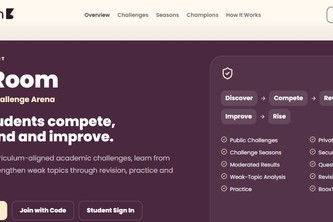
BooxRoom is an AI-powered academic challenge platform self-described as a system for secure assessments and practical project-based learning in educational environments. The author states it supports two main challenge types: assessment challenges (secure exams with automatic and manual marking) and practical challenges (project-based tasks using AI-generated prompts). It includes features like secure student authentication, timed assessments, detailed result review, and personalized improvement paths based on topic performance.
The platform is built as an extension of an existing system called BooxClash, using technologies including React, FastAPI, Firebase, and Google Vertex AI. The author reports that the backend has over 200 automated tests and the frontend was validated for production and PWA use.
What Changed: The project description indicates a shift from basic online exam interfaces to a more integrated platform supporting both secure assessments and competency-based practical challenges, with an emphasis on learner improvement post-assessment.
Single Most Important Open Question: Is there evidence of actual teacher or student adoption, or any real-world usage beyond the author's own development work?
Analysis Basis: This report is based entirely on the self-reported project description provided by the author. No external verification, revenue data, customer information, or traction metrics are available.
What The Product Actually Is
The description states that BooxRoom is:
- An academic challenge platform for teachers, administrators and students
- Supports two main types of challenges:
- Assessment challenges (secure exams with automatic and manual marking)
- Practical challenges (project-based tasks using AI-generated prompts)
Key features include:
- Secure student authentication
- Timed assessments with server-controlled timing
- Automatic answer saving and submission
- Protection of private answers and marking information
- Detailed result review including question-by-question breakdown
- Personalised improvement paths based on topic performance
- Practical challenge creation with AI assistance
- Rubric-based practical assessment
- Support for verified image evidence
The system is built as an extension of the existing BooxClash platform, using React, FastAPI, Firebase, and Google Vertex AI.
Claim: The author states that BooxRoom supports both secure assessments and practical project-based learning.
Evidence: Yes, in the "What it does" section.
Inference: The system appears to be designed for educational environments where teachers create challenges and students participate.
Evidence: Yes, in the "Inspiration" and "What it does" sections.
Positioning & Claim Evolution
The author states that BooxRoom was inspired by a desire to make learning more connected and meaningful beyond just final scores. The platform aims to support:
- Secure assessments
- Practical project-based challenges
- Personalised improvement paths
- Mastery-focused learning
The positioning appears to be evolving from a simple online exam interface to a complete academic challenge and learner-improvement ecosystem.
Claim: BooxRoom is positioned as a system that goes beyond traditional examinations.
Evidence: Yes, in the "Inspiration" section.
Inference: The platform positions itself as supporting both assessment and practical learning.
Evidence: Yes, in the "What it does" section.
Target Customer & ICP
The description states that BooxRoom is designed for:
- Teachers
- Administrators
- Students
It appears to target educational environments where teachers create secure assessments and practical challenges, while students participate and receive personalized feedback.
Claim: The platform targets teachers, administrators, and students in educational settings.
Evidence: Yes, in the "What it does" section.
Inference: The system is designed for use in schools or educational institutions.
Evidence: Yes, in the "Inspiration" section.
Business Model & Pricing Evidence
Not evidenced. The description does not contain any information about pricing models, monetization strategies, or business model details.
Claim: No evidence of business model or pricing.
Evidence: None provided.
Technical & Delivery Signals
The platform is built using:
- Frontend: React 19, TypeScript, Vite, Tailwind CSS, Progressive Web App support
- Backend: FastAPI, Python, Firebase Authentication, Cloud Firestore, Firebase Storage, Google Vertex AI, Gemini 2.5 Flash
- AI tools: Codex powered by GPT-5.6, used for engineering assistance
Key technical features include:
- Layered architecture with route → Pydantic validation → domain service → repository → database operations
- Secure paper publishing with immutable versions (student-safe public vs private marking)
- Attempt engine designed to handle unreliable internet connections and retry scenarios
- Practical submission storage using short-lived signed Firebase Storage URLs
- AI-assisted challenge generation
Claim: The platform uses a layered backend architecture and secure data handling.
Evidence: Yes, in the "How we built it" section.
Inference: The system is designed to be production-scale with security and reliability features.
Evidence: Yes, in the "How we built it" and "Challenges we ran into" sections.
Traction & Maturity Signals
Not evidenced. There is no mention of actual users, customers, or usage metrics beyond the author's own development work.
Claim: No evidence of traction or user adoption.
Evidence: None provided.
Competitive Context
Not evidenced. The description does not contain any information about competitors or market positioning relative to other platforms.
Claim: No competitive context provided.
Evidence: None provided.
Open Questions & Risks
- Single-person team: The project is built by one person (Chilongo Kondwani), which may limit scalability and ongoing development
- No traction evidence: No real-world usage or adoption data provided
- Self-reported only: All information is from the author's own description, with no independent verification
- Limited business model: No indication of how the platform will generate revenue
- Unverified claims: The system's security and functionality are described but not independently validated
Inference: The lack of team size, traction, and business model raises questions about scalability and commercial viability.
Evidence: Yes, in the "Team size" section and throughout.
Questions the description leaves open
- What is the actual user base or pilot program for this platform?
- How does the system handle scaling to multiple schools or institutions?
- What are the plans for monetization and revenue generation?
- Has there been any independent security review of the assessment systems?
- How will the AI-assisted features be maintained and updated over time?
- What is the roadmap for expanding into different grade levels or subjects?
- Are there any partnerships with educational institutions or governments?
Inference: These questions address key areas that are not evidenced in the description.
Evidence: None provided.
Overall Assessment
Not evidenced. The description does not contain any information about funding rounds, valuations, or investment interest.
Claim: No evidence of investment or partnership status.
Evidence: None provided.
User Stories BotA demo video on every pull request
Get a demo video on every new feature
GitHub App that watches your pull requests and records a narrated, captioned demo.
Save time on demo prep and make informed decisions faster with a video walkthrough of every new feature.
Source
Submitted to the OpenAI 2026 hackathon on Devpost. Project home on Devpost. Back to the full gallery on Devpost.
This competitive analysis was produced by top-founders.com (opens in a new tab)
Generated by a language model from this project's public Devpost page — its tagline, the author's own write-up and any built-with tags listed there — as captured in August 2026. Short quotations are the author's words. It is an opinion on the idea as a business, not on the people behind it, and it reflects the description as published then. If the project has moved on, request a correction below. The analysis is not independent research and contains no verified traction, revenue or customer data.
An independent guide by KFG International LLC — not affiliated with, endorsed by, or connected to Devpost or OpenAI.