

Archive position — measured, not model output
0 likes on Devpost
2,263 of the 7,850 archived projects have more likes, and 5,587 share exactly 0 — so this project's #6,597 place in the like-ranked listing is a tie-break inside that group, not a ranking.
Projects (log scale)
Likes on Devpost. ▲ marks this project's group.
Show the figures
| Likes | Projects | Share of archive |
|---|---|---|
| 0 | 5,587 | 71.2% |
| 1 | 1,758 | 22.4% |
| 2 | 284 | 3.6% |
| 3–4 | 132 | 1.7% |
| 5–9 | 75 | 1.0% |
| 10+ | 14 | 0.2% |
 User Stories BotA demo video on every pull request
Get a demo video on every new feature
GitHub App that watches your pull requests and records a narrated, captioned demo.
Save time on demo prep and make informed decisions faster with a video walkthrough of every new feature.
Executive Summary
What the company appears to be
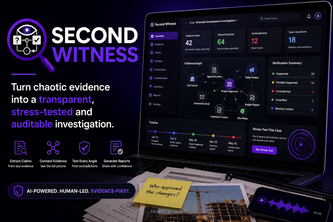
Second Witness is an AI-powered evidence intelligence workspace designed for investigation teams. The author states it helps transform fragmented source material into transparent, stress-tested and auditable cases. It uses AI agents to extract claims, build timelines, detect contradictions, and support adversarial review workflows.
What changed
The project description indicates a self-developed tool built over time by one person (the author), with no team or funding mentioned. It was submitted as part of the OpenAI 2026 hackathon, suggesting it is in early development or prototype stage.
Single most important open question
Is there any evidence that this product has been used in real-world investigations or tested by actual users? The description contains no mention of customers, adoption, revenue, or usage metrics beyond the author’s personal experience and vision.
What The Product Actually Is
The description states:
- Second Witness is an AI-powered evidence intelligence workspace.
- It allows users to upload various forms of source material (documents, screenshots, audio, emails, spreadsheets, links).
- It transforms this into an interactive investigation workspace with features like:
- Claim extraction
- Evidence graph
- Investigation timeline
- Contradiction detection
- Source independence analysis
- Stress-Test This Case workflow using AI agents (supporting researcher, contradiction hunter, source auditor, alternative explanation agent, case editor)
- Evidence-backed follow-up questions
- Privacy protection and redaction tools
- Auditable investigation reports
Inference: The product is a full-stack application built with modern web technologies including React, Node.js, OpenAI APIs (GPT-5.6), and others.
Positioning & Claim Evolution
The description states:
- The tool is not an automated truth detector, but rather a system that shows what is claimed, where it came from, which evidence supports or challenges it, and what remains unresolved.
- It aims to reduce confirmation bias by enabling adversarial workflows.
- The name “Second Witness” is inspired by the idea of testimony being examined, supported, and verified rather than accepted without evidence.
Inference: Positioning is centered on evidence transparency, human control, and reducing bias in investigative processes. It positions itself as a tool for journalists, researchers, and investigation teams seeking structured, auditable outcomes.
Target Customer & ICP
The description states:
- The primary users are journalists, researchers, and investigation teams.
- It is intended to help those working with scattered source material in complex investigations.
- The author personally chose the name inspired by the need to support his brother's work as a journalist.
Inference: The ICP likely includes individuals or small groups involved in investigative journalism, fact-checking, legal research, and compliance roles who deal with unstructured data and require tools for organizing claims and evidence.
Business Model & Pricing Evidence
The description states:
- No explicit business model or pricing information is provided.
- There is no mention of monetization strategy, subscription plans, or commercial use cases beyond the author’s personal motivation.
Not evidenced: No indication of how the product will be sold or whether it will be offered as a SaaS platform, open-source tool, or other format.
Technical & Delivery Signals
The description states:
- Built with React, Node.js, OpenAI API (GPT-5.6), Codex, and various cloud services.
- Uses structured AI outputs instead of uncontrolled text generation.
- Implements multi-agent workflows with clearly separated responsibilities.
- Includes features like evidence graph, document viewer, timeline reconstruction, contradiction detection, etc.
- Designed for privacy protection including redaction of sensitive data.
Inference: The technical stack suggests a modern full-stack web application with AI integration. The use of structured outputs and agent orchestration indicates an emphasis on traceability and control over AI behavior.
Traction & Maturity Signals
The description states:
- Team size: 0
- No mention of customers, users, or adoption metrics.
- No revenue, ARR, headcount, or funding rounds are mentioned.
- The project was submitted to a hackathon (OpenAI 2026), indicating early-stage development.
Not evidenced: There is no evidence of traction, user base, or product maturity beyond the author’s own development efforts.
Competitive Context
The description states:
- No direct competitors are named.
- It is positioned as a tool for investigative teams, not general-purpose AI tools or document management systems.
- The focus on adversarial workflows and stress-testing suggests it may differentiate from standard AI summarizers or knowledge bases.
Inference: Likely operates in a niche space related to investigative research, fact-checking, and evidence-based decision-making. May compete with tools like Notion, Airtable, or specialized legal research platforms, though not clearly defined.
Open Questions & Risks
The description states:
- The author is the sole developer.
- No team, funding, or commercial traction are evident.
- The product is described as a personal project, not a scalable business.
- It relies heavily on AI (GPT-5.6) and may be vulnerable to hallucinations or misinterpretations if not carefully validated.
- There is no mention of data privacy compliance, scalability, or long-term sustainability.
Inference: Key risks include:
- Lack of team or funding
- Unclear path to market or monetization
- Heavy reliance on AI outputs without clear validation mechanisms
- No evidence of real-world testing or user feedback
Questions the description leaves open
- Has the tool been tested with actual investigation teams or journalists?
- What is the plan for scaling beyond a single developer?
- How does the system handle edge cases where AI fails to extract claims or detect contradictions?
- Are there any plans for integrating with existing tools used by investigative teams (e.g., Notion, Airtable)?
- What are the long-term goals for monetization and product evolution?
- How will the tool ensure accuracy when dealing with ambiguous or incomplete source material?
Overall Assessment
The description states:
- The project is a self-developed prototype submitted to a hackathon.
- No evidence of traction, revenue, or team size beyond the author.
- It is not presented as a commercial product or venture.
Not evidenced: There is no basis for assessing investment potential or partnership viability. The tool appears to be in early development and lacks any indication of market readiness or proven demand.
Confidence level: Low — due to lack of external validation, user feedback, or business evidence.
User Stories BotA demo video on every pull request
Get a demo video on every new feature
GitHub App that watches your pull requests and records a narrated, captioned demo.
Save time on demo prep and make informed decisions faster with a video walkthrough of every new feature.
Source
Submitted to the OpenAI 2026 hackathon on Devpost. Project home on Devpost. Back to the full gallery on Devpost.
This competitive analysis was produced by top-founders.com (opens in a new tab)
Generated by a language model from this project's public Devpost page — its tagline, the author's own write-up and any built-with tags listed there — as captured in August 2026. Short quotations are the author's words. It is an opinion on the idea as a business, not on the people behind it, and it reflects the description as published then. If the project has moved on, request a correction below. The analysis is not independent research and contains no verified traction, revenue or customer data.
An independent guide by KFG International LLC — not affiliated with, endorsed by, or connected to Devpost or OpenAI.