

Archive position — measured, not model output
0 likes on Devpost
2,263 of the 7,850 archived projects have more likes, and 5,587 share exactly 0 — so this project's #2,673 place in the like-ranked listing is a tie-break inside that group, not a ranking.
Projects (log scale)
Likes on Devpost. ▲ marks this project's group.
Show the figures
| Likes | Projects | Share of archive |
|---|---|---|
| 0 | 5,587 | 71.2% |
| 1 | 1,758 | 22.4% |
| 2 | 284 | 3.6% |
| 3–4 | 132 | 1.7% |
| 5–9 | 75 | 1.0% |
| 10+ | 14 | 0.2% |
 User Stories BotA demo video on every pull request
Get a demo video on every new feature
GitHub App that watches your pull requests and records a narrated, captioned demo.
Save time on demo prep and make informed decisions faster with a video walkthrough of every new feature.
Executive Summary
What the company appears to be
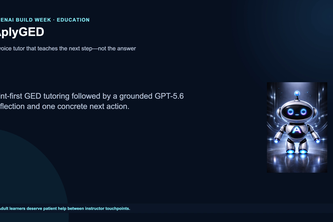
AplyGED is a voice-first GED tutoring tool built as part of an OpenAI hackathon project. The product is described as a controlled GED practice experience that provides hint-first tutoring and uses a GPT-5.6-powered engine to reflect on learner interactions and recommend next steps.
What changed
The project was developed during Build Week, with core components including a GPT-5.6 Learning Reflection and Next-Step Engine, structured outputs integration, and My Study Plan rendering. It builds upon pre-existing infrastructure such as TIA text and voice tutoring, authentication, and classroom tools.
Single most important open question
Is there evidence of traction or commercial viability beyond the hackathon prototype?
What The Product Actually Is
The description states that AplyGED is a voice-first GED tutor that provides hint-first tutoring, followed by GPT-5.6-powered reflection and next-step recommendations. It operates within an existing classroom environment (AplyBot) and integrates with:
- TIA for voice tutoring
- OpenAI’s GPT-5.6 via the Responses API
- FastAPI backend with Next.js/React frontend
- Clerk authentication and beta entitlements
The system processes learner signals such as subject, correct/incorrect counts, hints used, confidence movement, and existing review priorities to generate a grounded next action.
Inference The product is described as a prototype for adult GED learners, not yet deployed at scale or integrated into formal education systems.
Positioning & Claim Evolution
The author states that AplyGED was created to address the challenge of adult GED learners studying around work, caregiving, and inconsistent schedules, where private tutoring may be unavailable when a learner gets stuck.
It positions itself as a patient help tool that teaches the next step instead of revealing answers. The system is described as:
- Focused on hint-first tutoring
- Using GPT-5.6 for reflection and next-step guidance
- Designed to support adult learners in self-paced study
Claim
The product aims to offer a grounded, privacy-safe learning loop, but does not claim improved GED scores or official affiliation with GED testing.
Inference The positioning is narrow — focused on adult learners needing support between instructor touchpoints. It is not positioned as a replacement for formal education or a scalable platform for large-scale adoption.
Target Customer & ICP
The description states that AplyGED targets adult GED learners, who often study around work, caregiving, and transportation constraints.
It also mentions that the tool supports those who need help between instructor touchpoints.
Inference The ICP appears to be adult learners in informal or self-directed education settings — not formal students or institutions. No specific demographic data or customer segments are provided.
Business Model & Pricing Evidence
There is no evidence of pricing, revenue model, or monetization strategy in the description.
The project is described as a hackathon prototype, and no commercial or business model details are included.
Inference The business model is not evidenced. It is unclear whether this will be offered as a freemium, subscription, or enterprise product.
Technical & Delivery Signals
The system uses:
- Backend: Python/FastAPI
- Frontend: Next.js/React with Clerk authentication
- Voice tutoring: TIA and OpenAI Realtime
- AI engine: GPT-5.6 via OpenAI Responses API
- Structured outputs, strict validation, and privacy filters are implemented
- Codex was used for repository inspection, testing, and diagnostics
The system includes:
- A bounded signal object
- A GPT-5.6 Learning Reflection and Next-Step Engine
- A My Study Plan rendering
- Aggregate Realtime usage/cost tracking
- An AplyObservability dashboard slice
Inference The technical stack is described as modular, with a focus on privacy-safe signal processing and structured AI outputs. However, no evidence of production deployment or scalability is provided.
Traction & Maturity Signals
There is no evidence of traction, customers, revenue, or adoption beyond the hackathon prototype.
The project was built during Build Week and is described as a proof-of-concept with:
- A working learner experience
- A grounded GPT-5.6 integration
- Privacy-safe operational proof
- Foundation for responsible adult-learning pilots
Inference The product is at an early stage — a prototype, not yet in production or used by learners.
Competitive Context
No competitive landscape or market positioning is described. The project does not reference competitors or similar tools in the GED tutoring or adaptive learning space.
Inference There is no evidence of competitive analysis or awareness of existing players in this niche.
Open Questions & Risks
- Prototype-only: The product is described as a hackathon prototype with no commercial traction.
- No revenue or monetization strategy: No indication of how the product will be monetized.
- No customer data or adoption metrics: The project does not report on usage, retention, or user feedback.
- Limited scope: The system is built for a narrow use case (adult learners needing help between instructor touchpoints).
- Unverified claims: The description states that the tool does not claim improved GED scores or pass rates.
Questions the description leaves open
- What is the intended path from prototype to production?
- Are there any plans for pilot programs with adult learners or educational institutions?
- How will the product be monetized, and what pricing model is being considered?
- Has the team validated demand among adult GED learners?
- What are the key assumptions about learner behavior that underpin this tool?
- Is there a plan to expand beyond the GED subject area or support other languages?
Overall Assessment
Not evidenced.
The project is described as a hackathon prototype, and no evidence of traction, revenue, customers, or commercial viability is provided.
There is no indication that this product has moved beyond the experimental stage or is ready for investment or partnership.
The description does not provide sufficient grounds to assess whether AplyGED has potential for scaling or commercial success.
User Stories BotA demo video on every pull request
Get a demo video on every new feature
GitHub App that watches your pull requests and records a narrated, captioned demo.
Save time on demo prep and make informed decisions faster with a video walkthrough of every new feature.
Source
Submitted to the OpenAI 2026 hackathon on Devpost. Project home on Devpost. Back to the full gallery on Devpost.
This competitive analysis was produced by top-founders.com (opens in a new tab)
Generated by a language model from this project's public Devpost page — its tagline, the author's own write-up and any built-with tags listed there — as captured in August 2026. Short quotations are the author's words. It is an opinion on the idea as a business, not on the people behind it, and it reflects the description as published then. If the project has moved on, request a correction below. The analysis is not independent research and contains no verified traction, revenue or customer data.
An independent guide by KFG International LLC — not affiliated with, endorsed by, or connected to Devpost or OpenAI.