

Archive position — measured, not model output
0 likes on Devpost
2,263 of the 7,850 archived projects have more likes, and 5,587 share exactly 0 — so this project's #4,636 place in the like-ranked listing is a tie-break inside that group, not a ranking.
Projects (log scale)
Likes on Devpost. ▲ marks this project's group.
Show the figures
| Likes | Projects | Share of archive |
|---|---|---|
| 0 | 5,587 | 71.2% |
| 1 | 1,758 | 22.4% |
| 2 | 284 | 3.6% |
| 3–4 | 132 | 1.7% |
| 5–9 | 75 | 1.0% |
| 10+ | 14 | 0.2% |
 User Stories BotA demo video on every pull request
Get a demo video on every new feature
GitHub App that watches your pull requests and records a narrated, captioned demo.
Save time on demo prep and make informed decisions faster with a video walkthrough of every new feature.
Executive Summary
Company: InfraOps AI
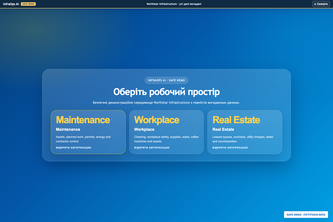
Self-reported purpose: A unified operational workspace for technical maintenance, administrative support, and leased real estate management.
Key claim: To centralize fragmented workflows across engineering systems, administrative processes, and real estate operations using a connected platform with three modules (SUTO, SUAZ, SUON).
Change: The author describes building a working prototype using OpenAI Codex as a development tool, based on their professional experience in infrastructure operations.
Most important open question: Does the described product have sufficient commercial traction or evidence of market need to justify further investment or partnership?
Analysis basis: Self-reported project description from Devpost submission by Иван Геринг. No external verification, revenue data, customer feedback, or performance metrics are provided.
What The Product Actually Is
The description states that InfraOps AI is a software platform designed to centralize operational processes related to:
- Technical maintenance (SUTO);
- Administrative support (SUAZ);
- Leased real estate management (SUON).
These modules are described as being connected within one workspace rather than separate applications.
It is currently a working prototype under active development, not yet incorporating AI functionality in its current version.
The platform aims to replace fragmented workflows based on emails, spreadsheets, and manual tracking with a structured operational environment.
Claim: InfraOps is a unified operational workspace for three domains: technical maintenance, administrative support, and real estate operations.
Evidence: Author's own write-up; not independently verified.
Positioning & Claim Evolution
The author positions InfraOps as a solution grounded in real-world operational workflows rather than generic software concepts.
It is described as:
- Based on personal experience in infrastructure operations;
- Designed around actual tasks such as maintenance scheduling, contractor coordination, and lease tracking;
- Built to reduce time spent searching for information and managing deadlines.
The platform is presented as an evolution from fragmented tools (emails, spreadsheets) to a single connected system.
No mention of competitors or market positioning beyond its own conceptual framework.
Claim: InfraOps addresses real operational inefficiencies through structured workflows.
Evidence: Author’s own write-up; not independently verified.
Target Customer & ICP
The description implies that InfraOps targets organizations with:
- Multiple facilities;
- Engineering systems requiring maintenance;
- Administrative support needs;
- Leased properties with associated obligations.
It is intended for teams managing:
- Technical maintenance;
- Administrative requests;
- Contractors;
- Documents;
- Deadlines;
- Operational responsibilities.
However, no specific customer segments or personas are defined. The target audience remains conceptual and not grounded in market data.
Claim: The platform serves operational teams across engineering, administrative, and real estate domains.
Evidence: Author’s own write-up; not independently verified.
Business Model & Pricing Evidence
There is no evidence of pricing strategy or business model in the description.
The author does not state whether InfraOps will be sold as a SaaS product, licensed software, or offered through other means.
No mention of monetization, subscription tiers, or customer acquisition costs.
Claim: No commercial model or pricing information provided.
Evidence: Not evidenced.
Technical & Delivery Signals
The platform is described as:
- A working prototype under active development;
- Built using OpenAI Codex as a development tool;
- Iteratively improved through feedback loops involving domain expertise and generated code;
- Designed with shared relationships between modules (facilities, tasks, contractors, deadlines).
Codex was used for:
- Application structure;
- Software architecture;
- Code generation;
- Interface components;
- Database logic;
- Debugging;
- Testing.
The author notes they are not a traditional software developer but leveraged Codex to build the prototype.
Claim: The platform uses AI tools (Codex) in its development process.
Evidence: Author’s own write-up; not independently verified.
Traction & Maturity Signals
There is no evidence of traction, revenue, or user adoption beyond the fact that it's a working prototype under active development.
The author emphasizes:
- That the current version does not include AI features;
- That the project was submitted to a hackathon (OpenAI 2026);
- That the demo uses fictional data and is independent of any real organization.
No customers, users, or performance indicators are mentioned.
Claim: No traction or maturity signals provided.
Evidence: Not evidenced.
Competitive Context
The description does not mention existing competitors or similar platforms in the market.
It focuses on how InfraOps differs from fragmented tools like spreadsheets and emails but does not reference other software solutions addressing these operational domains.
No competitive analysis, differentiation strategy, or market positioning against existing vendors is included.
Claim: No competitive context provided.
Evidence: Not evidenced.
Open Questions & Risks
Key risks include:
- Unproven commercial viability: The platform is a prototype with no evidence of traction or revenue.
- Lack of domain expertise in software development: The author states they are not a traditional developer, which may affect scalability and long-term product quality.
- No pricing or monetization strategy: Unclear how the platform will generate value or revenue.
- Dependency on AI tools for development: Reliance on Codex raises questions about reproducibility, maintainability, and future scalability without direct human involvement.
- Limited scope of current functionality: The system lacks AI features in its current form, which may be a key differentiator in the roadmap.
Inference: These risks stem from the lack of evidence for traction, business model, or technical maturity.
Questions the description leaves open
- What specific operational challenges did you observe in your professional experience that led to this idea?
- How do you plan to validate demand for InfraOps before full-scale launch?
- Are there any early adopters or pilot users who have tested the prototype?
- What is the timeline and roadmap for integrating AI capabilities into the platform?
- How will you monetize the product? Will it be SaaS, licensing, or another model?
- What are the key assumptions about user behavior that underpin your design decisions?
- How do you intend to scale beyond a single developer’s involvement?
Note: These questions aim to probe for evidence of traction, market validation, and strategic clarity.
Overall Assessment
Assessment: Not evidenced.
There is insufficient evidence to assess whether InfraOps AI has sufficient commercial potential or traction to warrant investment or partnership.
The project is described as a prototype under active development with no confirmed users, revenue, or market validation.
While the idea appears grounded in real-world operational needs, the lack of measurable outcomes or business model makes it difficult to evaluate its readiness for commercialization or strategic engagement.
Inference: Without further evidence of traction, customer feedback, or monetization strategy, any conclusion about investment or partnership value is speculative.
User Stories BotA demo video on every pull request
Get a demo video on every new feature
GitHub App that watches your pull requests and records a narrated, captioned demo.
Save time on demo prep and make informed decisions faster with a video walkthrough of every new feature.
Source
Submitted to the OpenAI 2026 hackathon on Devpost. Project home on Devpost. Back to the full gallery on Devpost.
This competitive analysis was produced by top-founders.com (opens in a new tab)
Generated by a language model from this project's public Devpost page — its tagline, the author's own write-up and any built-with tags listed there — as captured in August 2026. Short quotations are the author's words. It is an opinion on the idea as a business, not on the people behind it, and it reflects the description as published then. If the project has moved on, request a correction below. The analysis is not independent research and contains no verified traction, revenue or customer data.
An independent guide by KFG International LLC — not affiliated with, endorsed by, or connected to Devpost or OpenAI.