

Archive position — measured, not model output
0 likes on Devpost
2,263 of the 7,850 archived projects have more likes, and 5,587 share exactly 0 — so this project's #6,570 place in the like-ranked listing is a tie-break inside that group, not a ranking.
Projects (log scale)
Likes on Devpost. ▲ marks this project's group.
Show the figures
| Likes | Projects | Share of archive |
|---|---|---|
| 0 | 5,587 | 71.2% |
| 1 | 1,758 | 22.4% |
| 2 | 284 | 3.6% |
| 3–4 | 132 | 1.7% |
| 5–9 | 75 | 1.0% |
| 10+ | 14 | 0.2% |
 User Stories BotA demo video on every pull request
Get a demo video on every new feature
GitHub App that watches your pull requests and records a narrated, captioned demo.
Save time on demo prep and make informed decisions faster with a video walkthrough of every new feature.
Executive Summary
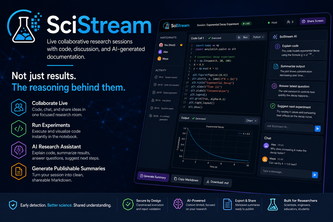
SciStream is a self-reported collaborative research workspace built as a hackathon project for the OpenAI 2026 hackathon. The author describes it as an AI-powered tool that integrates code execution, live chat, and auto-documentation into a single interface to preserve the scientific reasoning process. It is presented as a solution to fragmentation in current scientific collaboration workflows.
The description states SciStream aims to transform live experiments, discussions, and code into reusable scientific knowledge through features like Live Rooms, side-by-side code/chat, context-aware AI, and auto-documentation. The author claims it preserves the "why" behind research decisions by capturing the actual process rather than just final outputs.
Key commercial due-diligence questions include: What is the actual product-market fit? How does this differ from existing tools like Jupyter, Notion, or Slack? What are the real technical and security challenges of scaling this?
The single most important open question is whether there's evidence of traction, revenue, or customer validation beyond the author’s own description. The project has no demonstrated customers, revenue, or adoption.
What The Product Actually Is
The description states that SciStream is a collaborative research workspace that integrates code execution and live chat into one interface. It includes:
- Live Rooms: Sessions where teams can collaborate in real time
- Code & Chat Side-by-Side: Execution cells next to live participant chat
- Context-Aware AI: AI that explains errors or summarizes outputs based on specific room context
- Auto-Documentation: Compiles sessions into Markdown reports
The author describes it as a tool that preserves the actual research process as an artifact, not just final files. It is built with Python/Django backend, HTML/CSS/JS frontend, SQLite storage, and OpenAI API integration.
The product is presented as a prototype built for a hackathon, with no evidence of production deployment or user adoption.
Positioning & Claim Evolution
The author states that SciStream addresses fragmentation in scientific collaboration. It positions itself as a solution to the problem where researchers use multiple tools (Jupyter, Discord, Zoom, Slack) and lose reasoning and decision-making processes during experiments.
The claim evolution shows:
- Initial framing: Scientific collaboration is "an absolute mess"
- Problem identification: Fragmentation leads to loss of "why" behind results
- Solution proposition: A single interface that preserves the research process as artifact
- Value proposition: Reusable scientific knowledge base instead of scattered notes
The positioning is described as being focused on preserving human reasoning and reducing administrative friction, rather than replacing researchers with AI.
Target Customer & ICP
The description states that SciStream targets researchers who work in fragmented environments using multiple tools for collaboration. It appears to be aimed at scientific teams working with code-based experiments, particularly those using Jupyter notebooks or similar tools.
The author mentions "scientific" and "research" in the technology tags and project name, suggesting academic or research-oriented users. However, no specific customer segments, personas, or use cases beyond general "researchers" are detailed.
Business Model & Pricing Evidence
Not evidenced. The description does not contain any information about pricing models, monetization strategies, or business models. No claims about revenue streams, subscription tiers, or commercial arrangements are made.
Technical & Delivery Signals
The author states that SciStream is built with:
- Backend: Python and Django
- Frontend: HTML, CSS, vanilla JavaScript
- Storage: SQLite database
- AI Layer: OpenAI API with deterministic mock mode for offline testing
The architecture is described as modular with separate components for code execution, AI logic, and report generation. The author mentions they built a "deterministic execution pipeline" to handle sandboxing safely without security vulnerabilities.
They note challenges in:
- Sandboxing code safely
- Preventing AI hallucinations by limiting context window
- Scoping prototype honestly due to time constraints
Traction & Maturity Signals
Not evidenced. The description contains no information about users, customers, adoption rates, or product maturity beyond the fact that it was built for a hackathon. No metrics, user feedback, or usage data are provided.
The project is explicitly described as a prototype with no production deployment or demonstrated traction.
Competitive Context
Not evidenced. The description does not mention any competitors, existing solutions in the market, or competitive positioning against other tools. No claims about how SciStream compares to existing platforms like Jupyter, Notion, Slack, or GitHub are made.
Open Questions & Risks
- Unproven Market Fit: No evidence of customer validation or demand beyond the author's own description
- Technical Risk: The prototype uses a deterministic execution pipeline and mock AI mode, not production-grade security or AI handling
- Scalability Concerns: The architecture is described as modular but built for a hackathon with limited scope
- Lack of Commercial Evidence: No revenue, customers, or traction data available beyond the author's claims
- Single Founder: Only one team member listed (Syed Hussain Ather)
Questions the description leaves open
- What specific research workflows are you trying to solve that current tools don't address?
- How do you plan to handle security and sandboxing at scale?
- What is your path to production deployment beyond the hackathon prototype?
- Have you validated this with actual researchers or institutions?
- What are the key technical challenges you've identified for scaling this solution?
- How do you see the competitive landscape evolving in research collaboration tools?
Overall Assessment
Not evidenced. The description contains no information about funding rounds, valuation, or investment interest. No claims about commercial viability, market opportunity, or partnership potential are made beyond the author's own self-description.
The project is presented as a hackathon prototype with no demonstrated traction, revenue, or customer validation. The author states it's just "the foundation" and that they want to scale it out, but provides no evidence of progress toward that goal.
User Stories BotA demo video on every pull request
Get a demo video on every new feature
GitHub App that watches your pull requests and records a narrated, captioned demo.
Save time on demo prep and make informed decisions faster with a video walkthrough of every new feature.
Source
Submitted to the OpenAI 2026 hackathon on Devpost. Project home on Devpost. Back to the full gallery on Devpost.
This competitive analysis was produced by top-founders.com (opens in a new tab)
Generated by a language model from this project's public Devpost page — its tagline, the author's own write-up and any built-with tags listed there — as captured in August 2026. Short quotations are the author's words. It is an opinion on the idea as a business, not on the people behind it, and it reflects the description as published then. If the project has moved on, request a correction below. The analysis is not independent research and contains no verified traction, revenue or customer data.
An independent guide by KFG International LLC — not affiliated with, endorsed by, or connected to Devpost or OpenAI.