

Archive position — measured, not model output
1 like on Devpost
505 of the 7,850 archived projects have more likes, and 1,758 share exactly 1 — so this project's #1,865 place in the like-ranked listing is a tie-break inside that group, not a ranking.
Projects (log scale)
Likes on Devpost. ▲ marks this project's group.
Show the figures
| Likes | Projects | Share of archive |
|---|---|---|
| 0 | 5,587 | 71.2% |
| 1 | 1,758 | 22.4% |
| 2 | 284 | 3.6% |
| 3–4 | 132 | 1.7% |
| 5–9 | 75 | 1.0% |
| 10+ | 14 | 0.2% |
 User Stories BotA demo video on every pull request
Get a demo video on every new feature
GitHub App that watches your pull requests and records a narrated, captioned demo.
Save time on demo prep and make informed decisions faster with a video walkthrough of every new feature.
Executive Summary
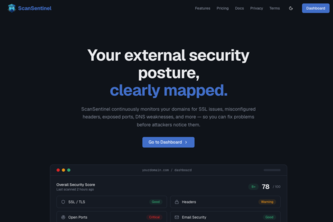
ScanSentinel is an AI-powered security intelligence platform described by a single founder as a tool to help organisations continuously monitor their external security posture. The platform combines automated security scanning with GPT-5.6-powered analysis to transform technical findings into clear, prioritised remediation guidance for developers and businesses.
The author states that ScanSentinel uses a modern SaaS architecture built with Next.js, TypeScript, Prisma, PostgreSQL, BullMQ, Redis, Docker, Clerk, and OpenAI integration. It is designed as a multi-tenant platform with asynchronous workers to separate scanning from AI processing.
Key claims include:
- Automated security scanning
- Risk scoring of findings
- AI-assisted analysis powered by GPT-5.6
- Evidence-backed remediation recommendations
- Multi-tenant SaaS architecture
- Background scanning with asynchronous workers
The most important open question is whether the described platform has achieved any meaningful traction or adoption, as no evidence of revenue, customers, or usage is provided beyond the author's own description.
What The Product Actually Is
The description states that ScanSentinel is an AI-powered security intelligence platform. It performs automated security checks and transforms technical findings into actionable insights. The platform includes:
- Automated security scanning capabilities
- Security findings and risk scoring
- Multi-tenant SaaS architecture
- Background scanning with asynchronous workers
- AI-assisted security analysis powered by GPT-5.6
- Evidence-backed remediation recommendations
The author describes the platform as helping organisations continuously monitor their external security posture.
Positioning & Claim Evolution
The author states that ScanSentinel bridges a gap between security scanning tools and developers or small businesses who struggle to understand what matters most, why it matters, and how to fix it. The positioning appears to be:
- A tool for organisations seeking to improve their external security posture
- An enhancement to existing security scanning tools by providing AI-powered analysis
- A solution that makes complex security findings easier to understand and act on
The claim evolution shows a progression from identifying a problem (understanding security findings) to proposing a solution (AI-powered analysis), with emphasis on making security actionable for developers and businesses.
Target Customer & ICP
The description states that ScanSentinel targets organisations, developers, and businesses. It is positioned to help "developers and businesses" understand complex security findings and act on them. The platform is described as serving "organisations continuously monitoring their external security posture."
However, no specific customer segments or personas are identified beyond general references to "organisations", "developers", and "businesses".
Business Model & Pricing Evidence
Not evidenced.
The description does not contain any information about pricing models, revenue streams, or business model details. No evidence of commercial arrangements, pricing tiers, or monetisation strategies is provided.
Technical & Delivery Signals
The author states that ScanSentinel was built using:
- Next.js App Router
- TypeScript
- Prisma ORM
- PostgreSQL
- BullMQ and Redis
- Docker Compose
- Clerk authentication
- OpenAI GPT-5.6 integration
Key technical signals include:
- Multi-tenant SaaS architecture
- Background scanning with asynchronous workers (BullMQ and Redis)
- Separation of security scanning from AI processing
- Use of modern web technologies including React, Tailwind CSS, and TypeScript
- Integration with OpenAI GPT-5.6 for analysis layer
The platform is described as using asynchronous workers to ensure that AI analysis enhances the experience without affecting core scanning engine reliability.
Traction & Maturity Signals
Not evidenced.
There is no evidence of any traction, customers, revenue, or adoption metrics in the provided description. The author states this was submitted to a hackathon and describes the platform as built by one person (Andrei Sandu). No information about usage, user base, or business development is included.
Competitive Context
Not evidenced.
The description does not mention any competitors or competitive landscape. No information is provided about existing solutions in the security intelligence or AI-powered security analysis space.
Open Questions & Risks
- Single-founder project with no evidence of team expansion or additional resources
- No traction, customers, or revenue data provided
- Self-reported claims without independent verification
- Use of GPT-5.6 which is not a publicly documented model version (the author states "GPT-5.6" but this is not an official OpenAI product)
- Platform described as built for a hackathon context rather than production deployment
- No evidence of commercial viability or business development beyond the initial build
Questions the description leaves open
- What specific security scanning capabilities does ScanSentinel provide, and how do they differ from existing tools?
- How is the AI analysis validated to ensure accuracy and prevent false positives?
- What are the actual technical requirements for deploying and running ScanSentinel?
- Has there been any testing with real security data or in production environments?
- What is the timeline for moving beyond the hackathon prototype to a commercial product?
- How does ScanSentinel handle privacy and data protection of sensitive security findings?
- What are the specific use cases where customers would pay for this platform versus using existing tools?
Overall Assessment
Not evidenced.
The description provides no information about financial performance, customer acquisition, market traction, or commercial viability that would support an investment or partnership decision. The project appears to be a hackathon submission with no demonstrated business metrics or commercial progress.
User Stories BotA demo video on every pull request
Get a demo video on every new feature
GitHub App that watches your pull requests and records a narrated, captioned demo.
Save time on demo prep and make informed decisions faster with a video walkthrough of every new feature.
Source
Submitted to the OpenAI 2026 hackathon on Devpost. Project home on Devpost. Back to the full gallery on Devpost.
This competitive analysis was produced by top-founders.com (opens in a new tab)
Generated by a language model from this project's public Devpost page — its tagline, the author's own write-up and any built-with tags listed there — as captured in August 2026. Short quotations are the author's words. It is an opinion on the idea as a business, not on the people behind it, and it reflects the description as published then. If the project has moved on, request a correction below. The analysis is not independent research and contains no verified traction, revenue or customer data.
An independent guide by KFG International LLC — not affiliated with, endorsed by, or connected to Devpost or OpenAI.