

Archive position — measured, not model output
1 like on Devpost
505 of the 7,850 archived projects have more likes, and 1,758 share exactly 1 — so this project's #1,867 place in the like-ranked listing is a tie-break inside that group, not a ranking.
Projects (log scale)
Likes on Devpost. ▲ marks this project's group.
Show the figures
| Likes | Projects | Share of archive |
|---|---|---|
| 0 | 5,587 | 71.2% |
| 1 | 1,758 | 22.4% |
| 2 | 284 | 3.6% |
| 3–4 | 132 | 1.7% |
| 5–9 | 75 | 1.0% |
| 10+ | 14 | 0.2% |
 User Stories BotA demo video on every pull request
Get a demo video on every new feature
GitHub App that watches your pull requests and records a narrated, captioned demo.
Save time on demo prep and make informed decisions faster with a video walkthrough of every new feature.
Executive Summary
What the company appears to be: SchemaPilot is a self-reported data pipeline tool designed to detect schema drift in CSV files, validate data quality, and automate safe repairs while flagging decisions requiring human review. It uses deterministic Python modules for core logic and GPT-5.6 only for generating advisory decision briefs.
What changed: The project was built as part of a hackathon submission and includes an end-to-end demo with automated tests, public documentation, and a transactional DuckDB pipeline. No commercial traction or revenue is evidenced.
The single most important open question: Is there any evidence of real-world usage or customer feedback beyond the author's own account?
Analysis basis: This report is based entirely on the self-reported project description provided by the caller. All claims are unverified and should be treated as stated by the author, not proven facts.
What The Product Actually Is
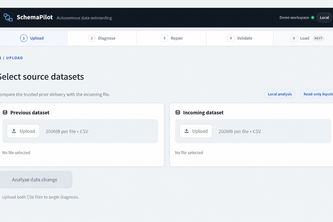
- The description states that SchemaPilot compares a trusted previous dataset with a new incoming delivery.
- It runs a workflow: Upload → Diagnose → Repair → Validate → Load → AI Decision Brief.
- It detects schema drift and validates data quality.
- Safe deterministic repairs are separated from decisions requiring human approval.
- A transactional DuckDB pipeline is used for execution.
- GPT-5.6 is used only for generating an advisory Decision Brief; it cannot alter data or decisions.
Inference: The product appears to be a prototype for managing CSV schema changes in data pipelines, with a focus on safety and human oversight.
Positioning & Claim Evolution
- The tagline states: “Turn breaking CSV changes into trusted, reviewable data pipelines.”
- The description claims that SchemaPilot makes data onboarding safer, explainable, and reviewable.
- It positions itself as solving recurring issues in CSV deliveries such as renamed columns, type drift, duplicate identifiers, invalid dates, unexpected business values, and inconsistent numeric formats.
Claim vs Fact: These are self-reported positioning statements. No evidence of customer adoption or market validation is provided.
Target Customer & ICP
- The description does not name specific customers or personas.
- It implies a use case for teams handling recurring CSV data deliveries.
- The tool is built with Python and Streamlit, suggesting technical users or developers may be primary adopters.
Not evidenced: No explicit target customer segments or ideal customer profiles are described.
Business Model & Pricing Evidence
- There is no mention of pricing, licensing, or monetization strategy.
- The project is presented as a hackathon demo with no indication of commercial intent or revenue streams.
Not evidenced: No business model or pricing information is provided.
Technical & Delivery Signals
- Built with Python, Streamlit, pandas, DuckDB, Pydantic, OpenAI Responses API, GPT-5.6, and Codex.
- The deterministic Python modules are the source of truth for schema comparison, validation, repair, row classification, and reconciliation.
- GPT-5.6 is used only for an advisory Decision Brief; it cannot change data or decisions.
- Includes a transactional DuckDB pipeline.
- 27 automated tests pass.
- Public GitHub repository with setup, security, and testing documentation.
Inference: The tool has a clear technical architecture and demonstrates engineering rigor in its prototype form.
Traction & Maturity Signals
- An end-to-end working public demo is included.
- A public GitHub repository exists.
- 27 automated tests pass.
- The project was submitted to the OpenAI 2026 hackathon.
Not evidenced: No evidence of real-world usage, customer adoption, or revenue generation beyond the author's own account.
Competitive Context
- The description does not mention competitors or similar tools.
- It is unclear whether SchemaPilot addresses a known gap in existing data pipeline or ETL tooling.
Not evidenced: No competitive analysis or market positioning relative to other tools is provided.
Open Questions & Risks
- The product is described as a hackathon submission with no commercial traction.
- GPT-5.6 is used only for advisory purposes, but the system still relies on human review for critical decisions.
- No evidence of scalability or production-grade deployment.
- The team size is listed as one person.
Inference: The tool may be in early prototype stage and lacks validation from real users or markets.
Questions the description leaves open
- What specific CSV data challenges are you solving, and how do you know they exist?
- Have you tested SchemaPilot with actual enterprise datasets or customers?
- How does the system handle large-scale or high-frequency data ingestion?
- Is there a plan to move beyond the current demo into production use?
- What is your roadmap for monetization or commercial viability?
Overall Assessment
- The project is presented as a hackathon prototype with limited evidence of traction or commercial readiness.
- It shows strong technical execution and clear separation between deterministic logic and AI advisory functions.
- No evidence of revenue, customers, or market validation exists.
Assessment: Not ready for investment or partnership without further demonstration of real-world usage or customer feedback. The product is technically sound but lacks commercial proof-of-concept.
User Stories BotA demo video on every pull request
Get a demo video on every new feature
GitHub App that watches your pull requests and records a narrated, captioned demo.
Save time on demo prep and make informed decisions faster with a video walkthrough of every new feature.
Source
Submitted to the OpenAI 2026 hackathon on Devpost. Project home on Devpost. Back to the full gallery on Devpost.
This competitive analysis was produced by top-founders.com (opens in a new tab)
Generated by a language model from this project's public Devpost page — its tagline, the author's own write-up and any built-with tags listed there — as captured in August 2026. Short quotations are the author's words. It is an opinion on the idea as a business, not on the people behind it, and it reflects the description as published then. If the project has moved on, request a correction below. The analysis is not independent research and contains no verified traction, revenue or customer data.
An independent guide by KFG International LLC — not affiliated with, endorsed by, or connected to Devpost or OpenAI.